
Jesus Came to Fulfill the Law: What Matthew 5:17 Means
When Jesus said he came to fulfill the Law, he meant that he would bring God's Old Testament revelation to its intended goal. He would obey the Father's will, accomplish the promises announced by the prophets, and complete the saving work anticipated by Israel's sacrifices. His teaching would reveal the full depth of God's commands. Fulfillment preserves Scripture's authority while changing how God's people live under the new covenant. To understand this, we must read Matthew 5:17 alongside Jesus' ministry, his cross, and the apostles' teaching.
What Does “Fulfill the Law” Mean in Matthew 5:17?
Jesus declares in Matthew 5:17 (WEBU):
“Don’t think that I came to destroy the law or the prophets. I didn’t come to destroy, but to fulfill.”
The expression the Law and the Prophets refers broadly to the Old Testament Scriptures, not simply a collection of rules. Moses' writings contain commandments alongside the history of creation, Abraham, the exodus, and God's covenant with Israel. The prophets call Israel to faithfulness and announce God's coming acts of judgment and salvation. Jesus claims that these Scriptures find their intended goal in him.
The Greek verb translated fulfill can mean to bring something to completion or make it fully realized. Matthew repeatedly describes events in Jesus' life as the fulfillment of Scripture (Matthew 1:22-23; Matthew 2:15). The second example is especially revealing. Hosea 11:1 originally recalls God's calling Israel out of Egypt; Matthew sees that history reaching a greater realization in Jesus, God's Son. Fulfillment includes promises coming true and earlier patterns reaching their appointed meaning. In Matthew 5, Jesus makes a claim about the whole scriptural story.
Why Did Jesus Say This in the Sermon on the Mount?
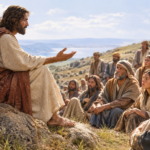
Jesus makes this announcement after the Beatitudes and his call for disciples to become salt and light (Matthew 5:1-16). He then warns against relaxing God's commandments and demands righteousness exceeding that of the scribes and Pharisees (Matthew 5:18-20). These words establish the seriousness of what follows. Jesus upholds the authority of God's revelation while teaching as the Messiah who brings it to completion.
His reference to the smallest letter and pen stroke emphasizes that no part of God's word is insignificant. The repeated word until in Matthew 5:18 also matters. God's purposes will be accomplished, and heaven and earth will not outlast the reliability of his word. Christ's death and resurrection bring decisive fulfillment, while the New Testament still looks toward the final completion of his kingdom. The different parts of the Law must therefore be understood according to the purposes God gave them and how those purposes are fulfilled.
In Matthew 5:21-48, Jesus addresses murder, adultery, divorce, oaths, retaliation, and love for enemies. His teaching exposes anger beneath violence, lust beneath adultery, and dishonesty behind impressive vows. Disciples must also turn from personal vengeance toward generous conduct (Matthew 5:38-42). Such instruction reaches both hidden motives and public behavior. The mountain setting recalls Moses receiving God's instruction, but Jesus repeatedly speaks on his own authority: he declares how his followers should live. The one who fulfills the Law is also its authoritative interpreter.
How Did Jesus Fulfill the Law and the Prophets?
He Obeyed God's Will Completely
Jesus was born under the Law of Moses (Galatians 4:4). At his baptism, he told John that they should fulfill all righteousness (Matthew 3:13-15). Throughout his ministry, he loved the Father and obeyed him, even when obedience brought suffering. Hebrews 4:15 describes his genuine temptation without sin. His faithfulness is essential to his saving mission, culminating in his willing death (Philippians 2:8).
The contrast with fallen humanity is central. The Law reveals God's holy standard, but sin prevents people from establishing their righteousness through personal effort. Romans 3:19-20 explains how the Law exposes human guilt. Christ came as the obedient Savior who accomplishes what sinners cannot accomplish for themselves. Through him, righteousness and reconciliation become gifts of God's grace (Romans 3:21-26).
He Accomplished the Promises of Scripture
After his resurrection, Jesus explained the Scriptures to two disciples traveling toward Emmaus. Beginning with Moses and the prophets, he showed how they spoke of him (Luke 24:25-27). Later, he named the Law of Moses, the Prophets, and the Psalms as witnesses to his suffering, resurrection, and the proclamation of repentance and forgiveness (Luke 24:44-47).
That explanation reaches beyond isolated predictions. God promised Abraham blessing for the nations (Genesis 12:3). He pledged David an enduring royal house (2 Samuel 7:12-16). The prophets anticipated a righteous king, a suffering servant, and a renewed covenant (Isaiah 53; Jeremiah 31:31-34). In Jesus, these promises converge in one saving work. His resurrection reveals that the apparent defeat of the cross was part of God's promised victory.
He Completed What the Sacrifices Foreshadowed
Israel's sacrificial worship taught the gravity of sin and the need for atonement. Its prescribed offerings served a real purpose within Israel's covenant life, yet their repetition pointed beyond themselves. Hebrews 10:1-4 calls the sacrificial system a shadow of coming good things and explains that animal blood could not finally take away sins.
Hebrews then presents Christ as the obedient one who offers himself (Hebrews 10:5-14). His single sacrifice accomplishes what recurring offerings could never complete. The priestly system prepared God's people to understand the reality revealed in his death. A sacrifice fulfilled through Christ's once-for-all offering no longer needs repetition. Believers now approach God through their risen high priest (Hebrews 10:19-22).
He Established the New Covenant and Gave the Spirit
Jeremiah promised a covenant marked by forgiven sins and God's instruction written on the heart (Jeremiah 31:31-34). Jesus identified his blood with that new covenant (Luke 22:20). Hebrews 8:6-13 explains why the earlier covenant order gives way to Christ's better priesthood and covenant. This change arises from God's own promise and reveals his continuing faithfulness.
The new covenant also concerns obedience. Romans 8:3-4 explains that God accomplished through his Son what the Law could not achieve because of human sinfulness. The Spirit enables believers to begin living according to God's righteous will. Forgiveness and inward renewal belong together. For a fuller examination of Jeremiah's promise, see what the new covenant means and how Jesus established it.
How Does Paul Explain the Law's Goal in Christ?
Romans 10:4: Fulfillment, Goal, and End
The WEBU describes Christ as the fulfillment of the Law for righteousness to everyone who believes (Romans 10:4). Some other English translations use end. The Greek word telos can express a goal, completion, or endpoint. Paul's argument joins these ideas: the Law's saving purpose reaches its goal in Christ, and believers no longer seek righteousness by keeping the Mosaic covenant.
The immediate context is crucial. Paul grieves over people who seek to establish their own righteousness instead of submitting to God's righteousness (Romans 10:1-4). Earlier, he declared that the Law and Prophets testify to the righteousness God now gives through faith in Jesus Christ (Romans 3:21-26). He can therefore say that faith establishes the Law (Romans 3:31). Scripture's testimony to sin, righteousness, and God's saving provision finds its answer in the Messiah.
Galatians 3: The Law Had a Temporary Covenant Role
Paul explains why God gave the Law centuries after his promise to Abraham. In Galatians 3:15-18, the later covenant at Sinai cannot cancel God's earlier promise. The Law was added because of transgressions and acted as a guardian until the promised offspring, Christ, came (Galatians 3:19-25). Its role was genuine, divinely given, and directed toward a promised future.
People from the nations now share Abraham's blessing through faith in Jesus (Galatians 3:13-14, 26-29). They receive the promised Spirit and belong to Christ without first becoming members of Israel's Mosaic covenant. God's promise has not failed. It has reached the nations through Abraham's promised descendant.
Must Christians Still Keep the Law of Moses?
Christians remain accountable to God's moral will, but the Church is not placed under the whole covenant legislation given to ancient Israel. The apostles addressed this question when some demanded that Gentile converts be circumcised and keep the Law of Moses. The Jerusalem council refused to impose that requirement while giving instructions concerning idolatry, sexual immorality, and fellowship (Acts 15:1-29).
Christian teachers have often used three categories to explain how the Law's commands relate to believers. These are interpretive distinctions, not three labeled divisions within the Pentateuch:
- Moral commands: Duties such as rejecting murder, adultery, theft, and falsehood express God's enduring concern for holiness and love. Jesus upholds and deepens them (Matthew 5:21-30; Matthew 22:36-40).
- Ceremonial regulations: Sacrifices, priestly rites, and ritual distinctions shaped Israel's worship and anticipated Christ. Their earlier covenant purpose is fulfilled through his saving work (Hebrews 10:1-18; Colossians 2:16-17).
- Civil judgments: Laws governing penalties, property, and public order directed ancient Israel as a covenant nation. Their concern for justice remains instructive, although the Church is not constituted as Israel's civil government.
Thomas Aquinas examined this relationship in Summa Theologiae, First Part of the Second Part, question 107, article 2. He explained that Christ fulfills the earlier Law by accomplishing its promised saving end. Jesus also clarifies its commands, including their demands upon the heart. Aquinas also described ceremonies as figures that give way when the realities they anticipate arrive. His discussion shows how a major medieval Christian theologian sought to honor the Law's authority and Christ's completed work together.
The threefold distinction has been especially influential in Western Christian theology. Other Christian teachers frame the relationship more through Christ's fulfillment and the life of the Church. Particular applications remain debated, including the Sabbath's relationship to Sunday worship and rest (Colossians 2:16-17; Romans 14:5-6). What the apostles make clear is that Christians are not required to observe the entire Mosaic covenant as the basis of salvation or membership in Christ's people.
What Righteousness Exceeds That of the Scribes and Pharisees?
Matthew 5:20 presents a demanding warning, not a contest to accumulate visible religious acts. Later, Jesus rebukes charitable giving, prayer, and fasting performed to gain human praise (Matthew 6:1-18). His concern is righteousness rooted in love for God. The scribes and Pharisees were not all alike, but Jesus repeatedly confronted outward religious observance that concealed disobedient desires.
The gospel supplies the foundation for a changed life. Romans 3:22-26 announces that God justifies sinners freely by grace through Christ's redemption. The Spirit then forms in believers the love God commands (Romans 8:3-4; Galatians 5:13-14). Historic Christian traditions differ in how they describe justification and the believer's growth in righteousness, but they share the conviction that salvation depends upon God's grace in Christ and calls for genuine obedience. The related question of faith and conduct is explored in how Paul and James explain faith and good works.
Jesus summarized the Law and Prophets through wholehearted love for God and love for one's neighbor (Matthew 22:37-40). Such love has concrete consequences: reconciliation instead of cherished resentment, faithfulness instead of hidden lust, truthful speech instead of manipulation, and mercy even toward enemies. The righteousness Jesus teaches concerns the whole person, made new by God's grace and shaped by his commands.
How Should Christians Read the Old Testament After Christ?
The Old Testament still teaches Christians about God's holiness, faithfulness, mercy, justice, and promises. Its narratives reveal the history into which the Messiah came. Its commandments expose sin and disclose what God values. Sacrifices prepare readers to understand atonement, while the prophets announce the hope Christ accomplishes. Paul affirms that Scripture remains useful for teaching and training in righteousness (2 Timothy 3:16-17).
Faithful reading first considers a passage's place in Israel's covenant life, then asks how Jesus and the apostles explain its fulfillment. A sacrificial regulation can instruct believers about atonement without requiring another animal offering. Israel's civil statutes can teach justice without becoming Church legislation. The command to love one's neighbor retains its force and becomes clearer through Jesus' teaching and example.
Jesus fulfilled the Law by bringing its commands, promises, and saving purposes to their appointed goal. He honored the Scriptures in his obedience and accomplished their deepest hopes through his death and resurrection. Christians therefore honor the Law and Prophets when they read them through Christ, trust his finished work, and follow him in the new life his Spirit gives.
Continue Studying in the Commentary
Explore the biblical passages behind this article with the Good Way Library’s full commentary.
- Matthew 5 Commentary: Kingdom Righteousness Fulfilled
- Luke 24 Commentary: Resurrection, Scripture, and Witness
- Galatians 3 Commentary: Faith, Promise, and Christ
- Hebrews 10 Commentary: Christ’s Sacrifice and Enduring Faith
- Romans 3 Commentary: God’s Righteousness Revealed
- Romans 10 Commentary: Christ and the Word of Faith
Related Articles
Continue exploring this subject through closely connected articles.





No more articles to show. Select “Show fewer articles” to collapse the list.
Partner With The Good Way Library
The Good Way Library is supported entirely by everyday readers like you. If this resource has helped you grow in your understanding of God’s Word and the Christian faith, please consider supporting this work with a one-time or monthly gift. Please also pray for our ministry and help us spread the word by sharing The Good Way Library with your church, friends, and family. Together, we can expand completely free access to faithful biblical teaching and help strengthen shared understanding and unity across the Christian church.