
The Elijah Who Was to Come: Why Jesus Identified John the Baptist
John the Baptist is the Elijah who was to come before the Messiah. Jesus identifies him this way in Matthew 11:14 and Matthew 17:10-13. Luke explains the meaning: John came in Elijah's spirit and power, carrying out a similar prophetic mission rather than becoming Elijah himself. His task was to call Israel to repentance and prepare the people to receive Jesus Christ. The main question that remains is whether the ancient prophet Elijah will also appear before Christ's final return.
What Did Malachi Promise About Elijah?
Malachi ends with a warning about the coming day of the Lord. God will judge persistent evil and bring healing to those who fear his name (Malachi 4:1-3). Then the prophet recalls the law given through Moses and announces a coming messenger:
Behold, I will send you Elijah the prophet before the great and terrible day of the LORD comes.
That promise appears in Malachi 4:5. The next verse describes Elijah's work: turning the hearts of fathers and children toward one another before judgment falls (Malachi 4:6). The promised messenger comes as an act of divine mercy, giving people a summons to return before the day of reckoning. Restored family relationships are one visible expression of a wider return to covenant faithfulness.
During Ahab's reign, Elijah confronted Baal worship and called a divided people back to the living God. At Mount Carmel, his prayer asked that Israel might know God had turned their hearts back again (1 Kings 18:36-39). That language makes Malachi's promise especially fitting. The future messenger would confront spiritual compromise and seek the same kind of return.
Malachi's closing references to Moses and Elijah also join the law and prophetic witness. This pairing becomes especially significant when both men appear at Jesus' transfiguration.
How Did John the Baptist Fulfill Elijah's Mission?
Before John was born, the angel Gabriel announced his mission to his father, Zacharias. Luke 1:16-17 says John would turn many Israelites to the Lord and go before him in the spirit and power of Elijah. Gabriel echoes Malachi's promise about fathers and children, then adds the turning of the disobedient toward the wisdom of the righteous. The prophecy concerns restored faithfulness to God, expressed through renewed relationships and obedience. John's calling was established before his ministry began.
John's public ministry resembles Elijah's in both appearance and message. Elijah was recognized by his rough appearance and leather belt (2 Kings 1:8). John wore camel's hair and a leather belt while preaching in the Judean wilderness (Matthew 3:1-6).
More decisive is what John preached. He demanded repentance, warned of approaching judgment, and challenged the assumption that descent from Abraham guaranteed safety (Matthew 3:7-12). He baptized people who confessed their sins and announced someone greater who would follow him. Like Elijah, John called Israel to renewed faithfulness. Unlike Elijah, John stood immediately before the Messiah whose arrival he was sent to announce.
John also fulfills the preparatory messenger promise of Malachi 3:1. Jesus applies that passage to him in Matthew 11:10, while the Gospels connect his wilderness ministry with Isaiah 40:3. These prophecies converge on one calling: prepare the way for the Lord. The Good Way Library's Malachi 3 commentary on the coming messenger explains why this preparation precedes the Lord's arrival. When John points to Jesus in John 1:29-34, the preparatory witness gives way to the one who takes away the world's sin.
Why Did Jesus Call John the Elijah Who Was to Come?
In Matthew 11:2-15, John is imprisoned and sends disciples to ask Jesus whether he is the expected one. Jesus points them to his works of healing and good news, then addresses the crowd about John. He honors John as more than an ordinary prophet because John occupies the promised place immediately before the Messiah.
Jesus then says in Matthew 11:14:
If you are willing to receive it, this is Elijah, who is to come.
The qualification about receiving the message matters. Recognizing John requires listeners to recognize God's unexpected way of bringing his promises to fulfillment. The people had heard the prophets, but many resisted both John's demand for repentance and Jesus' ministry (Matthew 11:16-19). The problem was not a missing forerunner. It was the refusal to heed the one God had sent.
Jesus' striking praise in Matthew 11:11-13 marks John's position in biblical history. Earlier prophets looked toward the coming kingdom; John announced its king at the threshold of his public ministry. His greatness rested in that calling, although he performed no recorded miracles (John 10:41).
Why Did John Deny That He Was Elijah?
John 1:19-23 records a delegation from Jerusalem asking John whether he was the Christ, Elijah, or the expected prophet. Asked directly if he was Elijah, John answered, "I am not." Yet he described himself as the wilderness voice preparing the Lord's way, drawing on Isaiah 40:3.
There is no contradiction once the question's meaning is clear. The delegation was asking whether John was Elijah personally, the ancient prophet who had been taken up to heaven (2 Kings 2:11). John denied that identity. Jesus identified John by his prophetic office and mission, as Luke 1:17 had already explained. This is fulfillment through a man who comes in Elijah's spirit and power, not reincarnation or a claim that John secretly was the same person.
John therefore directs attention away from his own status and toward the coming Christ (John 1:26-34).
Why Did Elijah Appear at the Transfiguration?
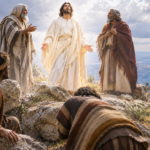
The question becomes more striking in Matthew 17:1-13. Jesus appears in glory before Peter, James, and John, with Moses and Elijah speaking with him. Here the figure is the ancient prophet Elijah, distinct from John the Baptist. The Father's command to listen to his beloved Son places Jesus at the center of the scene.
As the disciples descend, they ask why the scribes say Elijah must come first. Jesus affirms the prophetic expectation and adds that Elijah has already come, suffered rejection, and gone unrecognized. Matthew then states plainly that the disciples understood him to mean John the Baptist (Matthew 17:10-13).
Mark 9:11-13 records the same discussion but places special weight on the suffering of the Son of Man. The parallel between the rejected forerunner and the suffering Messiah is crucial. John had been arrested and executed under Herod (Mark 6:17-29). Jesus was moving toward his own rejection, death, and resurrection. The promised preparation had occurred, even though neither the messenger nor the Messiah matched expectations of immediate public triumph.
The scene keeps Elijah and John distinct while showing how both of their ministries direct attention to Christ.
Will Elijah Come Again Before the Second Coming?
Christians have long discussed whether Malachi's words also anticipate a future appearance of Elijah before the final judgment. The clearest New Testament conclusion remains that John fulfilled Elijah's preparatory mission before Christ's first coming. Yet Jesus' statement that Elijah comes and restores all things (Matthew 17:11) has led some readers to expect a further fulfillment at the end of the age.
This expectation is ancient. In Dialogue with Trypho, chapter 49, the second-century Christian writer Justin Martyr argues that John came in Elijah's prophetic spirit before Christ's first advent, while Elijah himself would precede Christ's return in glory. Justin's view is a documented early Christian interpretation, not an identification supplied explicitly by the New Testament.
Some interpreters also connect Elijah with one of the two witnesses in Revelation 11:3-12, partly because the witnesses can shut the sky so that rain does not fall. That resembles Elijah's ministry (1 Kings 17:1). Revelation, however, does not name either witness. Other Christians understand the Elijah promise as fulfilled in John, with no further personal return required. Both approaches should begin with Jesus' unmistakable identification of John rather than treating an uncertain future timetable as the main meaning of Malachi.
What Does Elijah's Fulfillment Mean for Christian Faith?
The heart-turning ministry of Malachi 4:5-6 reaches beyond an improved family atmosphere. Gabriel connects it with turning the disobedient toward righteous wisdom and preparing a people for the Lord (Luke 1:16-17). Real preparation for Christ involves repentance, renewed loyalty to God, and relationships transformed by obedience. John insisted that people produce fruit worthy of repentance, making their response visible in how they lived.
John's imprisonment did not cancel God's promise. His faithful witness prepared the way for a Messiah who would also be rejected.
The Elijah who was to come has therefore already stood at the threshold of the Gospel in the person of John the Baptist. His message still directs readers beyond the messenger to Jesus Christ, the Lord whose coming brings mercy to repentant sinners and whose final judgment makes repentance urgent.
Continue Studying in the Commentary
Explore the biblical passages behind this article with the Good Way Library’s full commentary.
Related Articles
Continue exploring this subject through closely connected articles.






No more articles to show. Select “Show fewer articles” to collapse the list.
Partner With The Good Way Library
The Good Way Library is supported entirely by everyday readers like you. If this resource has helped you grow in your understanding of God’s Word and the Christian faith, please consider supporting this work with a one-time or monthly gift. Please also pray for our ministry and help us spread the word by sharing The Good Way Library with your church, friends, and family. Together, we can expand completely free access to faithful biblical teaching and help strengthen shared understanding and unity across the Christian church.