
Why Does God Allow Suffering? A Christian Answer From Scripture
Why does God allow suffering? Scripture teaches that God remains good and sovereign even when he permits pain, injustice, illness, and death. Suffering belongs to a creation burdened by sin and decay. God can bring good from hardship, and Jesus Christ has entered human suffering to save his people. Yet the Bible does not explain why every individual tragedy happens.
Christians can trust God's character without claiming to know his private purposes for every loss. The book of Job, Jesus' teaching, and the apostles' promises of resurrection together provide a substantial answer, while leaving room for grief and unanswered questions.
What Does Job Teach About Innocent Suffering?
Job's losses were not punishment for secret sin
Before Job loses anything, the narrator identifies him as upright and God-fearing. God himself affirms Job's integrity (Job 1:1-8). The reader then witnesses a heavenly exchange that Job cannot see. Satan challenges Job's motives, claiming that Job serves God only because he enjoys divine protection and prosperity (Job 1:9-12).
God permits Satan to test Job within limits. Disaster follows: attackers kill servants, possessions disappear, and a violent wind kills Job's children (Job 1:13-19). A later confrontation leads to severe bodily affliction, though God forbids Satan to take Job's life (Job 2:1-8).
Job suffers despite his integrity, not because the story has uncovered hidden wickedness. The book distinguishes Satan's destructive purpose from God's sovereign governance of the test. God's permission is real, and Satan acts within boundaries he cannot set for himself. The narrative does not, however, give the reader a complete explanation of all God's reasons.
This difference in knowledge is essential. Readers learn about the heavenly accusation, but Job and his friends do not. They must wrestle with what has happened without access to that scene.
His friends confused religious certainty with wisdom
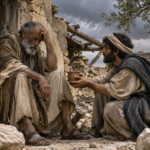
Job's friends initially respond with compassion. They weep and sit beside him in silence for seven days (Job 2:11-13). Later, their speeches insist that such suffering must reveal serious wrongdoing. Their reasoning sounds orderly, but it contradicts what the narrator and God have already said about Job.
At the end, God rebukes the friends for failing to speak rightly about him (Job 42:7-9). Job himself has struggled and spoken beyond his knowledge, as he acknowledges in Job 42:1-6. Yet the book treats his anguished engagement with God differently from the friends' confident accusations.
True statements about God's justice can become false judgments when applied to someone whose circumstances we do not understand. The book warns against treating another person's suffering as evidence of secret guilt.
Why does Job receive no complete explanation?
When God answers Job, he asks about the order and mysteries of creation (Job 38-41). The speeches expose the limits of human understanding. God does not disclose to Job the heavenly conversation from the opening chapters.
In Job 42:10-17, God restores Job's prosperity and gives him additional children. This restoration matters, but it does not undo the deaths of his first children. Nor does it promise every righteous sufferer a similar recovery in this life. Job's ending directs attention to God's wisdom and mercy, while refusing to turn earthly prosperity into a guaranteed reward for faith.
Does Suffering Mean God Is Punishing Someone?
Sometimes wrongdoing brings painful consequences, and Scripture recognizes God's discipline of his children (Galatians 6:7-8; Hebrews 12:5-11). But neither category explains every tragedy. Treating suffering as automatic evidence of personal punishment repeats Job's friends' mistake.
Jesus confronts the assumption directly in Luke 13:1-5. People tell him about Galileans killed by Pilate. He also mentions eighteen people who died when a tower fell in Siloam. Were they worse sinners than others? Jesus says no. He calls everyone to repentance without assigning extraordinary guilt to the victims.
In John 9:1-3, the disciples ask whose sin caused a man's blindness from birth. Jesus rejects the proposed blame and directs attention toward God's works. He then heals the man. This particular miracle reveals Christ's identity; it is not a license to claim that every disability exists for a miraculous demonstration.
A tragedy may remind everyone of mortality and the need for God, but it does not entitle observers to pronounce judgment on those who suffer. A person may appropriately examine their own life before God. Others should offer help rather than speculate about hidden sins.
If God Is Good, Why Does He Permit Evil?
Scripture insists that God is holy and sovereign while condemning cruelty, betrayal, and injustice. His permission of evil does not make evil morally good. Nor does the Bible present Satan or human wickedness as powers equal to God.
The cross is the clearest example of divine purpose operating amid genuine human wrongdoing. Peter says Jesus was handed over according to God's determined plan and foreknowledge, yet he holds the agents of the crucifixion responsible (Acts 2:22-24). God accomplished redemption through a wicked act without making the act righteous.
Augustine offered a related insight in Enchiridion, section 11: God's power and goodness are such that he can bring good even from evil he permits. This guards two truths. God can govern history toward his purposes, and evil remains something to resist and grieve.
Human choices explain some suffering, especially violence, betrayal, and neglect. They cannot by themselves explain disease, earthquakes, or every other natural hardship. No single explanation accounts for every kind of pain, and Scripture does not provide the hidden reason for every occurrence. God's sovereignty gives Christians a reason to trust him; it does not give them exhaustive knowledge of his purposes.
What Does a Fallen Creation Have to Do With Pain?
Genesis 1-3 moves from God's good creation to human disobedience, alienation, toil, and mortality. The New Testament develops this wider picture rather than reducing all suffering to the conduct of individual victims.
In Romans 8:18-25, Paul describes creation as groaning under bondage to decay. Believers also groan while awaiting the redemption of their bodies. Even people who have the Holy Spirit continue to experience weakness and death.
Paul's point is forward-looking. The present creation awaits liberation alongside the final glory of God's children. Suffering is part of a world awaiting restoration, not the permanent condition God intends for his people. This does not mean that a particular illness or natural disaster can be traced to a particular person's sin. The passage concerns creation's condition and the hope of its renewal.
Can God Bring Good Out of Suffering?
The New Testament describes several ways God works amid trials. None allows us to declare that a particular tragedy was necessary or that its purpose is obvious.
Tested faith and living hope in 1 Peter 1
Peter addresses believers who are grieved by various trials. He begins with their new birth through Christ's resurrection and their imperishable inheritance (1 Peter 1:3-5). Only then does he speak of faith tested like gold in fire (1 Peter 1:6-9).
The order matters. Their hope rests on the risen Savior before any trial is interpreted as spiritually useful. Tested faith may emerge as genuine and enduring, but Peter does not tell Christians to enjoy their pain or regard grief as unbelief. Growth through hardship is possible without calling the hardship itself good.
God's strength in fragile people in 2 Corinthians 4
Paul compares gospel ministers to clay vessels containing treasure. The treasure is the knowledge of God's glory in Jesus Christ; the fragile vessel underscores that the power belongs to God (2 Corinthians 4:5-7).
Paul describes pressure, perplexity, persecution, and bodily danger (2 Corinthians 4:8-12). His endurance is not evidence that hardship barely hurts. Elsewhere he admits that affliction left him despairing even of life (2 Corinthians 1:8-11).
He nevertheless looks toward resurrection. God raised Jesus and will also raise those who belong to him (2 Corinthians 4:13-14). When Paul compares present affliction with eternal glory (2 Corinthians 4:16-18), he measures its duration and outcome against eternity. He is not dismissing another person's agony.
The promised good in Romans 8
Romans 8:28 declares that all things work together for good for those who love God and are called according to his purpose. The next verse identifies a central part of that purpose: conformity to the image of God's Son (Romans 8:29).
This promise does not guarantee immediate healing, financial recovery, or an explanation for bereavement. Paul has already spoken of groaning, weakness, and patient waiting (Romans 8:18-27). He later names persecution, deprivation, and danger without suggesting they always disappear (Romans 8:35-39).
God's promised good ultimately belongs to his saving purpose in Christ. Christians may trust that purpose without claiming to know what a particular loss accomplished.
What Does Jesus' Own Suffering Tell Us?
The Christian answer is more than an argument about providence. The eternal Son of God became truly human, endured injustice and death, and rose again. His suffering reveals divine love in action.
In John 11:17-44, Jesus meets Martha and Mary after Lazarus dies. He promises resurrection and then weeps at the tomb. His tears matter because he knows he is about to raise Lazarus. Certain hope does not make present grief inappropriate. Christ neither mocks mourners nor treats their sorrow as a failure of faith.
At the cross, Jesus willingly suffered to bring sinners to God (1 Peter 2:21-25). His death is unique in its saving purpose. We should not assume that every other person's suffering serves an identifiable purpose comparable to his sacrifice. Yet the cross gives Christians reason to trust God's love when they cannot understand their circumstances.
The resurrection adds something that comfort alone cannot provide. Jesus has defeated death, and his people await bodily resurrection. Christian hope reaches beyond whatever relief this present life may offer.
What Has God Actually Promised to Suffering Believers?
God promises his presence and sustaining love, not an exemption from hardship. Romans 8:31-39 names suffering and danger while declaring that they cannot separate God's people from his love in Christ. The Holy Spirit also helps believers in weakness when they do not know how to pray (Romans 8:26-27).
God's comfort can equip believers to care for others (2 Corinthians 1:3-7). That is a genuine fruit of grace, but it would be wrong to conclude that someone was harmed merely to prepare them to comfort another person.
Scripture's largest promise is future restoration. Revelation 21:1-5 describes God dwelling with his people in the renewed creation. Revelation 21:4 says:
He will wipe away every tear from their eyes.
The passage also promises the end of death, mourning, crying, and pain. This is more than a prediction that circumstances will improve. God promises to remove suffering itself in the world made new. That hope rests on the risen Christ, even where earthly healing or justice does not arrive.
How Should Christians Care for Someone Who Is Suffering?
The most faithful response is often concrete compassion rather than a theory about why God allowed the pain. Job's friends were helpful when they sat with him; they became harmful when they insisted they knew the cause.
- Listen without rushing to explain. Allow grief, questions, and silence. Job 2:11-13 portrays friends who initially came to sympathize and comfort.
- Refuse to assign blame without evidence. Jesus rejected the claim that victims of tragedy were worse sinners than others (Luke 13:1-5).
- Avoid pronouncing God's hidden purposes. Phrases such as "God did this to teach you a lesson" can claim knowledge Scripture has not provided.
- Offer practical help. Provide meals, transportation, appropriate medical or professional support, or assistance with everyday responsibilities. Love should take visible form (1 John 3:17-18).
- Make space for lament and prayer. Psalms 13 and Psalms 88 show that faithful people can speak honestly to God from deep anguish.
Care may also require protecting someone from abuse, pursuing justice, or seeking treatment. Trust in providence never requires a person to refuse help or endure preventable harm. The possibility that God can bring good from suffering gives no one permission to inflict it or ignore it.
When the Reason Remains Unknown
Job never receives a complete explanation of his losses. Paul endures hardship while trusting the God who raises the dead. Peter speaks to grieving believers whose hope rests in Christ's resurrection. None teaches that genuine faith requires understanding every painful circumstance.
Christians can therefore reject evil, mourn honestly, pray for relief, and act to reduce suffering without denying God's sovereignty. God's goodness does not depend on our ability to explain every tragedy. Jesus Christ, crucified and risen, provides the clearest revelation of his saving love.
The Bible leaves many questions about particular events unanswered. It also promises that suffering and death will not have the final word. Until that promised restoration, faithfulness includes trusting the Lord, seeking wisdom, and remaining beside those who grieve.
Continue Studying in the Commentary
Explore the biblical passages behind this article with the Good Way Library’s full commentary.
Related Articles
Continue exploring this subject through closely connected articles.







No more articles to show. Select “Show fewer articles” to collapse the list.
Partner With The Good Way Library
The Good Way Library is supported entirely by everyday readers like you. If this resource has helped you grow in your understanding of God’s Word and the Christian faith, please consider supporting this work with a one-time or monthly gift. Please also pray for our ministry and help us spread the word by sharing The Good Way Library with your church, friends, and family. Together, we can expand completely free access to faithful biblical teaching and help strengthen shared understanding and unity across the Christian church.