
Romans 9 and Election: God’s Mercy, Israel, and the Promise
Romans 9 teaches that God’s saving purpose depends upon his gracious calling, not ancestry, human merit, or inherited religious status. Paul addresses a painful question: if God made promises to Israel, why have so many Israelites rejected Jesus Christ? His answer traces God’s freedom in choosing the line of promise, showing mercy, and calling Jews and Gentiles into fellowship with Christ. The chapter raises profound questions about individual election, but Paul’s primary concern is the faithfulness of God’s word and the salvation he gives through the Messiah.
Why Does Paul Discuss Election in Romans 9?
Paul begins with grief for his fellow Israelites (Romans 9:1-3). Their privileges are remarkable: the covenants, the giving of the law, worship, the promises, and the patriarchs belong to their history. Above all, Christ came from Israel according to his human ancestry (Romans 9:4-5). Paul does not dismiss that history or speak as though Israel’s calling had been a mistake.
His question is whether God’s promises have failed when many of their historical recipients remain unbelieving. Romans 9-11 answers by distinguishing covenant ancestry from saving participation in the promise. The argument moves from God’s freedom in election to the necessity of faith, then to a warning against Gentile pride. The Good Way Library’s overview of Romans places these chapters within Paul’s larger account of the gospel.
What Does “Not All Israel” Mean in Romans 9:6?
Paul states the central distinction in Romans 9:6:
For they are not all Israel that are of Israel.
The following verses explain his meaning. Physical descent from Abraham does not automatically make someone an heir of the saving promise. God established his covenant line through Isaac, the son promised to Sarah, although Abraham had other descendants (Romans 9:7-9; Genesis 17:18-21). God’s promise has never depended simply upon genealogy.
Here Israel has two related senses: the historical people descended from the patriarchs, and those who truly participate in God’s promise. Paul does not claim that every appearance of the name Israel throughout Scripture means the Church. Indeed, he continues to call his own kinspeople Israelites and speaks of a believing remnant among them (Romans 11:1-6). Accurate interpretation must respect those distinctions.
At the same time, the New Testament identifies all who belong to Christ, Jew or Gentile, as Abraham’s heirs through faith (Galatians 3:26-29). Ephesians 2:11-22 describes one new humanity reconciled to God through the cross. The redeemed people of God are united in Christ, not divided into separate paths of salvation based on ethnicity. The promise finds its fulfillment in the Messiah, rather than in physical descent by itself.
Why Did God Choose Jacob Instead of Esau?
Paul turns to Rebekah’s twins, who shared the same parents. Before either child had done good or evil, God announced that the elder would serve the younger (Romans 9:10-13). The ordinary privilege of the firstborn could not dictate God’s covenant purpose. His calling came first, apart from any achievement by the children.
The source passage in Genesis 25:22-23 speaks explicitly of two nations and two peoples. Likewise, Malachi 1:2-4 looks back on Jacob and Esau through the later histories of Israel and Edom. These contexts establish a corporate and historical dimension to the choice: God carried the covenant promise through Jacob’s line.
Yet Paul deliberately speaks of the brothers before their birth. The individuals are not incidental to his argument, even though they represent peoples. The oracle establishes God’s freedom to determine the line of promise, but it does not explicitly announce Esau’s personal eternal destiny. Readers should resist treating a statement about covenant election as though it supplied a complete list of the saved and condemned.
The sharp language of loving Jacob and hating Esau comes from Malachi’s contrast between God’s dealings with Israel and Edom. It expresses real divine favor and judgment within covenant history. Its severity should not be concealed, but neither should it be reduced to a claim that God acts from arbitrary hostility toward infants.
Is God Unjust to Show Mercy to Some?
Paul raises the objection himself: does God’s freedom make him unjust (Romans 9:14-18)? He answers by recalling God’s mercy to Israel after the golden calf. In Exodus 33:19, God declares his freedom to show mercy and compassion. Israel deserved judgment, yet its survival depended upon God’s gracious action. Mercy cannot be earned or demanded as a debt.
Pharaoh provides the contrasting example. God used the ruler’s opposition to display his power and make his name known (Romans 9:17; Exodus 9:16). In Exodus, Pharaoh repeatedly resists God’s command, and the narrative also says that God hardens his heart (Exodus 8:15; Exodus 9:12). Both human defiance and divine judgment belong to the account.
Christians differ over how God’s hardening operates and how it relates to Pharaoh’s prior choices. Paul does not give a mechanical explanation of divine causation. He does insist that God governs history justly, that Pharaoh remains responsible for evil, and that no sinner can claim mercy as something owed.
What Does the Potter and Clay Illustration Mean?
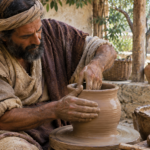
Romans 9:19-24 presses the issue further. If God accomplishes his purpose, why does he still find fault? Paul answers by comparing the Creator’s authority over humanity to a potter’s authority over clay. The image rebukes the attempt to place God under human judgment.
The Old Testament supplies background for the metaphor. Isaiah confronts the absurdity of a created thing questioning its Maker (Isaiah 29:16; Isaiah 45:9). Jeremiah describes a potter reshaping a spoiled vessel and applies the scene to God’s dealings with nations, including their repentance or rebellion (Jeremiah 18:1-10). This prophetic context warns against a fatalistic use of the image, without diminishing God’s sovereign authority.
Paul distinguishes vessels of wrath endured with patience from vessels of mercy prepared beforehand for glory. The wording is not symmetrical: he explicitly describes God preparing the vessels of mercy, while using a different construction for the vessels of wrath (Romans 9:22-23). That difference deserves notice, although it does not settle every question about divine judgment.
The passage then identifies the recipients of God’s call as people drawn from both Jews and Gentiles (Romans 9:24). This is where Paul’s argument is going. God’s mercy creates a people who cannot boast in their ancestry or achievements.
Why Does Paul Quote Hosea and Isaiah?
Paul’s quotations from the prophets explain how the call of Gentiles and the salvation of a remnant fit God’s promises. Hosea originally addresses Israel’s covenant judgment and restoration (Hosea 1:10; Hosea 2:23). Paul draws upon that restoration language to describe those once outside God’s people receiving his mercy (Romans 9:25-26). He does not erase Hosea’s original setting; he shows how God’s mercy also reaches the nations through Christ.
Isaiah supplies a parallel warning about Israel. Even if Israel’s descendants were as numerous as the sand of the sea, only a remnant would be saved (Romans 9:27-29; Isaiah 10:22-23). Large numbers and an honored heritage never guaranteed that every descendant possessed saving faith.
The one people God redeems includes believing Israelites and believing Gentiles. Both stand by mercy rather than entitlement. The prophetic testimony therefore explains how God’s word remains trustworthy even when many within historical Israel do not believe.
Does Romans 9 Teach Individual or Corporate Election?
The question cannot be answered by excluding either individuals or communities from Paul’s argument. Isaac and Jacob are particular people through whom covenant history advances. Pharaoh is one ruler whose resistance affects nations. The vessels of mercy are those called from Jews and Gentiles, and the chapter ends by contrasting righteousness received through faith with unbelief (Romans 9:24; Romans 9:30-33).
Across historic Christian traditions, believers affirm that salvation begins with divine grace and cannot be purchased through human merit. Important disagreements remain about how God’s eternal choice relates to individual faith and human response.
- Augustinian and Reformed approaches emphasize God’s gracious election of particular people before their faith, seeing saving faith itself as a gift of divine mercy. They connect Romans 9 with God’s saving purpose in Romans 8:28-30.
- Wesleyan and Arminian approaches emphasize God’s prior, enabling grace and the reality of a human response that can be resisted. They often give greater weight to the corporate dimensions of Jacob and Esau and to the call to faith at the end of Romans 9.
- Catholic and Eastern Orthodox approaches likewise affirm the necessity of God’s initiating grace and reject salvation earned apart from him. They differ among themselves and from these Protestant systems in how they explain predestination, freedom, and cooperation with grace.
The history of interpretation shows that these disagreements are longstanding. John Chrysostom, in Homily 16 on Romans, appeals to God’s foreknowledge and the disposition of Jacob and Esau while urging moral responsibility. Augustine, in On the Predestination of the Saints, Book I, chapters 3 and 34, argues that even the beginning of saving faith is God’s gift and that election precedes belief.
Their approaches cannot simply be merged. Romans 9 clearly denies that human merit establishes a claim upon God’s mercy. Christians dispute how its teaching on God’s calling determines the saving faith of each individual. The chapter should be read for what Paul actually argues, rather than forced to settle every later formulation of predestination and free will.
Why Must Romans 10 and 11 Remain in View?
Romans 9 ends with the decisive question of righteousness. Gentiles attain righteousness through faith, while many within Israel stumble over Christ because they pursue righteousness as though it came through works of the law (Romans 9:30-33). Paul is not constructing an isolated theory of divine selection. His reasoning leads directly to the response demanded by the gospel.
Romans 10 begins with his prayer for Israel’s salvation. He proclaims Christ as the fulfillment of the law for righteousness to everyone who believes (Romans 10:1-4). The invitation extends to Jew and Gentile alike: everyone who calls upon the Lord will be saved (Romans 10:9-13). Faith, preaching, and responsibility stand within the same argument as divine election.
Romans 11 then denies that God has rejected his people wholesale. There is a remnant chosen by grace, and Paul warns Gentile believers not to boast over unbelieving branches (Romans 11:1-6; Romans 11:17-24). His image is one cultivated olive tree, with believing Gentiles sharing in the nourishing root. Unbelieving natural branches can be grafted in again through faith. The root supports the branches; no group earns the right to despise another.
The difficult promise that “all Israel will be saved” in Romans 11:26 calls for separate treatment (read our article on that here). Whatever conclusion one reaches about its precise scope and timing, Paul identifies the Deliverer and the removal of sins as central. The passage gives no warrant for a second way of salvation apart from Jesus Christ or for the automatic salvation of every person with Israelite ancestry.
Does Romans 9 Refer to the Modern State of Israel?
No. Romans 9 does not refer to the modern State of Israel or assign it a special guarantee of salvation. Paul writes about ancient Israel, its covenant privileges, its historical unbelief, and God’s saving mercy in Jesus Christ. The modern State of Israel was established on May 14, 1948. It is a contemporary political nation, not the same entity as the ancient covenant community or the redeemed people united to Christ.
The New Testament’s teaching on God’s people must be drawn from its own argument. Galatians 3:26-29 identifies those who belong to Christ as Abraham’s heirs according to promise. Ephesians 2:11-22 describes Jews and Gentiles reconciled in one body, with Christ as the cornerstone. Romans 11 likewise portrays one olive tree sustained by God’s covenant mercy. These passages offer no separate salvation based on nationality, descent, or allegiance to a government.
This does not erase Israel’s historical role, the Jewish identity of Jesus and the apostles, or Paul’s affection for his Jewish kinspeople. He expressly forbids Gentile arrogance and calls believers to humility (Romans 11:18-22). Nor does refusing to equate a modern state with biblical election justify hostility toward Jewish people. The gospel judges spiritual pride wherever it appears.
Some modern dispensationalist interpretations assign a distinct prophetic role to a restored national Israel. Such claims require arguments from other passages and cannot be imposed on Romans 9. Neither modern citizenship nor ethnic ancestry confers automatic election, saving faith, or divine endorsement of a state’s actions. God’s redeemed family is gathered through Christ by grace, from Jews and Gentiles together.
How Do Romans 8 and Ephesians 1 Clarify God’s Purpose?
Romans 8:28-30 describes God’s purpose to conform believers to the image of his Son. Its sequence of foreknowledge, predestination, calling, justification, and glorification grounds assurance amid suffering. Paul’s aim is pastoral: God will not abandon those who belong to Christ (Romans 8:31-39). This makes the opening question of Romans 9 especially urgent. If God’s promise could fail, how secure would the believer’s hope be?
Ephesians 1:3-14 locates election in Christ. God’s purpose precedes the foundation of the world and aims at holiness, adoption, and the praise of his grace. The passage also describes believers hearing the gospel, believing, and receiving the Holy Spirit as a seal (Ephesians 1:13-14). The inheritance is secured through the Redeemer rather than inherited through a national identity.
These chapters deepen the doctrine of election, although interpreters disagree about its precise operation. Their shared emphasis is God’s initiative, union with Christ, and the certainty of his saving purpose. Election is never offered as grounds for ethnic superiority, indifference to repentance, or neglect of evangelism.
What Should Romans 9 Produce in the Church?
Paul begins with sorrow for people he loves and ends Romans 11 praising God’s unsearchable wisdom (Romans 11:33-36). Between those points, he strips away every claim that lineage, religious performance, or spiritual status can oblige God to save. He also rejects Gentile boasting and proclaims one Lord who saves those who call upon him.
Romans 9 teaches God’s freedom in mercy and his faithfulness to the covenant promise fulfilled in Christ. Its hard questions deserve careful study, but its message is not an invitation to speculate about the fate of strangers or to sanctify modern national power. It calls Christians to trust the Savior, honor God’s grace, pray for the unbelieving, and welcome everyone who belongs to Christ as a member of the one redeemed people of God.
Continue Studying in the Commentary
Explore the biblical passages behind this article with the Good Way Library’s full commentary.
Related Articles
Continue exploring this subject through closely connected articles.





No more articles to show. Select “Show fewer articles” to collapse the list.
Partner With The Good Way Library
The Good Way Library is supported entirely by everyday readers like you. If this resource has helped you grow in your understanding of God’s Word and the Christian faith, please consider supporting this work with a one-time or monthly gift. Please also pray for our ministry and help us spread the word by sharing The Good Way Library with your church, friends, and family. Together, we can expand completely free access to faithful biblical teaching and help strengthen shared understanding and unity across the Christian church.