
Why the Sinless Jesus Was Baptized in the Jordan
Jesus was baptized to fulfill the Father's righteous will, identify with the people he came to save, and begin his public ministry as the promised Messiah. He needed neither repentance nor forgiveness. His baptism revealed his obedient love, the Holy Spirit's presence, and the Father's approval of his beloved Son.
The question comes from Matthew 3:13-17. John the Baptist called people to repent and baptized those confessing their sins. Jesus then approached John and requested the same baptism. Why would the sinless Savior enter waters associated with repentance? The answer begins with Jesus' own words and extends to his mission of salvation.
Why Was John's Baptism Associated With Repentance?
John preached in the wilderness of Judea, announcing that the kingdom of heaven was near. His hearers confessed their sins and received baptism in the Jordan River (Matthew 3:1-6). John urged them to produce fruit worthy of repentance rather than depend upon their ancestry for spiritual security (Matthew 3:7-10). His ministry prepared Israel to receive the coming Messiah.
The Gospels connect John's calling with Isaiah 40:3, the prophetic announcement of a voice preparing the Lord's way. His work also fulfilled the promised forerunner's mission, explored in the Good Way Library's article on John the Baptist as the Elijah who was to come.
Jesus entered this setting as someone unlike any other person in the crowd. Hebrews 4:15 describes him as tempted without sin. Similarly, 2 Corinthians 5:21 teaches that he knew no sin. He had nothing to confess and no guilt to wash away. John's response shows that he recognized the difficulty.
What Did Jesus Mean by "Fulfill All Righteousness"?
When Jesus came to be baptized, John objected. Matthew 3:14 records John acknowledging that he needed baptism from Jesus. The one preparing the way knew that the coming Christ was greater than himself.
Jesus answered in Matthew 3:15:
Allow it now, for this is the fitting way for us to fulfill all righteousness.
Fulfilling righteousness meant carrying out God's righteous purpose through faithful obedience. John had been sent to prepare the way through preaching and baptism. Jesus, in turn, willingly received the baptism associated with that God-given ministry. Neither man's role was accidental; both had a part in the Father's plan.
The word us includes John in the action. Although John felt unworthy to baptize him, obedience required John to complete the task entrusted to him. His hesitation gave way to submission when Jesus explained the Father's will.
Matthew repeatedly presents Jesus as the one who fulfills God's purposes. In Matthew 5:17, Christ says he came to fulfill the Law and the Prophets. His submission at the Jordan belongs to the same life of perfect obedience that continued through his ministry and culminated at the cross (Philippians 2:8). Baptism expressed the righteousness he already possessed; it did not make him righteous.
Why Did Jesus Stand Among Sinners?
The people entering John's waters acknowledged their need for forgiveness. Jesus entered those waters without sharing their guilt. His baptism was an act of willing identification with the people he came to redeem. It anticipated the greater work he would accomplish on their behalf.
As the incarnate Son of God, Jesus truly shared our humanity. Hebrews 2:14-18 explains that he took part in flesh and blood and became a merciful, faithful High Priest. He came near to those who needed salvation and obediently accepted the mission the Father had given him.
Isaiah 53:11-12 describes the righteous Servant bearing the sins of others and interceding for transgressors. That prophecy reaches its fulfillment in Christ's suffering and death. At the Jordan, he stood with those who confessed sin; at Calvary, he bore sin as their Savior. His identification with sinners never compromised his sinlessness.
What Did the Father and Holy Spirit Reveal at Jesus' Baptism?
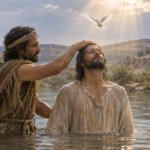
Matthew 3:16-17 describes the heavens opening after Jesus was baptized. The Spirit of God descended like a dove, and the Father declared Jesus to be his beloved Son, with whom he was pleased.
The account presents the three distinct persons of the Trinity acting together:
- Jesus Christ, the Son, receives baptism in the Jordan.
- Holy Spirit: The Spirit descends upon Jesus in a visible manifestation like a dove.
- God the Father speaks from heaven and expresses delight in his Son.
Jesus did not become divine or become the Son of God at this moment. John 1:1-14 identifies him as the eternal Word who became flesh. The voice from heaven revealed who he was, while the Spirit's descent signaled his messianic mission.
Isaiah 42:1-4 gives this event a deeper Old Testament background. There God speaks of his chosen Servant, the one in whom he delights, and declares that his Spirit rests upon him. Matthew 12:17-21 later applies this prophecy to Jesus. Isaiah's promised Servant would carry God's justice to the nations with gentleness and perseverance. The Father's delight and the Spirit's descent at the Jordan identify Jesus with this calling.
John the Baptist also received a particular sign. According to John 1:31-34, he had been told that the one upon whom the Spirit descended and remained would baptize with the Holy Spirit. John administered water; Jesus would give the Spirit to his people. The event confirmed the identity of the Messiah whom John had been sent to announce.
What Does Each Gospel Add to the Account?
The four Gospels emphasize related details without telling the story in precisely the same way.
| Gospel | Contribution |
|---|---|
| Matthew 3:13-17 | Jesus explains that baptism fulfills righteousness. |
| Mark 1:9-13 | The Spirit descends and then drives Jesus into wilderness testing. |
| Luke 3:21-23 | Jesus prays as heaven opens; his public ministry begins. |
| John 1:29-34 | John testifies to the Spirit's sign and identifies Jesus as God's Son. |
Mark connects the baptism directly with the wilderness. In Mark 1:12-13, the Spirit drives Jesus into the wilderness, where Satan tempts him for forty days. The obedient Son enters his mission facing the testing that will demonstrate his faithfulness.
Luke adds that Jesus was praying when heaven opened (Luke 3:21-22). He then notes that Jesus was about thirty years old when he began his ministry (Luke 3:23). John's Gospel gives the Baptist's testimony rather than narrating the baptism itself. Together, these accounts show that the Jordan was a turning point in the public revelation of Christ's identity and mission.
How Did the Baptism Point Toward the Cross?
John's announcement in John 1:29 identifies Jesus as the Lamb of God who takes away the world's sin. The description looks ahead to Christ's sacrifice. Isaiah 53:4-12 explains how the righteous Servant bears others' sins, a theme developed further in the Good Way Library's study of Isaiah 53 and the suffering Servant.
Later, Jesus speaks of his approaching suffering as a baptism. In Mark 10:38-39, he asks his disciples whether they can undergo the baptism awaiting him. Luke 12:50 likewise records his anticipation of a baptism yet to be accomplished. In these sayings, baptism pictures the overwhelming suffering that he would endure.
The baptism in the Jordan and the suffering at the cross are distinct events, yet they belong to one obedient mission. Jesus entered John's waters freely and later gave himself freely for sinners. The Jordan revealed the Son who would accomplish salvation; the cross secured that salvation through his sacrifice. His resurrection confirmed his victory over sin and death (1 Corinthians 15:3-4).
How Did the Early Church Understand Jesus' Baptism?
Cyril of Jerusalem addressed Christ's baptism while instructing people preparing for Christian baptism in the fourth century. In Catechetical Lecture 3.11, he taught that Jesus had no sins requiring forgiveness. Instead, Cyril understood the sinless Lord's participation as sanctifying baptism and extending divine grace to those who would receive it.
Cyril connected this teaching with the Incarnation: the Savior truly shared human nature so that humanity could share in the blessings of his saving work. His explanation also preserved an essential distinction. Christ is God's Son by nature, while believers receive sonship by grace, a point Cyril develops in Catechetical Lecture 3.14.
This early Christian witness places the Jordan within the larger story of redemption. The one who received baptism from John would also command his disciples to baptize the nations.
Was John's Baptism the Same as Christian Baptism?
John's baptism prepared people for the Messiah who was coming. Christian baptism looks to Jesus Christ, who has died and risen. The distinction becomes clear in Acts 19:1-7, where Paul explains that John's baptism called people to believe in the one coming after him, Jesus. Those who had received only John's baptism were then baptized in the name of the Lord Jesus.
Christ commanded his disciples to baptize in the name of the Father, Son, and Holy Spirit (Matthew 28:19). Romans 6:3-4 connects Christian baptism with Christ's death and resurrection, and with the call to walk in newness of life. The Christian rite belongs to the completed saving work of Jesus, whereas John's baptism announced his approaching arrival.
Catholic, Orthodox, and historic Protestant Christians differ over how baptism relates to regeneration and grace, and over who should receive it. Their shared foundation is Christ's command and saving work, while Jesus' baptism at the Jordan is unique because the Savior had no sins requiring repentance or forgiveness.
What Does Jesus' Baptism Teach Christians Today?
Jesus submitted to the Father's will even when John could not initially understand why baptism was appropriate. John responded by trusting the Lord's instruction and fulfilling his own assigned role. Both actions teach the value of obedience grounded in God's revealed purposes.
Christ's baptism also directs attention beyond the outward ceremony to the Savior himself. The Father identifies his beloved Son, the Spirit confirms his mission, and John points others toward the one who takes away sin. Christian baptism should likewise direct believers toward Christ's death, resurrection, and call to faithful discipleship.
Jesus was baptized because he came to fulfill righteousness and save sinners, not because he needed saving. The obedient Son entered the Jordan at the beginning of a mission that would lead to the cross, the empty tomb, and new life for everyone who trusts in him.
Continue Studying in the Commentary
Explore the biblical passages behind this article with the Good Way Library’s full commentary.
Related Articles
Continue exploring this subject through closely connected articles.



No more articles to show. Select “Show fewer articles” to collapse the list.
Partner With The Good Way Library
The Good Way Library is supported entirely by everyday readers like you. If this resource has helped you grow in your understanding of God’s Word and the Christian faith, please consider supporting this work with a one-time or monthly gift. Please also pray for our ministry and help us spread the word by sharing The Good Way Library with your church, friends, and family. Together, we can expand completely free access to faithful biblical teaching and help strengthen shared understanding and unity across the Christian church.