
Exodus 40 Commentary: The Glory Fills the Tabernacle
Exodus 40 records the tabernacle’s setup, consecration, and God’s glory filling it, as Israel begins life under God’s dwelling presence.

Exodus 40 records the tabernacle’s setup, consecration, and God’s glory filling it, as Israel begins life under God’s dwelling presence.

Exodus 39 records the priestly garments, the finished tabernacle work, and Moses’ inspection, showing that holy service rests on careful obedience.

Exodus 38 records the altar, basin, court, and material totals, showing careful obedience, holy service, and accountable stewardship in Israel’s worship.

Exodus 37 records Bezalel’s construction of the ark, table, lamp stand, incense altar, and holy oil, showing exact obedience to God’s pattern.
![ROLE You are my Bible Chapter Image Director. Your task is to design a distinct hero image concept for a commentary page for {BOOK} {CHAPTER}. The image must visually represent the central events, theological emphasis, symbolic weight, or covenant significance of this specific chapter. The goal is to maintain a consistent visual brand across the entire commentary series while ensuring that each chapter has a clearly distinct visual identity tied to its own content. GLOBAL STYLE LOCK (NON-NEGOTIABLE) All images must follow these visual rules: • Photorealistic documentary photography style • Symbolic objects only (still life or environment) • No people or identifiable faces • No readable text anywhere • No scroll writing, inscriptions, or typography • Ancient materials only where appropriate (stone, linen, wood, clay, bronze, leather, reeds) • No modern objects • No fantasy or illustration style • No cinematic movie scenes • No dramatic special effects Lighting: • natural light • soft shadows • restrained exposure • reverent atmosphere Camera style: • realistic photography • subtle film grain • crisp textures • shallow depth of field when appropriate Aspect ratio: 16:9 hero image Composition: • simple • symbolic • rule of thirds • leave clean negative space for a page heading overlay CHAPTER FOCUS RULE (MANDATORY) The image must represent the specific content of {BOOK} {CHAPTER}, not merely the whole book in general. Base the symbolism primarily on the chapter’s main action, covenant moment, theological message, judgment, deliverance, ritual action, speech, object, place, or turning point. Prefer symbols that arise directly from the chapter itself. Only use broader book-level symbolism if the chapter’s content clearly supports it. SYMBOL SELECTION RULES The image must contain: Primary Symbol One main symbolic object, setting, or environmental feature that represents the dominant idea or event in the chapter. Secondary Symbol (optional) Use only if it strengthens the chapter symbolism. Maximum: one secondary object. Do not overcrowd the scene. SYMBOL SOURCES Choose symbols from things that appear in or strongly represent the chapter, such as: • covenant objects • ritual items • wilderness elements • agricultural imagery • temple materials • royal symbols • prophetic sign imagery • natural elements tied to the chapter’s message • architectural structures • tools or objects from biblical life • travel or camp elements • battle or judgment remnants • offerings, altars, vessels, garments, food, or boundary markers VARIATION ENGINE (MANDATORY) Each chapter must differ visually by varying several of the following elements: • primary object • secondary object • environment type • camera distance • camera angle • lighting conditions • dominant texture • mood • time of day • color tone • negative space location Possible environment types: • desert / wilderness • hillside / open land • temple architecture • interior stone room • ritual altar setting • agricultural landscape • shoreline / water setting • ancient road / travel setting • ruined city / judgment setting • camp / tent setting • cave / mountain setting • throne-room style architecture • palace interior courtyard • pastoral field setting ANTI-REPETITION RULE Avoid repeating the same primary object used for previous chapter images unless it is essential to the text. Previously used image elements: {USED_VISUAL_ELEMENTS} If a symbol from this list appears too similar to your idea, choose a different object, environment, or framing approach. Prefer fresh symbolism that still fits the chapter faithfully. If a repeated symbol is unavoidable, vary the environment, angle, lighting, distance, and composition so the image still feels distinct. FAITHFULNESS RULE The image must reflect the actual content of {BOOK} {CHAPTER}. Do not invent major objects or themes that are absent from the chapter. Do not include symbols from later chapters unless they are clearly anticipated in this chapter. Do not force Christian symbolic overlays that bypass the chapter’s own textual imagery. Keep the symbolism reverent, text-rooted, and visually clear. IMAGE CONCEPT OUTPUT Image Concept Title Primary Symbol Secondary Symbol (optional) Environment Composition Style (still life, environmental still life, architectural, symbolic landscape) Camera + Framing (example: close 35mm shot, wide landscape shot, overhead still life) Lighting Negative Space Placement (left, right, upper) Why This Represents {BOOK} {CHAPTER} 2–3 sentences explaining the symbolism based specifically on the chapter. FINAL IMAGE GENERATION PROMPT Write one clean image prompt that follows all rules above. The prompt must include: • the objects • the environment • lighting • camera style • texture details • 16:9 framing • negative space area • photorealistic look • chapter-specific symbolic clarity FINAL PROMPT FORMAT Write the prompt as one paragraph formatted like this: Photorealistic documentary style image of [primary object] with [secondary object if used], set in [environment]. Ancient materials such as [materials]. Natural lighting with soft shadows. Realistic textures, shallow depth of field, subtle film grain. Composition using rule of thirds with open negative space on the [side] for a website heading overlay. Symbolic still life, no people, no readable text, no modern objects, no fantasy illustration style. 16:9 aspect ratio. INPUTS (EDIT THESE ONLY) BOOK: Exodus CHAPTER: 32 PREVIOUSLY USED VISUAL ELEMENTS: Blood vase, frogs in bowl, hailstorm aftermath flax field, locust swarm, doorway, passover preparation, twilight, desert oasis, parted sea, rock split, desert camp, mountain base, stone altar, stone pit, wool cloak, fruit basket, ritual site, wooden chest, gold tools, tabernacle, altar, priest breastpiece, rustic desert camp meal setting, rustic camp courtyard, artisan tools, golden treasures, stone tablets, crafting tools, earthly textures](https://goodwaylibrary.com/wp-content/uploads/2026/03/Exodus-36-Commentary-Featured-Image-Earthy-textures-in-a-rustic-workshop-768x432.jpg)
Exodus 36 shows Israel’s overflowing giving and the careful construction of the tabernacle, where wisdom, obedience, and holiness shape every detail.

Exodus 35 joins Sabbath obedience, freewill offerings, and Spirit-given craftsmanship as Israel begins to build the tabernacle God commanded.

Exodus 34 records covenant renewal, God’s self-proclamation, covenant commands, and Moses’ shining face, showing mercy, holiness, and mediated fellowship with God.

Exodus 33 shows why God’s presence matters, how Moses intercedes for Israel, and how divine glory, goodness, mercy, and holiness govern covenant fellowship.

Exodus 32 recounts Israel’s golden calf, Moses’ intercession, covenant judgment, and the deep seriousness of idolatry before the holy God.

Exodus 31 joins Spirit-given craftsmanship, Sabbath holiness, and the covenant tablets, showing God’s worship, rest, and word belong together.

Exodus 30 gives the incense altar, atonement money, bronze basin, holy oil, and sacred incense, showing that God governs every approach to his presence.

Exodus 29 explains Aaron’s consecration, the altar’s sanctification, and the daily offerings that mark God’s dwelling among Israel.

Exodus 28 explains Aaron’s priestly garments, showing how holiness, representation, and acceptance before God shape Israel’s worship and prepare for a greater priest.

Exodus 27 explains the bronze altar, the court, and the lamp oil, showing how sacrifice, access, and continual light shape worship.

Exodus 26 explains the tabernacle’s curtains, boards, veil, and entrance, showing how God ordered holy space for his dwelling among Israel.

Exodus 25 begins the tabernacle instructions, showing how God would dwell among Israel through holy gifts, holy furniture, and holy order.
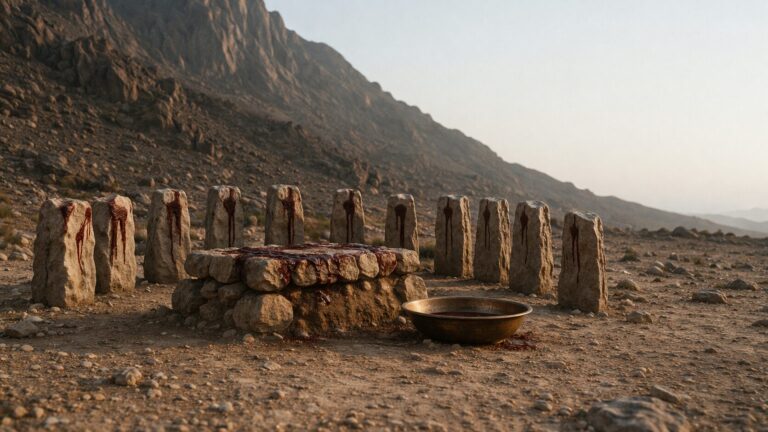
Exodus 24 seals God’s covenant with blood, confirms Israel’s pledge, and brings Moses into the cloud of God’s glory on Sinai.

Exodus 23 joins justice, Sabbath rest, worship, and conquest promises, showing how God orders Israel’s life, land, and obedience.

Exodus 22 applies covenant holiness to theft, negligence, sexual sin, oppression, worship, and firstfruits, showing God’s justice in ordinary life.

Exodus 21 applies God’s covenant holiness to servants, violence, injury, and negligence, showing how justice protects life, dignity, and ordered community.

Exodus 20 gives God’s covenant words at Sinai, grounding worship, rest, family life, and neighbor-love in the grace of redemption.

Exodus 19 brings Israel to Sinai, sets covenant identity before them, and prepares the people to meet God with fear and holiness.

Exodus 18 records Jethro’s confession, Israel’s shared meal before God, and wise counsel that helps Moses judge the people faithfully.

Exodus 17 shows God giving water from the rock, exposing Israel’s testing, and defeating Amalek through Moses, Joshua, Aaron, and Hur.

Exodus 16 shows God feeding Israel with quail and manna, testing obedience, and teaching Sabbath rest through daily dependence in the wilderness.

Exodus 15 records Israel’s song after the sea, Miriam’s praise, the bitter waters at Marah, and God’s first wilderness test.

Exodus 14 shows God trapping Pharaoh, opening the sea, saving Israel on dry ground, and judging Egypt so his name is known.

Exodus 13 explains consecrated firstborn sons, annual remembrance, Joseph’s bones, and God’s leading presence as Israel begins the journey from Egypt.

Exodus 12 explains the Passover, the death of Egypt’s firstborn, Israel’s release, and the covenant meal that shaped Israel’s memory and worship.

Exodus 11 announces the death of the firstborn, Israel’s favor in Egypt, and God’s final distinction before deliverance.
Exodus