
Step 1: Begin the Journey | Christian Discipleship With Jesus
The Good Way Discipleship Course | Step 1 of 12
Following Jesus With Someone Beside You
Christian discipleship begins with Jesus Christ. He calls us to know him, trust him, learn his teachings, and follow him throughout our lives. Yet following Jesus involves more than understanding Christian beliefs or developing better habits. It is a lifelong relationship with our Savior, shaped by his Word, sustained by his grace, and lived through the Holy Spirit.
The Good Way Library created this free twelve-part discipleship course to help people grow in that relationship. Together, we will explore what Christ has accomplished for us, what it means to abide in him, and how his teachings shape our daily lives. Our goal is not simply to help you complete twelve lessons, but to prepare you for a lifetime of following Jesus and helping others do the same.
The Central Truth: Jesus commands his followers to make disciples, baptize them, and teach them to observe everything he commanded. Christian discipleship begins with his saving grace, continues through fellowship with him, and leads outward into his mission.
Welcome to The Good Way Discipleship Course
This course is designed primarily for two people: someone who wants to grow in Christian faith and a more mature Christian who agrees to walk alongside them.
We call these participants the disciple and the discipler. Both are followers or prospective followers of Jesus, and both should approach the journey with humility and a willingness to learn.
- If you are the disciple: Read the assigned Scripture and lesson before your meeting whenever possible. Bring your questions, speak honestly about what you believe, and remain open to learning. You do not need to impress anyone or pretend to understand something you find difficult.
- If you are the discipler: Read the same material and prepare to guide the conversation. This first lesson includes a complete orientation for you. The remaining eleven lessons will also contain instructions specific to each step.
You can participate independently if you cannot find a suitable discipler. However, we strongly encourage you to seek a mature Christian who can study, pray, and walk through the course with you.
This course is more than an introduction to Christian beliefs. It invites you to grow in knowing and following Jesus alongside other believers. Whether you have recently come to faith or have followed Christ for many years, intentional discipleship can deepen your understanding of Scripture, strengthen Christian fellowship, and prepare you to encourage others in their walk with the Lord.
How to begin: If you already have a mature Christian willing to disciple you, arrange your first meeting and read Step One (this article) beforehand. You will work through Step One together during that meeting. If you do not yet have a discipler, begin reading Step One on your own, use its guidance to invite someone, and then return to the lesson together for your first meeting. After each meeting, both participants prepare for the next step by reading its assigned Scripture and lesson.
Download and Share the Complete Discipleship Course
Prefer studying offline or using a printed guide? You can download the complete course to read, print, or share with others:
We encourage you to freely share this resource with anyone who desires to follow Jesus and grow in the faith.
Begin With Scripture
Primary Reading: Matthew 28:16–20 (WEBU)
Before continuing, open your Bible and read these five verses carefully. They contain the Great Commission, the command that establishes the purpose of this entire course.
As you read, pay attention to three important questions:
- His authority: What does Jesus reveal about himself?
- His command: What does he instruct his followers to do?
- His promise: What assurance does he give those who follow him?
Read the passage again before studying the explanation below. Allow Scripture itself to establish the foundation of your understanding.
Companion Readings:
- Acts 2:37–47: Observe how people respond to the apostolic proclamation of Jesus Christ. Notice their baptism, commitment to biblical teaching, fellowship, worship, and prayer.
- 2 Timothy 2:1–2: Notice how Paul instructs Timothy to pass faithful Christian teaching to others who will be able to teach still more people.
These passages introduce two important principles. Discipleship happens within Christian fellowship, and those who receive faithful teaching are called to pass it on.
What Christian Discipleship Really Means
The Risen Jesus Calls His Followers
Matthew 28 concludes the Gospel with the resurrection of Jesus and the mission he gives his disciples. After his crucifixion and burial, the women discover the empty tomb. An angel announces that Jesus has risen, and the risen Christ meets the women and directs his disciples to Galilee.
The eleven disciples travel to the mountain where Jesus has instructed them to meet him. Matthew records that they bow before Jesus, although some doubt or hesitate (Matthew 28:16–17). Even after everything they have witnessed, the disciples still have much to learn.
Jesus does not begin by praising their abilities or explaining how they can become successful religious leaders. Instead, he establishes the foundation of their mission by declaring his own authority.
In Matthew 28:18 (WEBU), Jesus says:
“All authority has been given to me in heaven and on earth.”
This statement changes how we understand everything that follows. The Great Commission is not an independent project that Christians must accomplish through their own strength. It is the mission of the risen Lord, who possesses authority over heaven and earth.
The foundation of Christian discipleship is not what we can accomplish for Jesus, but who Jesus Christ is and what he has accomplished for us.
Jesus is the promised Messiah, the eternal Son of God who became truly human, died for sinners, and rose bodily from the dead. He is our Savior and Lord, not merely an inspiring moral teacher.
Everything in this course begins with him.
Make Disciples and Teach Them to Obey
In Matthew 28:19, Jesus commands his followers to “make disciples of all nations” (WEBU).
A disciple is someone who learns from and follows a teacher. Throughout the Gospels, Jesus called people to follow him personally. They listened to his teaching, observed his life, asked questions, received correction, and learned to trust him through many different circumstances.
Jesus taught about the Kingdom of God, repentance, forgiveness, prayer, humility, service, love, and obedience. His disciples did not simply receive religious information. They learned what it meant to belong to him.
This distinction remains important today. A person may know many Bible passages, attend church regularly, and understand Christian terminology while still resisting the practical implications of Jesus’ teachings.
Biblical knowledge is essential, but it is not the final destination of discipleship. The purpose of learning Christ’s teachings is to know him more deeply and increasingly live according to what he commands.
Jesus makes this clear in Matthew 28:20. He instructs his followers to teach new disciples to observe everything he commanded.
Notice the emphasis. Jesus does not merely tell Christians to explain his commands. He directs them to teach others to observe those commands.
For example, someone may understand that Jesus commands forgiveness while continuing to hold bitterness against another person. Another may know the Lord’s Prayer without developing a life of prayerful dependence upon God.
Discipleship connects our understanding of Scripture with the way we actually live.
Throughout this course, we will return to two foundational questions:
- Who are you, Lord? What does this passage reveal about Jesus Christ, his character, his saving work, and his purposes?
- How shall I follow you? What does this truth call me to believe, trust, change, or obey through the help of the Holy Spirit?
The first question keeps our attention upon Christ. The second reminds us that genuine understanding should lead to faithful obedience.
Baptism and Christian Fellowship Belong to Discipleship
The Great Commission also commands baptism in the name of the Father, Son, and Holy Spirit.
Baptism belongs to the Christian response to the gospel and the life of Christ’s church. In Acts 2, Peter proclaims Jesus as the crucified and risen Lord. Those who receive the apostolic message are baptized and become part of a community devoted to teaching, fellowship, prayer, and worship.
Christian traditions differ concerning baptism’s proper recipients, significance, and administration. Nevertheless, historic Christianity recognizes its importance, and Jesus explicitly includes baptism in his commission.
If you are exploring Christianity, Step Two will explain the gospel, repentance, faith, and new birth more fully. If you already trust Jesus Christ but have not been baptized, consider discussing baptism with a pastor or trusted church leader.
You do not need to wait until Step Ten, which focuses on the church, to begin participating in Christian fellowship.
Following Jesus is personal, but it was never intended to be permanently isolated.
Jesus Promises His Continuing Presence
The Great Commission concludes with one of Jesus’ most encouraging promises.
Matthew 28:20 (WEBU) declares:
“Behold, I am with you always, even to the end of the age.”
Jesus does not send his followers into the world and then abandon them. He promises his continuing presence as they carry out his mission. His disciples will face hardship, uncertainty, opposition, and their own weakness, but the risen Lord remains faithful.
The Christian life is therefore not a journey toward an absent Savior.
For those who genuinely belong to Christ, he is already present with them through the Holy Spirit. They are called to trust him, abide in him, and follow him throughout their lives.
This truth will become increasingly important as we continue.
Grace Comes Before Christian Growth
Many Christians approach spiritual growth with a familiar assumption: if they pray enough, study enough, improve their behavior, and become sufficiently obedient, perhaps they will finally become the people God wants them to be. This way of thinking can turn discipleship into an exhausting effort to earn what God has already graciously given. Scripture teaches a different foundation.
Ephesians 2:1–10 explains that apart from God’s mercy, humanity is spiritually dead in sin. Our deepest problem is not simply inadequate religious knowledge or insufficient discipline. We need the saving work of Jesus Christ. Yet God, rich in mercy, makes believers alive with Christ. Salvation is his gift of grace, received through faith, not a reward for human accomplishment.
Paul then explains that those saved by grace are God’s workmanship, created in Christ Jesus for good works (Ephesians 2:10). Notice the order: God saves us by grace, and that grace produces a new life of faithful obedience. We do not perform good works to purchase salvation. We are called to live faithfully because Christ has saved us.
Romans 6:1–14 develops this truth further. Paul explains that believers are united with Christ in his death and resurrection. Their relationship to sin’s dominion has been decisively changed, and they are called to live in the newness of life that belongs to Christ. Our new life is not something we manufacture through spiritual techniques. It begins with God’s saving action.
What Is Already True in Christ?
For someone who genuinely belongs to Jesus Christ, Scripture teaches several remarkable realities:
- Forgiveness: Christ’s saving work provides forgiveness of sins and reconciliation with God (Ephesians 1:7; Romans 5:1–11).
- New life: Believers are made alive with Christ and receive a new identity in him (Ephesians 2:4–10; 2 Corinthians 5:17).
- Union with Christ: Christians share in Christ’s death and resurrection and are called to live according to that reality (Romans 6:1–14).
- The Holy Spirit: God gives his Spirit to dwell within believers, assuring, guiding, and transforming them (Romans 8:9–17).
- Adoption: Those who belong to Christ are welcomed into God’s family as his children (Galatians 4:4–7).
These blessings are not prizes awaiting completion of twelve discipleship lessons. They are gifts grounded in the saving work of Jesus Christ.
However, this does not mean Christians have already attained complete maturity or sinless perfection. We continue growing in holiness, understanding, love, obedience, and dependence upon God. We also await the future resurrection and full transformation promised through Christ (Philippians 3:12–21).
The Christian life therefore involves three connected realities:
- What Christ has accomplished: His saving work establishes new life, forgiveness, reconciliation, and union with him for those who believe.
- What the Holy Spirit is doing now: God continues forming Christlike character as believers grow in faith, repentance, love, and obedience.
- What God has promised for the future: Believers await the resurrection, complete transformation, and final fulfillment of God’s saving purposes.
These truths protect us from two opposite mistakes. We should neither try to earn God’s acceptance through religious effort nor assume that grace makes repentance and obedience unnecessary.
If you are not yet a Christian, these saving blessings should not be presumed to belong to you automatically. You are welcome to explore the course, examine Scripture, and ask honest questions. Step Two will explain how sinners are called to respond to Jesus through repentance and faith.
Learning to Abide in Christ
One of the greatest purposes of this discipleship course is to help you develop a deeper relationship with Jesus Christ. Christianity is not simply a collection of beliefs that influence our behavior. It is life with the living Christ.
In John 15:1–17, Jesus describes himself as the true vine and his followers as branches. A branch does not produce life independently. Its fruitfulness depends upon its continuing connection to the vine. Jesus uses this illustration to teach his disciples about abiding in him. To abide in Christ is to remain in trusting dependence upon him, receiving his Word, living in his love, praying, and responding faithfully to his teaching.
Christ does not invite us to manufacture spiritual life through greater personal effort. He calls us to remain in him, the source of genuine fruitfulness. This understanding changes the way we approach ordinary Christian activities. We study Scripture because we desire to know God and receive his truth. We pray because we have fellowship with our heavenly Father through Jesus Christ. Further, we seek obedience because we love the Lord who has graciously loved us.
We also learn to turn toward Christ throughout ordinary life. We may pray while beginning our day, making difficult decisions, caring for family members, working, serving others, or facing disappointment. Our relationship with Christ does not end when our scheduled devotional time finishes.
What Does It Mean to Listen to God?
Living with Christ includes becoming attentive to his Word and seeking his wisdom.
God speaks authoritatively through Scripture. As we read and understand his Word, the Holy Spirit helps us recognize truth, receive correction, and grow in faithful obedience. We also bring our concerns before God in prayer and seek wisdom through appropriate Christian counsel.
However, we should not assume every feeling, desire, or inward impression is a direct message from God. Our judgments must remain subject to Scripture and should be considered with humility and discernment.
Nor should we believe that spiritual growth always produces strong emotions or extraordinary experiences. Faithful Christians sometimes endure hardship, spiritual dryness, confusion, and seasons of uncertainty.
Our confidence rests in Christ’s faithfulness, not in the intensity of our feelings.
We will explore abiding in Christ more deeply in Step Four. For now, remember that Jesus himself is the foundation, source, and goal of the Christian life.
Why Discipleship Is Meant to Be Shared
Although your relationship with Jesus is deeply personal, Christian discipleship is not intended to remain an isolated pursuit.
Acts 2:42–47 describes believers who devote themselves to apostolic teaching, fellowship, prayer, worship, and caring for one another. Their faith shapes not only their private lives but also their relationships within the church.
Paul later instructs Timothy to entrust faithful teaching to others who will be able to teach still more people (2 Timothy 2:1–2). Christian instruction is meant to be received, lived, and passed on.
This is why The Good Way Library strongly encourages you to complete the course with another Christian.
Find Someone Who Can Walk Beside You
Ideally, your discipler will be a spiritually mature Christian whose faith and character you respect. Consider a pastor, small-group leader, faithful family member, longtime Christian friend, or another trustworthy member of your church.
Look for someone who demonstrates these qualities:
- Faithfulness to Scripture: They are willing to study God’s Word carefully and submit to its teaching.
- Christlike character: They demonstrate humility, patience, honesty, and love for others.
- Christian fellowship: They participate meaningfully in a healthy local church.
- A willingness to help: They can listen, pray, explain Scripture, answer questions, and continue learning alongside you.
Your discipler does not need to be a professional theologian or an experienced Bible teacher. They also do not need to know The Good Way Library beforehand.
The course supplies the material you will study together. Your discipler provides Christian companionship, encouragement, and guidance.
An Invitation You Can Send
If someone comes to mind, consider reaching out with a personal invitation. You could write:
I am beginning The Good Way Library’s free twelve-part Christian discipleship course. It focuses on knowing Jesus more deeply, understanding the gospel, learning his teachings, and growing in faithful Christian living. The course works best when a mature Christian walks through it with someone else. I respect your faith and wondered if you would consider going through it with me. You would not need to prepare the lessons yourself. We could read Scripture, discuss the material, pray together, and learn along the way. Would you be willing to talk about it?
Adapt the message to your relationship. The important thing is to make a genuine invitation rather than waiting indefinitely for someone to volunteer.
If the first person cannot participate, do not be discouraged. Consider another trustworthy Christian who might be willing to help.
A Healthy Discipleship Relationship
A discipler should encourage spiritual growth through Scripture, prayer, patient guidance, and personal example. They should never demand unquestioning loyalty, control another person’s decisions, or require the disclosure of deeply personal matters.
Both participants should approach the relationship with humility and respect. Private conversations deserve appropriate care, while serious safety concerns must be handled responsibly.
Discipleship should strengthen your connection to Christ and his church, not create unhealthy dependence upon one individual.
Christians Before Us: Learning From the Early Church
Christians have been helping others learn and practice the faith since the earliest generations of the church.
The New Testament shows believers gathering around the apostles’ teaching, sharing life together, praying, worshiping, and caring for those in need. This pattern continued beyond the apostolic age.
An early Christian instructional work known as the Didache, commonly dated to the late first or second century, includes teaching about Christian conduct, baptism, prayer, and community life. Its precise date remains debated, and it is not part of Scripture. Nevertheless, it provides historical evidence that early Christians took seriously the responsibility of teaching others how to live faithfully.
In the second century, Irenaeus of Lyons (c. 130–202) demonstrated the importance of receiving Christian teaching from faithful believers and passing it on to others. As a young man in Asia Minor, Irenaeus listened to Polycarp, the bishop of Smyrna, who had known Christians from the apostolic generation. Those early experiences helped shape his lifelong commitment to preserving and explaining the Christian faith. Irenaeus eventually became bishop of Lyons in Gaul, where he taught Scripture and defended the church against teachings that distorted the identity of Jesus Christ and the message of salvation. His example reminds us that Christian discipleship is not something we must discover or accomplish alone. We benefit from believers who have walked faithfully before us, and as we mature, we become responsible for helping others understand and follow the same Lord. This reflects the pattern of passing on faithful teaching described in 2 Timothy 2:2.
Across subsequent centuries, Christians continued instructing new believers through local churches, pastoral teaching, Christian friendships, and summaries of essential belief such as the historic creeds.
The Good Way Library also provides studies of the Apostles’ Creed, Nicene-Constantinopolitan Creed, Athanasian Creed, and Definition of Chalcedon through our Christian Resource Library. These historic statements explain foundational Christian beliefs handed down across generations, while Scripture remains our final authority.
Our course is not intended to invent a new Christianity. It is designed to help ordinary Christians understand and live the faith once for all revealed in Scripture and faithfully taught through the church for millennia.
How to Begin the Twelve-Step Course
The Good Way Discipleship Course is designed primarily for one mature Christian to walk alongside another person. However, independent study is possible when a suitable mentor is unavailable.
Ideally, this twelve-step course should be completed through weekly, one-on-one meetings between a discipler and a disciple over approximately three months. However, the schedule should remain flexible to accommodate individual needs, questions, and circumstances. Some subjects deserve additional time, and a thoughtful conversation is more valuable than rushing through the material.
What You Will Need
You do not need expensive materials, special qualifications, or paid resources.
- A Bible: The Good Way Library uses the World English Bible, Updated (WEBU), for direct quotations, but you may also read the assigned passages in your usual Bible.
- Something for notes: A notebook or digital document can help you record questions, passages, reflections, and prayers.
- A regular time: Choose a realistic schedule for reading, prayer, and conversation.
- Christian fellowship: If possible, arrange to meet with a trustworthy mature Christian and remain connected to a healthy local church.
Between meetings, spend time reading Scripture and considering its meaning. Bring what you learn before God in prayer, and remain open to responding faithfully in ordinary life.
These practices support your learning, but they do not determine your worth before God.
Let Scripture Remain First
Throughout this course, we will direct you toward Good Way Bible commentaries, book overviews, and other Christian resources.
However, the Bible itself remains the foundation of everything we teach.
Read the assigned passage before consulting our commentary. Consider what it says, what it reveals about God, and how it fits within the broader message of Scripture.
Then use the commentary to deepen your understanding. Its Walkthrough, Application, Interpretive Options, Cross-References, and Leading sections can help you explore difficult passages and prepare for discussion.
As an optional companion to the twelve lessons, consider reading through the Gospel of John. Its teaching about Jesus’ identity, saving work, love, and relationship with his disciples reinforces many subjects we will study.
Where This Journey Leads
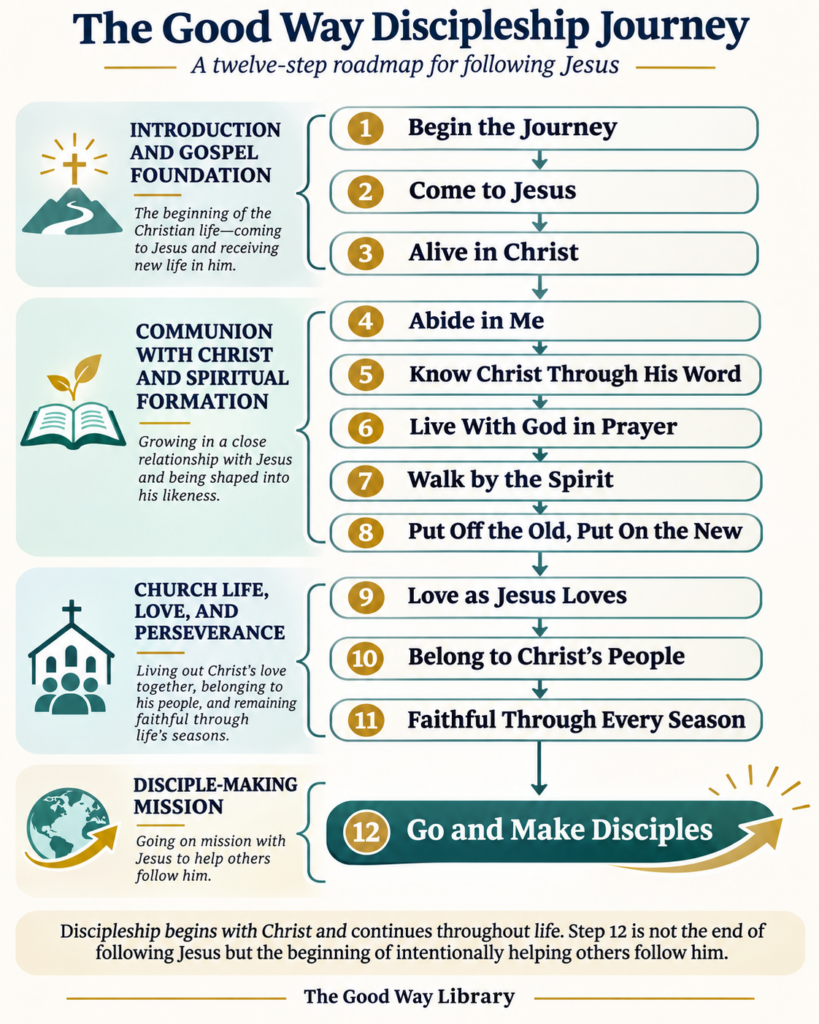
The course begins with the gospel and new life in Christ. It then develops a deeper understanding of abiding in Jesus, Scripture, prayer, walking by the Holy Spirit, repentance, and Christian love. Later lessons address belonging to the church, perseverance through suffering, and helping other people follow Jesus.
The final step returns to Matthew 28 and the responsibility of making disciples.
Consider what could happen if one Christian faithfully helped two others begin discipleship, and those Christians eventually helped two more, while earlier participants continued serving others. Under these idealized assumptions, one participant could become three after one cycle, nine after two, and 243 after five.
This illustrates the potential of discipleship multiplication, not a prediction of conversions. Real discipleship involves people, patience, prayer, and God’s work rather than numerical targets.
You do not have to finish this course before beginning to love, serve, and encourage others. You can participate in Christ’s mission now through prayer, kindness, Christian witness, and faithful service.
Step Twelve will help you consider how to accompany another person intentionally, but following Jesus and loving others are lifelong callings, not rewards for completing a program.
For the Discipler: How to Lead This Course
If you have agreed to accompany someone through these twelve steps, this section is written especially for you. Read it before your first meeting and return to it whenever you need guidance.
You do not need to be a pastor, theologian, or experienced Bible teacher. You also do not need to prepare twelve lessons yourself. The Good Way Library provides the biblical instruction, discussion questions, and suggested activities.
Your role is to walk alongside another person as a fellow follower of Jesus Christ. Help them encounter Scripture, understand its teaching, ask honest questions, pray, and learn to respond faithfully to Christ.
You are not responsible for manufacturing spiritual growth in someone else. God works through his Word and Spirit, while you serve as a faithful companion.
Each later lesson will contain its own shorter For the Discipler section. The instructions below establish the general approach for the entire course.
Before Your First Meeting
Begin by preparing your own heart through prayer and Scripture.
Read Matthew 28:16–20, Acts 2:42–47, and 2 Timothy 2:1–2 before meeting. Consider what the risen Jesus commands, what he promises, and how these passages connect discipleship with Christian fellowship and the faithful transmission of biblical teaching.
Read this lesson in full. If helpful, review the Good Way Matthew 28 commentary, particularly its Walkthrough and Leading: The Teaching Guide sections.
You do not need to prepare a sermon or an impressive presentation. Instead, prepare to listen, explain Scripture faithfully, and encourage the learner.
Pray that God would give you humility, wisdom, patience, and genuine concern for the person you will accompany.
Begin With a Personal Conversation
Before studying the lesson, take time to understand why the learner wants to participate.
You might ask what brought them to the course, whether they are exploring Christianity or already profess faith, and what they hope to understand about Jesus. You may also ask whether they participate in a local church.
Do not assume the person is already a Christian. Some participants have strong faith but little formal instruction. Others have attended church for years without fully understanding the gospel. Still others remain uncertain about what they believe.
Allow them to explain their background in their own words. Do not pressure them to give a personal testimony, disclose painful experiences, or claim beliefs they do not hold.
Briefly explain that the course is self-paced and aims to establish a foundation for lifelong discipleship. Encourage honest questions and continued participation in a healthy local church.
A Suggested First Meeting
A normal discipleship meeting lasts approximately sixty to ninety minutes. Your first meeting can follow this flexible pattern:
- Welcome and prayer (5–10 minutes): Ask about the learner’s background and hopes for the course. Begin with a brief prayer for wisdom and understanding.
- Read Scripture together (15 minutes): Read Matthew 28:16–20 aloud. Ask what Jesus claims, commands, and promises. Discuss how Acts 2 and 2 Timothy 2 help explain Christian fellowship and passing on the faith.
- Discuss the lesson (20–30 minutes): Work through the questions below, focusing on Jesus’ authority, the meaning of discipleship, grace, and Christ’s promised presence. You do not need to address every question if a meaningful conversation develops.
- Agree on how to continue (10–15 minutes): Discuss meeting frequency, preparation between lessons, preferred communication, confidentiality, and healthy boundaries. Consider how participation in a local church will remain part of the journey.
- Pray and prepare for Step Two (5–10 minutes): Pray together, establish the next meeting time, and invite the learner to read John 3:1–21 before continuing.
This is a suggested structure, not a rigid schedule. Some participants may need more time for questions, while others may benefit from a shorter meeting.
The important thing is to establish a welcoming relationship centered upon Jesus Christ and Scripture.
How to Guide Every Lesson
- Review the previous step | Begin each meeting by briefly revisiting the preceding lesson. Ask what the learner understood, questioned, or attempted to put into practice. Encourage honest reflection without grading their progress or requiring private disclosures.
- Begin with Scripture | Read the principal passage before relying on commentary. Ask what the passage says, what it meant in context, and what it reveals about God.
- Keep Christ at the center | Ask what the passage reveals about Jesus, his saving work, his promises, and the life he gives to those who belong to him.
- Connect grace with obedience | Help the learner understand what God has accomplished through Christ before discussing practical responses. Christian obedience flows from grace; it does not purchase God’s acceptance.
- Encourage genuine conversation | Ask open-ended questions and allow time for thoughtful answers. You do not need to fill every silence or resolve every uncertainty immediately.
- Pray together | Invite the learner to bring questions, concerns, and thanksgiving before God. Never judge the sincerity of someone’s faith by the length or eloquence of their prayers.
- Use Good Way as a companion resource | The commentaries can explain historical context, difficult verses, and interpretive questions. They should support direct Bible study rather than replace it.
What to Watch For
People bring different backgrounds, questions, strengths, and struggles into discipleship.
Some wrestle with doubts about salvation. Others are unfamiliar with Scripture or have experienced unhealthy spiritual leadership. Some face grief, addiction, significant emotional distress, or difficult personal relationships.
Respond with humility and care rather than assuming every problem can be resolved through a Bible-study exercise.
A discipler must never demand unquestioning obedience, control personal decisions, isolate someone from family or church, or insist that personal impressions carry the authority of God’s Word.
Respect the learner’s privacy, but do not promise absolute secrecy. Serious safety concerns, suspected abuse, immediate danger, or applicable safeguarding obligations may require appropriate assistance.
For medical, mental-health, addiction, abuse, or crisis concerns, encourage suitable pastoral support and qualified professional care. When someone faces immediate danger, appropriate emergency assistance takes priority. Serious issues require serious support, do not try to solve a problem you are not qualified to handle. Get professionals involved and/or elevate to a ministry leader for a discussion on how to go forward.
Your responsibility is to help another person follow Christ faithfully, not to become their sole spiritual authority or source of care.
Before Moving Forward
At the conclusion of Step One, do not worry about giving the learner a grade or determining exactly how spiritually mature they are.
Instead, consider whether they understand the purpose of the course.
Can they explain why Jesus commands his followers to make disciples? Do they recognize the importance of baptism, teaching, and Christian fellowship? Do they understand that salvation rests upon God’s grace rather than completing twelve lessons?
Allow time for unresolved questions. Before beginning Step Two, agree on a realistic meeting schedule and encourage them to read John 3:1–21.
Above all, remember that both of you are continuing to learn and follow Jesus. The discipler does not stop being a disciple simply because they are helping someone else.
Discipling Children and Teenagers: The Good Way Discipleship Course is designed for adults, and we generally recommend waiting until a young person reaches adulthood before beginning this particular program. For children and teenagers, discipleship is best guided by their parents or legal guardians, who may choose to use portions of the course as appropriate. A church may also determine that the course is suitable for a supervised group setting with appropriate safeguards. However, we do not recommend independent, one-on-one mentoring relationships between unrelated adults and minors through this program. If the course is used with minors, churches must follow their established child protection policies, maintain transparent communication with parents or guardians, and provide appropriate supervision in accountable group settings. All communication, interactions, and personal boundaries must be suitable for the young person’s age and safety and should be monitored appropriately. Because this course includes personal conversations and adult discipleship responsibilities, we recommend that minors participate only through the parent-led or appropriately supervised church settings described here.
Discuss Together
Read Matthew 28:16–20 once more, then consider the following questions. If you have a discipler, discuss them together. If you are studying independently, write your responses.
- Jesus’ authority: What does Jesus claim in Matthew 28:18, and why should that shape our understanding of discipleship?
- The purpose of discipleship: What is the difference between knowing what Jesus commands and learning to observe those commands?
- Grace and obedience: How does understanding salvation as God’s gift change the way we approach spiritual growth?
- Life with Christ: Why is it important to understand discipleship as fellowship with Jesus rather than simply completing Christian activities?
- Christian fellowship: What do Acts 2:42–47 and 2 Timothy 2:1–2 teach about learning, fellowship, and passing Christian teaching to others?
- Your own journey: Are you currently exploring Christianity, beginning the Christian life, returning to faithful fellowship, or seeking greater maturity? What questions about Jesus matter most to you?
- Walking together: Who might be a trustworthy Christian to accompany you, and what would help you begin that relationship?
These questions encourage understanding and honest discussion. You do not need impressive answers. The goal is to learn from Scripture and become more attentive to what Christ teaches.
Put It Into Practice
Spend Time With the Great Commission
Read Matthew 28:16–20 again during the coming week. Consider what Jesus reveals about himself, what he commands, and what he promises.
Then spend a few moments in prayer. Ask God to help you approach discipleship with humility, faith, and a desire to know Christ more deeply.
Invite Someone to Walk With You
Identify a mature Christian you trust and consider inviting them into the course. If someone has already agreed to participate, arrange your first meeting and discuss how you will study together.
Prepare a Bible, a notebook if helpful, and a realistic amount of time for Scripture reading and prayer.
Begin Praying for Another Person
Think of someone who might benefit from encouragement, friendship, prayer, or an opportunity to learn about Jesus.
Begin praying for that person. You do not need to establish another discipleship relationship immediately, but you can begin recognizing that following Christ includes concern for the spiritual well-being of others.
This is the beginning of an outward-looking Christian life. As we grow in fellowship with Jesus, his love should increasingly shape how we care for people around us.
If You Are Studying Alone
You can still work through this course meaningfully without a personal discipler. Read the assigned Scripture passages, consider the discussion questions, write down your reflections, and respond in prayer.
You may also use the For the Discipler section to understand the purpose of each meeting and guide your own study. You do not need to follow its meeting schedule exactly.
However, independent study should not become permanent isolation. If possible, seek relationships with mature Christians and participate in a healthy local church where Scripture is faithfully taught, worship is practiced, and believers encourage one another.
The Good Way Library can help you study, but it cannot replace the fellowship and care of Christ’s people.
Suggested Prayer
Heavenly Father, thank you for sending your Son, Jesus Christ, to save sinners and call us to follow him. Thank you that salvation rests upon your grace rather than anything I could accomplish through my own efforts. I want to know Jesus more deeply, understand his Word, and learn to live faithfully in fellowship with him. Give me humility where I need correction, wisdom where I lack understanding, and confidence in the saving work of your Son. Help me depend upon your Holy Spirit rather than my own strength. Surround me with faithful Christians who will encourage me in the truth, and prepare me to love, serve, and help others follow Christ. In Jesus’ name, amen.
Scripture to Remember
Matthew 28:20 (WEBU)
“Behold, I am with you always, even to the end of the age.”
Jesus’ promise of continuing presence is an especially fitting foundation for the course. As you begin this journey, remember that the risen Christ does not send his people into the world alone.
Return to this promise when you feel uncertain about your ability to understand Scripture, grow spiritually, or follow Jesus faithfully.
Continue Studying With The Good Way Library
The following free resources provide additional biblical explanation for Step One. Read the assigned Scripture passages first, then use the commentary to strengthen your understanding.
- Matthew 28 Commentary: Resurrection and the Great Commission – Explore the risen Jesus’ authority, the command to make disciples, baptism, teaching obedience, and his promise of continuing presence. This is the primary commentary for Step One.
- The Book of Matthew Overview: The King and His Kingdom – Understand how Matthew presents Jesus as the promised Messiah and King, and how the Great Commission completes the Gospel’s message.
- Acts 2 Commentary: Pentecost and the Spirit – Examine how the earliest believers responded to the gospel through repentance, baptism, apostolic teaching, fellowship, worship, and prayer.
- 2 Timothy 2 Commentary: Grace, Endurance, and Truth – Study Paul’s instruction to pass faithful biblical teaching to others who can teach still more people. The Leading section is especially useful for prospective disciplers.
Before the Next Step
You have begun a journey that should continue long after these twelve lessons are completed.
Christian discipleship is not about achieving religious perfection or becoming impressive in biblical knowledge. It is about knowing Jesus Christ, trusting his grace, abiding in him, following his teaching, and growing in faithful fellowship with his people.
Before moving forward, consider whether you have a trustworthy Christian who can accompany you. If possible, arrange your first meeting. If you are studying independently, establish a realistic time to continue and remain open to Christian fellowship.
Next Reading: John 3:1–21
In this passage, Jesus speaks with Nicodemus, a respected religious teacher who discovers that religious knowledge alone cannot give someone new life. Jesus explains the necessity of being born again and reveals God’s saving love for the world.
Step Two: Come to Jesus will explain the gospel, the person and saving work of Jesus Christ, repentance, faith, and the new life that God gives through him. The Christian life begins with Christ, continues through Christ, and finds its ultimate fulfillment in him.
Partner With The Good Way Library
The Good Way Library is supported entirely by everyday readers like you. If this resource has helped you grow in your understanding of God’s Word and the Christian faith, please consider supporting this work with a one-time or monthly gift. Please also pray for our ministry and help us spread the word by sharing The Good Way Library with your church, friends, and family. Together, we can expand completely free access to faithful biblical teaching and help strengthen shared understanding and unity across the Christian church.