
Step 3: Alive in Christ
The Good Way Discipleship Course | Step 3 of 12
Identity, Assurance, Forgiveness, and Hope
Central Truth: Believers are united to the crucified and risen Jesus Christ. They do not earn their new identity through spiritual effort. By God’s grace, they learn to trust what Christ has accomplished, live by the Holy Spirit, and grow into the life they have received. Notice that last word: received. It already happened. If you are saved, the life of Christ is already in you!
Have you ever felt that you were doing well as a Christian one week and failing terribly the next? Perhaps you prayed regularly, read your Bible, and resisted temptation for several days. Then you lost your patience, neglected prayer, or returned to an old habit. Suddenly, you wondered whether God was disappointed in you or whether you were really changing at all.
Many Christians experience this struggle. We sometimes begin measuring our relationship with God by our recent behavior. When we do well, we feel accepted. When we fail, we feel distant. Without realizing it, we begin living as though Christ’s finished work must be supplemented by our own success.
But Scripture teaches us to begin somewhere different.
In Step Two, we learned that salvation comes through God’s grace, received by faith in Jesus Christ. We considered why we need a Savior, how Jesus died for sinners and rose bodily from the grave, and why we must respond to him with repentance and faith.
Now we will consider what becomes true of a person who genuinely belongs to Christ.
The New Testament describes believers as forgiven, justified, adopted into God’s family, given the Holy Spirit, and united with the risen Jesus. These are not rewards waiting at the end of successful discipleship. They are gifts of God’s grace, received through faith in Christ.
The Christian life is not an effort to become accepted by God through good behavior. It is learning to live faithfully because we have been received through Jesus Christ.
This does not mean Christians stop struggling with sin or no longer need to repent. It means that our starting point has changed. Instead of asking only how we can become better people, we begin by asking what Jesus has already accomplished and how we can live in response to him.
Begin With Scripture
Before continuing, open your Bible and read the following passages. Begin with the principal reading, then read both companion passages. Read Scripture itself before consulting the explanations in this lesson or any commentary.
Principal Reading: Romans 6:1–14
Paul explains how believers share in Christ’s death and resurrection, why sin no longer has rightful dominion over them, and how this new reality changes their everyday choices.
Notice the order of Paul’s argument. He first explains what has happened through Christ. Only afterward does he instruct believers how to respond.
Companion Reading One: Romans 8:1–17
This passage develops the meaning of new life in Christ. It explains freedom from condemnation, the indwelling Holy Spirit, adoption into God’s family, and the believer’s future inheritance.
Companion Reading Two: 1 John 1:5–2:2
Read through the end of chapter one and continue into 1 John 2:1–2. John explains how Christians acknowledge their sins truthfully, receive forgiveness, and trust Jesus Christ as their righteous Counselor and atoning sacrifice.
These passages belong together. Romans 6 explains our new relationship to sin, Romans 8 explains our life in the Spirit, and 1 John explains how ongoing confession and forgiveness fit within genuine fellowship with God.
If you are reading through the Gospel of John alongside this course, continue at a comfortable pace. John’s Gospel will deepen your understanding of who Jesus is and what it means to receive life through him.
Main Teaching: What It Means to Be Alive in Christ
Romans 6:1–4 | Grace Changes Our Relationship With Sin
Romans 6 begins with a question that may surprise us.
In the previous chapter, Paul explained that God’s grace is greater than the sin that entered the world through Adam. Jesus Christ has accomplished what sinful humanity could never accomplish for itself. Through him, God’s grace triumphs over sin and death.
But someone might misunderstand that teaching. If grace becomes greater where sin increases, why not continue sinning so that God’s grace can be displayed even more?
Paul firmly rejects that conclusion in Romans 6:1–2.
His explanation is important. He does not begin by telling Christians to become more disciplined or try harder. Instead, he reminds them that something decisive has already happened to those who belong to Christ.
They have died to sin.
That statement does not mean believers are physically dead, have lost their ability to make sinful choices, or have reached moral perfection. Paul means that their former relationship to sin has fundamentally changed.
Before salvation, sin ruled over them. They stood guilty before God and could not free themselves from sin’s dominion. Through Jesus Christ, that former rule has been broken.
Paul then connects this new reality with baptism in verses 3–4. Baptism identifies Christians with Jesus in his death, burial, and resurrection. It directs our attention away from the old life under sin and toward the new life found in the risen Lord.
Historic Christian traditions differ in how they explain baptism’s relationship to regeneration and the reception of grace. Yet Paul’s central emphasis is unmistakable: belonging to Christ involves a decisive change of identity and allegiance that should lead to a changed life.
If you have professed faith in Jesus but have not been baptized, speak with a faithful local church about baptism. We will explore this subject more fully in Step Ten.
Grace does not give Christians permission to remain under sin’s rule. Grace brings them into a new relationship with Jesus Christ, in which genuine holiness becomes possible.
Romans 6:5–7 | Your Old Identity No Longer Rules You
Paul continues by explaining that believers have been united with Christ in his death and resurrection.
This teaching is often called union with Christ.
Union with Christ means that believers belong to Jesus so completely that his saving death and resurrection establish their new standing before God and determine the direction of their lives.
Jesus truly died on the cross for sinners and truly rose bodily from the grave. These are historical saving acts, not merely symbols of personal improvement. When someone comes to Christ in genuine faith, that person receives the saving benefits of what Jesus has accomplished.
Paul explains in verse 6 that the believer’s former self was crucified with Christ so that sin would no longer hold the same power of enslavement.
The expression old man refers to who we were under sin’s dominion. Paul is not teaching that our physical bodies are evil or that our personalities must disappear. He is describing the end of our former identity under sin’s mastery.
This matters because Christians sometimes think about sin as though they are helplessly bound to obey it.
Someone who has struggled for years with anger, dishonesty, bitterness, or another destructive pattern may begin to believe that the behavior is simply who they are and that genuine change is impossible.
Romans 6 challenges that assumption for those who belong to Christ.
Their history is real, their temptations may remain powerful, and their struggles should not be minimized. Nevertheless, their past no longer determines their deepest identity. Jesus Christ has a greater claim upon them.
This does not promise immediate victory over every sinful habit. Some struggles require sustained repentance, wise boundaries, patient support, and appropriate pastoral or professional care.
But believers are no longer condemned to treat sin as their rightful master. Through the Holy Spirit, God enables them to resist sin and increasingly practice righteousness.
The old life has lost its authority, even while the struggle against old desires continues.
Romans 6:8–11 | Christ’s Resurrection Defines Your New Life
Paul now directs our attention from the believer’s death with Christ to Jesus’ resurrection.
Christ has risen and will never die again. Death no longer rules over him. His resurrection is not a temporary escape from the grave but a permanent victory over death.
Our new life depends entirely upon this living Savior.
Because Jesus lives, those who belong to him have new spiritual life now and the promise of bodily resurrection in the future. Christian hope is not merely that the soul survives death. God promises to raise and glorify his people through the risen Christ.
Paul then gives this instruction in Romans 6:11:
Thus consider yourselves also to be dead to sin, but alive to God in Christ Jesus our Lord.
The word consider is important. Paul tells believers to recognize and live according to what God has made true of them in Christ.
He does not tell them to imagine that they are perfect. Nor does he suggest that believing something strongly enough will automatically eliminate temptation.
Instead, he calls them to understand the reality of their relationship with Jesus.
- When temptation appears, remember that sin no longer has rightful ownership over you.
- When guilt becomes overwhelming, remember that Christ has provided forgiveness through his sacrifice.
- When obedience seems difficult, remember that your risen Lord is faithful and that his Spirit works within his people.
- When spiritual growth feels slow, remember that God has begun a work that reaches beyond your present circumstances.
This is more than positive thinking. It is faith responding to God’s revealed truth.
Romans 6:12–14 | Live According to What Christ Has Done
Only after explaining union with Christ does Paul give his practical commands.
He instructs believers not to allow sin to reign in their mortal bodies. He also tells them not to offer themselves to sinful purposes but to present themselves to God as people who have been brought from death into life.
Notice the movement of his teaching:
- Christ has acted. His death and resurrection have broken sin’s dominion over those who belong to him.
- Believers are called to recognize what is true. They are alive to God in Christ Jesus.
- Believers must respond through obedience. They are to refuse sin’s rule and offer themselves to God for righteous purposes.
This is the order of grace-shaped discipleship.
Imagine that you are becoming angry with someone. Your old response may be to speak harshly, seek revenge, or refuse to listen.
Romans 6 does not instruct you merely to repeat a religious phrase and hope the anger disappears. Instead, it calls you to remember whose you are.
You belong to Jesus Christ. You can turn to him in prayer, refuse to let anger govern your speech, and choose a truthful and loving response. Do note, however, that you may need to apologize, seek counsel, or establish appropriate boundaries. Such obedience can be difficult, but it becomes possible through the grace of God.
You are not trying to make yourself acceptable to God by succeeding in that moment. You are responding to the Lord who has already shown grace to you.
Paul concludes verse 14 by explaining that sin will not have dominion over believers because they are under grace rather than under law.
This does not mean God’s moral instructions have become irrelevant. It means believers no longer stand under the law’s condemning verdict as their means of seeking righteousness. They belong to Christ and live under God’s saving and transforming grace.
Christian obedience is active and necessary, but it follows salvation rather than purchasing it.
The remainder of Romans 6 continues this argument. Paul contrasts slavery to sin with service to righteousness and concludes by describing eternal life as God’s free gift in Christ Jesus (Romans 6:15–23).
What Is True in Christ
Romans 6 teaches that believers have a new relationship to sin and to God. Other New Testament passages help us understand the blessings included in salvation.
These promises belong to those who genuinely trust in Jesus Christ. If you are still exploring Christianity or are uncertain about your faith, you do not need to claim them as personal experiences before coming to Christ. Continue considering the gospel and his invitation to repentance and faith.
Forgiven and Justified Before God
Every human being has sinned against God. Forgiveness does not mean that sin is unimportant or that God simply overlooks evil.
Jesus Christ bore our sins through his sacrificial death. Because of his saving work, those who trust him receive genuine forgiveness. Ephesians 1:7 connects redemption and forgiveness directly with Christ’s blood and the riches of God’s grace.
Scripture also teaches justification. To be justified means to be declared righteous before God on the basis of Jesus Christ and his saving work, received through faith.
We stand guilty because of our sins, but God graciously grants a righteous standing to those who belong to Christ.
Romans 8 begins by declaring that there is no condemnation for those who are in Christ Jesus.
That confidence does not come from the claim that Christians never do wrong. It comes from the fact that Jesus has dealt with their guilt.
- Forgiveness | God has dealt with our sins through Jesus Christ. We do not need to earn forgiveness through self-punishment or religious achievement.
- Justification | God declares believers righteous through faith in Christ. Their acceptance rests upon the Savior’s work rather than their own moral performance.
These truths change how we respond to accusation and failure. We can acknowledge our sins honestly without treating every failure as the loss of God’s acceptance.
Adopted Into God’s Family
Salvation is not merely the cancellation of a debt. God also welcomes believers into his family.
Ephesians 1:3–6 describes adoption through Jesus Christ as part of God’s gracious saving purpose. Romans 8:14–17 explains that the Holy Spirit leads God’s children and enables them to approach God as their Father.
The God who created heaven and earth receives believers as his children through Jesus Christ. We are not merely tolerated servants living at a distance from him.
We are welcomed into his household. Think about that! How amazing that is!
Adoption does not mean that believers become divine or share God’s nature. It means that through Christ they receive a genuine family relationship with God, together with the promise of an eternal inheritance.
You can therefore come before your heavenly Father with reverence and trust.
When you are afraid, you can pray to him. When you need wisdom, you can ask him. If you have sinned, you can return to him honestly. Your heavenly Father does not measure your worth by how impressive your prayers sound or how successful your previous week has been.
He receives his children through his Son.
Indwelt and Helped by the Holy Spirit
God has not given believers forgiveness and then left them to manage the Christian life alone.
Romans 8 teaches that the Holy Spirit dwells in those who belong to Christ. Ephesians 1:13–14 describes the Spirit as God’s seal and pledge of the inheritance promised to believers.
The Holy Spirit is not an impersonal feeling or a force that Christians learn to control. He is God, the third person of the Holy Trinity, working in perfect unity with the Father and the Son.
He gives life, helps believers resist sin, supports them in weakness, and forms Christlike character. His presence confirms that salvation is not limited to forgiveness for the past. God is presently at work in his people, preparing them for their future inheritance.
You may not always feel the Spirit’s work emotionally. Scripture does not teach that every genuine believer must experience continual spiritual excitement.
His work is often evident in quieter ways: growing love for Christ, conviction of sin, willingness to obey Scripture, prayer in weakness, patient endurance, and increasing concern for others.
These things are not substitutes for faith in Christ. They are ways God’s grace becomes visible in a believer’s life.
Assurance That Rests on Jesus
One of the most important questions a Christian can ask is whether they can have confidence that they belong to Jesus.
Some believers struggle constantly with uncertainty. They wonder whether their faith is strong enough, whether their repentance was sincere enough, or whether a recent failure has separated them from God.
Others may claim certainty about salvation while showing little concern for repentance, truth, or obedience.
Scripture addresses both dangers.
Read John 10:27–30. Jesus describes himself as the Good Shepherd who knows his sheep, gives them eternal life, and protects them. The focus is on the faithfulness and power of Jesus.
Romans 8:31–39 similarly directs believers toward God’s saving purpose, Christ’s death and resurrection, and his continuing intercession.
Our confidence is not that we have become incapable of failing. Our confidence is in the Savior who is able to save.
Christian assurance is not meant to rest on how intensely we can maintain a feeling of certainty. It rests on the person and promises of Jesus Christ.
When your feelings change, his completed sacrifice has not changed. When you experience weakness, his resurrection has not been undone. This gives genuine believers a substantial reason for hope.
Assurance and honest self-examination belong together. In 1 John 5:11–13, John explains that eternal life is found in God’s Son and that believers may know they have eternal life. Throughout the same letter, he connects genuine fellowship with God to belief in Jesus, love for other Christians, truthful confession, and obedience.
These are not additional payments required to purchase salvation. They are consistent expressions of a life transformed by grace.
A person who deliberately rejects Christ, refuses repentance, and embraces sin without concern should not use the promises of assurance as permission to continue. But a struggling believer who grieves over sin, desires to follow Jesus, and returns to him in repentance should not conclude that every failure proves their faith was false.
There is a difference between struggling against sin and making peace with its rule.
A Note on Christian Differences: Historic Christian traditions differ in how they explain perseverance in salvation. Reformed Christians emphasize God’s preservation of all who are genuinely saved. Wesleyan and Arminian traditions emphasize continuing faith and warn of the possibility of falling away. These differences should not obscure the shared biblical responsibilities to trust Christ, continue in faith, repent of sin, and take God’s promises and warnings seriously.
This lesson does not require you to settle every disagreement about perseverance. Instead, look to Christ for salvation, trust his promises, continue in his Word, and remain among his people.
Forgiveness When You Sin Again
Every Christian continues to face temptation and moral weakness. This raises an important question: what should someone do when they sin after coming to Christ?
Some respond by denying or minimizing what happened. Others become trapped in shame, believing that God must now be persuaded to accept them again.
Neither response reflects the fullness of biblical teaching.
Read 1 John 1:5–10. John teaches that God is holy and truthful. Genuine fellowship with him cannot be built upon a deliberate refusal to acknowledge sin. He also makes clear that claiming to be without sin is self-deception.
In 1 John 1:9, we read:
If we confess our sins, he is faithful and righteous to forgive us the sins and to cleanse us from all unrighteousness.
Confession means honestly acknowledging our sins before God. We do not need elaborate language or an attempt to make ourselves sufficiently miserable. We need truthfulness, repentance, and trust in God’s mercy.
John continues into 1 John 2:1–2 by explaining that his desire is for believers not to sin, while directing those who do sin toward Jesus Christ, the righteous Counselor and atoning sacrifice.
Notice how these truths fit together. God does not excuse sin. Christians are instructed not to sin. When they do sin, their hope remains in Jesus Christ.
This protects us from both despair and carelessness.
Imagine that you speak harshly to a family member. You realize that your words were wrong and that you have harmed someone you love.
A faithful response begins by turning toward Christ. You acknowledge your sin before God and ask for forgiveness and help. Where it is safe and appropriate, you admit what you did to the person you harmed and seek to make things right.
Then you continue following Jesus.
You do not need to remain trapped in shame as though shame itself were evidence of repentance. Genuine repentance should increasingly produce truthfulness, humility, wisdom, and changed conduct.
Sometimes significant wrongdoing requires more than a simple apology. It may involve restitution, church accountability, protective boundaries, or qualified professional assistance. Forgiveness does not erase responsibilities or require unsafe reconciliation.
But in every circumstance, Christ remains the source of our hope.
Confession brings sin into God’s light. Repentance turns us away from it. Faith returns our attention to Jesus Christ.
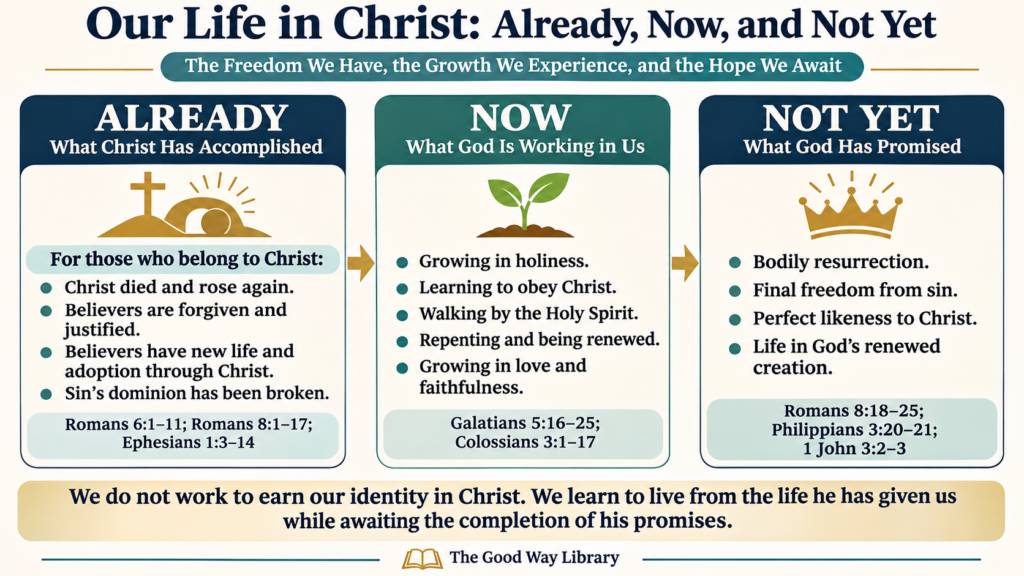
Already Given, Growing Now, and Still to Come
We must understand three different aspects of salvation to avoid confusion.
Some blessings have already been given to those who belong to Christ. Others are presently being worked out through the Holy Spirit. Still others await the return of Jesus and the resurrection of the body.
| Already Given in Christ | Growing Now by the Spirit | Still to Come |
|---|---|---|
| Believers are united with Christ in his death and resurrection (Romans 6:3–11). | Believers actively resist sin and present themselves to God (Romans 6:12–14). | Believers will share fully in bodily resurrection life (Romans 8:11). |
| Believers have received forgiveness, justification, and adoption (Ephesians 1:5–7; Romans 8:1, 15). | God forms holiness, repentance, love, and obedience in his children (Romans 8:12–14). | God’s children will receive their inheritance in its fullness (Romans 8:17–25). |
| The Holy Spirit has been given as God’s seal and pledge (Ephesians 1:13–14). | The Spirit helps believers in weakness and renews their lives (Romans 8:9–16, 26–27). | God’s people will be glorified with Christ, free from sin and death (Romans 8:29–30; Colossians 3:4). |
This distinction is essential.
You do not need to become more justified through a successful week of Christian living. Your righteous standing before God is grounded in Jesus Christ. At the same time, you are not already perfectly mature. God is genuinely working to shape your thoughts, desires, conduct, and relationships.
And you have not yet received everything God has promised. Christians still experience suffering, physical death, and the struggle against sin while awaiting the resurrection.
Colossians 3:1–4 connects these realities. Believers have been raised with Christ in their new spiritual life, their lives are presently hidden with him, and their future glory will be revealed when he appears.
We begin from what Christ has accomplished, walk with him in the present, and look forward to what he will complete.
This gives us both humility and hope. We need not pretend that we have arrived, but we also need not live as though Christ has accomplished nothing until we become better people.
Christians Before Us: Our Hope Rests in the True Christ
Christians across the centuries have defended the identity of Jesus Christ because salvation depends upon who he truly is. The Nicene-Constantinopolitan Creed, associated with the Council of Constantinople in AD 381, confesses the Son’s full deity.
The Athanasian Creed speaks even more forcefully, declaring that whoever desires to be saved must hold to the true Christian faith, especially its confession of the Trinity and of Jesus Christ as both God and man. Its solemn warning emphasizes that these are not minor theological details, but foundational truths about the God who saves us and the Savior in whom we place our faith.
For more historical background, see The Good Way Library’s Nicene Creed and our Athanasian Creed resources.
In the seventeenth century, John Bunyan (1628–1688) struggled deeply with questions about sin, forgiveness, and whether he truly belonged to Jesus Christ. Before becoming a well-known Christian preacher and the author of The Pilgrim’s Progress, Bunyan experienced prolonged periods of spiritual uncertainty and fear. In his autobiographical work, Grace Abounding to the Chief of Sinners, he described his struggles with guilt and his gradual growth in understanding the mercy of God through Jesus Christ. Bunyan learned that assurance could not safely rest upon changing emotions, personal accomplishments, or an imagined ability to become completely free from temptation. Instead, he increasingly directed his attention to the promises of God and the sufficiency of Christ. His experience reminds us that the foundation of our salvation is not the strength of our feelings but the finished work of Jesus Christ. Christians should examine themselves honestly, confess their sins, and continue trusting the Savior who forgives and restores those who belong to him (Romans 8:1; 1 John 1:9).
Learning to Follow Jesus In Dependence
Knowing our identity in Christ should change the way we approach ordinary life.
The goal is not simply to understand Christian doctrine well enough to explain it. We want to know Jesus personally, trust him, and increasingly live according to his teaching.
Listen to Christ Through His Word
In John 8:31–32, Jesus instructs those who have believed him to remain in his Word. Continuing in his teaching is a mark of genuine discipleship.
This is a direct instruction from Jesus.
Romans 6:11–13 gives the apostle Paul’s Spirit-inspired application of the gospel: consider yourself alive to God, refuse sin’s rule, and offer yourself to God for righteous purposes. Likewise, the instruction to confess sin in 1 John 1 comes through apostolic teaching.
These instructions belong together under the authority of Scripture. Jesus commands his disciples to follow and remain in his teaching, and his apostles explain what that obedience means in light of his saving work.
Listening to God begins with receiving Scripture as his authoritative Word. The sixty-six canonical books of the Old and New Testaments provide the written standard by which Christian teaching and spiritual claims are tested.
We should read carefully, consider each passage in its context, pray for understanding, and seek wise Christian counsel where necessary.
The Holy Spirit helps believers understand and respond to Scripture. But not every private thought, feeling, or impression is a direct message from God. Our experiences must be examined in light of Scripture rather than given equal authority with it.
Learn to Depend on Jesus in Everyday Life
You can begin living consciously with Jesus in the circumstances you are already facing.
When you feel anxious: Bring your concerns to your heavenly Father in prayer. Remember that your relationship with him rests upon Christ’s grace, not upon your ability to control every circumstance.
When temptation comes: Remember that sin no longer has rightful rule over you. Ask the Lord for help, recall what Scripture teaches, and choose a wise and obedient response.
When you make a mistake: Confess it honestly rather than hide from God. Receive his mercy through Christ and seek to repair harm where appropriate.
When you feel spiritually weak: Remember that God’s faithfulness is not measured by your emotional strength. Continue receiving his Word, praying, and participating in the fellowship of his people.
When you experience progress: Give thanks to God rather than treating your improvement as evidence of personal superiority. The Holy Spirit is the source of genuine spiritual growth.
These are not techniques that guarantee a particular feeling. They are simple ways of turning toward the living Christ in faith.
You are not trying to persuade Jesus to come near through your religious effort. You are learning to live in dependence upon the Savior who has brought his people near to God and given them his Spirit.
Let Grace Become Encouragement for Others
Understanding our new life in Christ should also shape the way we treat other people.
You may know another Christian who feels defeated by repeated failure, burdened by guilt, or afraid that God has abandoned them. You can offer patient encouragement.
Perhaps you could read a portion of Romans 8 together, listen to their concerns, or remind them that forgiveness is grounded in Jesus Christ rather than personal spiritual performance.
Do not claim to know another person’s heart or promise assurance apart from genuine faith in Christ. Instead, point them toward the trustworthy Savior revealed in Scripture.
You may also encourage someone through prayer, practical kindness, or helping them connect with a healthy Christian congregation.
We do not need to wait until the final lesson of this course to begin loving others. As we receive the grace of Christ, we become increasingly able to share his truth and compassion.
For the Discipler: Walking Through This Step Together
Before You Meet | Read Romans 6:1–14, Romans 8:1–17, and 1 John 1:5–2:2. Prepare to explain the difference between what Christ has accomplished, what the Spirit is forming now, and what awaits resurrection. Review the Good Way Romans 6 commentary, particularly its Walkthrough and Leading sections. Pray for wisdom to discuss assurance without minimizing sin or creating unnecessary fear.
During the Meeting | Read Romans 6 together before opening the commentary. Follow Paul’s argument in order: union with Christ first, then the commands to consider, resist, and present oneself to God. Use the three-column table to distinguish completed salvation, present growth, and future glory. Invite the learner to explain forgiveness, adoption, and assurance in ordinary language. Allow time for questions and prayer.
What to Watch For | Some learners believe God’s acceptance depends on their recent behavior. Others may assume grace makes repentance unnecessary. Address both concerns biblically and gently. Do not require intimate confessions, promise sinless perfection, or pronounce certainty about another person’s salvation. Persistent anxiety, serious distress, abuse, or addiction may require appropriate pastoral and qualified professional support.
Before Moving Forward | Invite the learner to explain why obedience follows grace rather than earns it. Confirm that they understand how confession differs from self-condemnation and why assurance rests in Christ. If substantial questions remain, revisit the passages without pressure. Prepare to explore daily dependence upon Jesus in Step Four.
Discuss Together
Read Romans 6:1–14 again before discussing these questions. If you are studying with a discipler, answer them together. You do not need to complete every question in one meeting.
- What Christ Has Accomplished: According to Romans 6:1–11, what has happened to believers through Jesus’ death and resurrection? Why does Paul explain these truths before giving commands?
- Freedom From Sin: What does it mean to be freed from sin’s dominion? How is this different from claiming that Christians will never sin again?
- The Foundation of Assurance: According to Romans 8, what has God done that gives believers confidence when they experience guilt, fear, or uncertainty?
- Confession and Forgiveness: How does 1 John 1:5–2:2 explain both the seriousness of sin and the continuing sufficiency of Jesus Christ?
- Grace and Acceptance: What would you say to a Christian who believes God only accepts them after a particularly good week of prayer, Bible reading, or obedience?
- Assurance and Self-Examination: How can Christians trust Christ’s promises while continuing to examine their lives honestly? What distinguishes genuine assurance from using grace as an excuse to avoid repentance?
Put It Into Practice
These responses are opportunities to receive God’s Word and live according to it. They are not measurements of your spiritual worth.
Remember What Is True in Christ
Read Romans 6:1–14, Romans 8:1–17, and Colossians 3:1–4 again during the coming week. Using the three-column table from this lesson, write one truth already given to believers in Christ, one area where the Holy Spirit is presently forming obedience, and one promise that awaits future fulfillment.
Consider how these truths shape your understanding of your identity in Christ. When your feelings, circumstances, or struggles seem to contradict God’s promises, return to Scripture and remind yourself of what He has declared to be true.
If you have a discipler, discuss your observations together and consider how these biblical truths can strengthen your daily walk with Christ.
Bring Your Struggles Honestly Before God
Spend time considering whether you tend toward unnecessary self-condemnation or careless assumptions about God’s grace. Do you sometimes question your standing before God because of your struggles? Or do you occasionally excuse sinful behavior because you know that salvation is a gift?
Bring these concerns honestly before God in prayer. Ask Him to strengthen your confidence in Christ while also teaching you to walk in obedience. If you need to confess wrongdoing or seek to repair harm, consider a truthful and safe response. Determine to pray to God every day for these concerns until your next discipleship meeting.
You may discuss these matters with a trusted Christian or your discipler, but you are not required to disclose private details to complete this lesson. The goal is to grow in truth, repentance, and dependence upon Christ.
Encourage Another Person With Gospel Hope
Think of someone who may be discouraged, fearful, struggling with guilt, or spiritually weary. Spend time praying for that person and asking God to help you demonstrate Christ’s love through your words and actions.
If appropriate, offer to read part of Romans 8 or do Romans Road together, share a biblical promise, or simply listen with patience and compassion. Consider how the truths you have studied about grace, assurance, and new life in Christ might encourage someone facing difficulties.
The purpose is not to produce a particular response or demonstrate your own spiritual maturity. It is to begin putting God’s grace into practice by loving others and pointing them toward the hope found in Jesus Christ.
If You Are Studying Alone
You can complete this lesson meaningfully without a discipler. Read the assigned passages, write your answers to the discussion questions privately, and work through the three-column exercise. Consider sharing what you learn with a trustworthy Christian when the opportunity arises.
If questions about salvation or assurance continue troubling you, consider speaking with a faithful pastor or mature Christian. You do not need to manufacture an emotional experience or force yourself into certainty.
Continue seeking healthy Christian fellowship. God’s gift of new life is personal, but he also calls his people to worship, learn, pray, and grow together.
Suggested Prayer
Father in heaven,
Thank you for the grace you have shown through your Son, Jesus Christ. Thank you that salvation does not depend upon my ability to make myself righteous, but upon what Jesus has accomplished through his death and resurrection.
Teach me to understand what it means to be alive in Christ. Help me trust your promises rather than measure your love by my changing feelings or my recent successes and failures. When I struggle, remind me of your faithfulness. When I sin, lead me to honest repentance and renewed trust in your mercy.
Holy Spirit, help me resist what dishonors God and increasingly live according to the new life you have given. Where I have failed, lead me to repentance without despair. Where I have become careless, give me humility and a renewed desire to obey.
Help me know Jesus more deeply, trust him in ordinary circumstances, and encourage others with the hope of his gospel. Keep my heart fixed on Christ as I grow, and strengthen my hope in the resurrection and the life to come.
In Jesus’ name, amen.
Scripture to Remember
Romans 6:11 (WEBU)
Thus consider yourselves also to be dead to sin, but alive to God in Christ Jesus our Lord.
Try to remember this verse throughout the week. Its purpose is not to make you ignore temptation or pretend that you have become perfect. It reminds you that your relationship with sin and with God has changed through Jesus Christ.
As you learn the verse, consider the meaning of each part. Christ has broken sin’s dominion, and you are called to live before God as someone who belongs to the risen Lord.
Continue Studying With Good Way
The following resources will help you study these biblical teachings in greater depth. Begin with Scripture itself, then use these commentaries to clarify the text and consider its application.
- Romans 6 Commentary: Dead to Sin, Alive to God | Begin here for a deeper explanation of union with Christ, baptism, freedom from sin’s rule, and the relationship between grace and obedience. The Walkthrough of verses 1–14 is especially useful for understanding this lesson’s central passage.
- Romans 8 Commentary: Life in the Spirit | Explore God’s promises concerning freedom from condemnation, the indwelling Holy Spirit, adoption, assurance, and future resurrection. Pay special attention to verses 1–17 and the later discussion of Christ’s intercession and God’s enduring love.
- Ephesians 1 Commentary: Chosen, Sealed, and Exalted | Study the spiritual blessings God gives through Christ, including redemption, forgiveness, adoption, and the Holy Spirit’s seal. This chapter provides a broader understanding of the believer’s identity within God’s saving purpose.
- 1 John 1 Commentary: Fellowship in the Light | Learn how fellowship with God involves truthfulness, repentance, and reliance upon the cleansing blood of Jesus. This commentary is especially helpful for understanding why confession remains part of Christian life without becoming an effort to earn salvation again.
The Good Way Library’s commentaries are intended to serve your study of Scripture, not replace it. After reading an explanation, return to the biblical passage and consider how its teaching directs you toward Jesus Christ.
Before the Next Step
You have now considered one of the most important foundations of Christian discipleship. Those who belong to Jesus are not trying to create a new spiritual identity through religious effort. Christ has already acted for them through his death and resurrection.
They are forgiven, welcomed into God’s family, and given the Holy Spirit. They are also called to continue growing, confessing sin, resisting temptation, and living faithfully before God.
There is much still to learn, and none of us has reached final perfection. But the Christian life begins with God’s grace, continues through his grace, and looks forward to the glory he has promised.
Before Step Four, read John 15:1–17.
In that passage, Jesus describes himself as the true vine and his followers as the branches. We have learned what it means to have life in Christ. Our next question is how we continue living in conscious dependence upon him.
How do we remain close to Jesus during ordinary days? How do prayer, Scripture, obedience, and the Holy Spirit’s work belong together? What does it mean to abide in Christ when we feel weak, distracted, or spiritually distant?
These questions lead us into Step Four: Abide in Me.
The Christian life is not merely a life changed by something Jesus accomplished in the past. It is also a life lived today in fellowship with the risen Savior. And because you belong to him, you are invited to keep walking with him.
Partner With The Good Way Library
The Good Way Library is supported entirely by everyday readers like you. If this resource has helped you grow in your understanding of God’s Word and the Christian faith, please consider supporting this work with a one-time or monthly gift. Please also pray for our ministry and help us spread the word by sharing The Good Way Library with your church, friends, and family. Together, we can expand completely free access to faithful biblical teaching and help strengthen shared understanding and unity across the Christian church.