
Step 8: Put Off the Old, Put On the New | Growing in Holiness Through Christ
The Good Way Discipleship Course | Step 8 of 12
Repentance and Holiness From Grace
Learning to put off the old and put on the new is an essential part of following Jesus Christ. The Christian life involves genuine change in how we think, speak, respond to temptation, treat others, and live before God. Yet this transformation does not begin with our ability to improve ourselves. It begins with the new life God has given to those who belong to Jesus.
In our previous lessons, we explored salvation through grace, our identity in Christ, abiding in him, Scripture, prayer, and the transforming work of the Holy Spirit. Now we will consider what that new life means when we encounter temptation, destructive habits, anger, dishonesty, and struggles within our relationships.
The goal is not to become acceptable to God through flawless behavior. We are learning to live according to what Christ has accomplished, turning away from sin and responding to his grace through the Holy Spirit. This is the biblical meaning of Christian repentance and growing holiness.
The Central Truth: Because believers belong to Jesus Christ, they are called to put away their former sinful ways, receive renewal through God’s truth, and increasingly live in righteousness and holiness. Repentance is not an attempt to earn salvation, but a faithful response to the new life Christ has given.
Begin With Scripture
Primary Reading: Ephesians 4:17–32 (WEBU)
Before continuing, open your Bible and read the entire passage. Paul explains how Christians are to leave behind their former way of life and live according to the new identity they have received through Jesus Christ.
As you read, pay attention to three important questions:
- The former life | What attitudes, desires, and behaviors does Paul tell Christians to leave behind?
- The new life | What does it mean to learn Christ, be renewed in our thinking, and put on the new man?
- The practical response | How should this transformation affect honesty, anger, work, speech, kindness, and forgiveness?
Read the passage a second time, noticing that Paul does not simply condemn sinful behavior. He also explains the good conduct that should replace it.
Companion Readings:
- Romans 6:11–14 | Paul teaches believers to consider themselves alive to God in Christ and no longer surrender themselves to sin’s rule.
- Colossians 3:1–17 | Paul connects the believer’s new identity with putting sinful practices to death and clothing oneself in compassion, humility, forgiveness, and love.
Additional Reading: 1 John 1:5–2:2 | John explains why Christians must acknowledge their sins honestly and continue depending upon Jesus Christ for forgiveness and cleansing.
These passages reinforce one another. Ephesians explains the practical shape of renewed Christian living, Romans grounds obedience in union with Christ, Colossians describes the character of the new life, and 1 John teaches how believers should respond when they sin.
Why Christian Holiness Begins With Grace
Remember What God Has Already Accomplished
Before examining Paul’s commands in Ephesians 4, we must understand where they appear in the letter.
Ephesians begins by explaining the extraordinary blessings God gives through Jesus Christ. Paul describes believers as redeemed through Christ’s blood, forgiven by grace, and sealed with the promised Holy Spirit (Ephesians 1:3–14). He later explains that God makes spiritually dead sinners alive with Christ and saves them by grace through faith (Ephesians 2:1–10).
Paul also teaches that Jesus has reconciled believers to God and brought people from different backgrounds together into one body. In Ephesians 4:1–16, he calls Christians to preserve their Spirit-given unity and grow toward maturity under Christ, the head of the church.
Only after establishing these truths does Paul turn toward the particular behaviors Christians must abandon and the new conduct they should pursue.
God’s saving grace comes first. The call to holiness follows from the life and identity believers have received in Christ.
This order matters. We do not put away sinful behavior to convince God to adopt us. Those who genuinely belong to Christ have already been welcomed through his grace, and the Holy Spirit is transforming the way they live.
The Old Way of Life No Longer Defines Us
In Ephesians 4:17–19, Paul describes the former way of life associated with humanity’s alienation from God. He speaks of futile thinking, darkened understanding, hardened hearts, and desires that lead toward impurity and greed.
Paul’s description is serious because sin affects more than outward behavior. It also distorts what people believe, desire, value, and pursue. A person who places personal advantage above truth may begin justifying dishonesty. Someone who regards resentment as a form of strength may gradually become controlled by anger.
Paul is not condemning an ethnicity or claiming that every non-Christian behaves identically. Many of his original readers were Gentiles themselves. His concern is the spiritual condition and former patterns of life from which believers have been rescued.
The problem begins deeper than individual actions. A heart turned away from God produces distorted thinking, and that thinking influences the choices that follow.
These patterns can become deeply familiar, but familiarity does not make them good. Paul calls believers to recognize that they no longer belong to their former way of life.
Learning Christ Changes Everything
In Ephesians 4:20–21, Paul explains that his readers have not learned Christ according to the sinful patterns he has just described. Instead, they have received the truth found in Jesus.
This language is important because Paul does not merely say Christians have learned different religious rules. He speaks about learning Christ.
To become his disciple is to receive the truth about him, belong to him through faith, and increasingly live according to his teaching. Christian transformation is therefore connected directly to the person of Jesus, not simply to our desire to become more respectable people.
Paul then describes three connected aspects of this transformation in Ephesians 4:22–24:
- Put off the old man | Reject the former way of life and its deceptive, corrupting desires.
- Be renewed in your mind | Allow God’s truth to reshape your understanding, values, and judgments.
- Put on the new man | Live according to the new humanity God has created in righteousness and holiness.
The language of putting off and putting on resembles changing garments. Yet Paul’s teaching is more than a picture of changing personal habits. The old and new humanity also concern the kind of people Christians have become together through Christ.
The former life damages relationships through falsehood, hostility, selfishness, and impurity. The new life builds a community characterized by truth, generosity, kindness, and love.
Christian holiness is learning to live consistently with the new life Christ has already given.
This does not mean every sinful habit immediately disappears at conversion. Believers continue to grow, repent, receive correction, and learn obedience throughout their lives. Christ’s saving work is complete, but our present transformation is still underway.
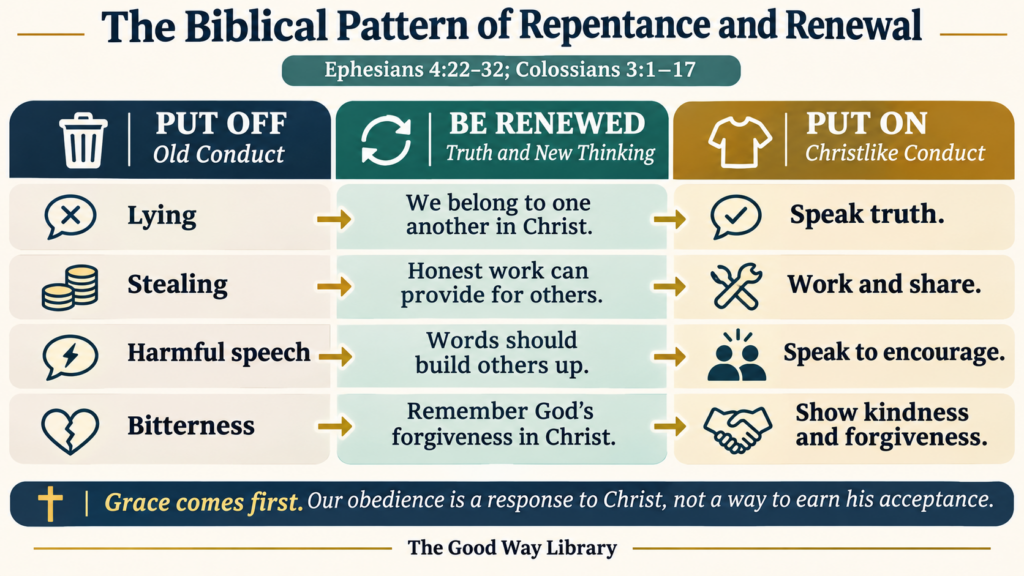
Putting Off the Old and Putting On the New in Everyday Life
Beginning in Ephesians 4:25, Paul applies the new life to ordinary situations involving speech, work, anger, relationships, and forgiveness.
An important feature of his teaching is that rejecting sin is joined to pursuing righteousness. Christians are not simply told to stop doing wrong. They are taught how their conduct should be redirected toward what honors Christ and blesses others.
Replace Falsehood With Truth
Ephesians 4:25 commands believers to put away falsehood and speak truthfully with one another.
Paul explains that Christians are members of one another. Dishonesty therefore does more than violate an individual moral rule. It damages relationships within the body of Christ and undermines the trust that should characterize Christian fellowship.
Falsehood can take many forms. It may involve an outright lie, a misleading explanation, exaggeration intended to impress others, or withholding important facts to manipulate someone. These behaviors may appear advantageous in the moment, but they can cause lasting harm.
The positive command is truthfulness. Christians should become people whose words can be trusted, even when honesty is uncomfortable or costly.
This does not mean every person is entitled to every private detail of our lives. Wisdom, confidentiality, and appropriate boundaries remain important. Speaking truthfully does not require disclosing information that someone has no right to demand.
Jesus likewise teaches the importance of truthful speech in Matthew 5:33–37. His followers should become known for honesty rather than deception or manipulative promises.
The old pattern is dishonesty for personal advantage. The new pattern is truthfulness that strengthens trust.
Respond to Anger Without Giving Sin Control
In Ephesians 4:26–27, Paul recognizes the danger of anger. He instructs believers not to allow anger to become sinful and warns against giving the devil an opportunity.
Anger itself is not always evidence of wrongdoing. We may experience understandable anger when confronted with injustice, betrayal, cruelty, or serious harm. Even so, anger can quickly become destructive when it begins controlling our words and decisions.
A person may respond to anger through insults, threats, revenge, prolonged bitterness, or attempts to punish someone emotionally. Such responses may feel justified in the moment, but they can damage relationships and lead to further sin.
Paul’s warning about not letting the sun go down on our wrath emphasizes the urgency of addressing anger responsibly. It does not establish a requirement that every conflict must be resolved before bedtime, regardless of circumstances or safety.
Sometimes the wisest immediate response is to stop an argument, establish distance, pray, and seek appropriate help before continuing a difficult conversation.
Jesus addresses anger in Matthew 5:21–26. He warns against contemptuous hostility and teaches the importance of taking reconciliation seriously. His words call us to examine our hearts rather than assuming that avoiding physical violence is sufficient.
Christians should therefore learn to recognize anger, refuse destructive responses, and seek truth and peace where doing so is appropriate and safe.
The old pattern allows anger to govern our conduct. The new pattern responds with self-control, truth, and a willingness to seek peace.
Replace Taking With Honest Work and Generosity
Ephesians 4:28 gives another practical example of Christian transformation.
Paul instructs the person who previously stole to stop stealing and work honestly. Yet the command does not end with simply earning an honest living. He also teaches that the person should be prepared to share with someone in need.
This is a powerful picture of the new life in Christ. The former pattern was taking what belonged to another person. The new pattern involves honest labor and a willingness to give.
The transformation reaches beyond avoiding punishment or maintaining a respectable reputation. It redirects the person’s conduct from selfish gain toward the good of others.
Not everyone is physically able to work, and people experience different economic circumstances. Paul is not suggesting that poverty, illness, or unemployment automatically reflects spiritual failure. His concern is integrity, responsible conduct, and generosity according to the opportunities God provides.
Those who belong to Christ should seek to handle work, money, possessions, and other people’s property honestly. Where possible, they should also look for ways to help those in need.
The old pattern takes for personal advantage. The new pattern practices integrity and generosity.
Use Words That Build Others Up
Ephesians 4:29 addresses the way Christians speak. Paul forbids corrupt speech and calls believers to use words that build others up according to their needs.
Speech can cause tremendous harm. A cruel remark, humiliating joke, false accusation, or repeated insult can leave lasting damage. Christians are not immune to these temptations, especially during disagreements or moments of frustration.
But Paul teaches that our words should serve the good of others.
This does not mean Christians must avoid difficult truths or speak only in pleasant language. Sometimes love requires honest correction, a firm boundary, or a serious conversation about harmful behavior. The question is whether our speech is truthful, appropriate, and directed toward what is good rather than toward humiliation or manipulation.
Paul immediately connects this instruction with the Holy Spirit in verse 30. He warns believers not to grieve the Spirit of God, through whom they have been sealed for the day of redemption.
The Holy Spirit is not an impersonal force. He is God, present and active within believers, forming holiness and strengthening Christ’s church. Our conduct matters because it should agree with the life he is producing.
The old pattern uses words to injure or control. The new pattern speaks truthfully in ways that strengthen others.
Replace Bitterness With Kindness and Forgiveness
Paul concludes Ephesians 4 by commanding believers to put away bitterness, wrath, anger, outcry, slander, and malice.
These attitudes and actions can gradually destroy relationships. Bitterness keeps injuries alive in the heart, while slander and hostility allow those injuries to spread through harmful speech and conduct.
The positive alternative appears in Ephesians 4:32 (WEBU):
“And be kind to one another, tender hearted, forgiving each other, just as God also in Christ forgave you.”
Notice the foundation of the command. Paul does not instruct Christians to forgive so that God might finally become willing to forgive them. He points to the mercy God has already shown through Jesus Christ.
For the believer, God’s forgiveness becomes both the example and the reason for extending forgiveness toward others.
Forgiveness is also an act of trusting God’s perfect justice. In Romans 12:19, the Lord declares, “Vengeance belongs to me; I will repay.” God does not ask us to forgive because wrongdoing is unimportant or because those who harm others deserve no consequences. Rather, he commands us to surrender personal vengeance because judgment ultimately belongs to him. When we forgive, we are trusting God’s promise that he will deal justly with every wrong, even when we cannot see when or how he will act. His judgment is infinitely wiser, more righteous, and more complete than any revenge we could pursue ourselves. We do not need to carry the burden of making others pay for what they have done. We can entrust that responsibility to the Lord, knowing that his justice will never fail. Forgiveness does not mean abandoning justice. It means trusting the perfect Judge rather than taking vengeance into our own hands.
This does not make forgiveness effortless. Serious betrayal, long-standing conflict, and painful experiences may require time, prayer, wise counsel, and careful boundaries. Nor does forgiveness mean pretending wrongdoing never occurred. Scripture takes sin seriously, including the need for truth, justice, and accountability.
We will explore Christlike love and relationships more deeply in Step Nine. For now, recognize that forgiveness is an important expression of the new life Christ is forming in his people.
Christian Holiness Includes Our Thoughts and Desires
So far, we have considered honesty, anger, work, speech, and forgiveness. Yet Scripture teaches that holiness also reaches the desires and intentions of the heart.
Jesus makes this especially clear in the Sermon on the Mount.
Jesus Calls Us to Purity of Heart
In Matthew 5:27–30, Jesus teaches that adultery is not merely a matter of outward behavior. He addresses lustful intention and calls his followers to take temptation seriously.
This teaching reveals that holiness involves more than maintaining an acceptable public reputation. God cares about our thoughts, desires, intentions, and the ways we regard other people.
Sexual holiness therefore includes learning to honor others rather than treating them as objects for personal satisfaction. It calls Christians to faithfulness, integrity, and respect for the bodies and dignity of others.
Jesus uses strong imagery about removing what causes someone to stumble. His language emphasizes the seriousness of dealing with sin, not a command to injure one’s body.
A wise Christian response may involve changing habits, avoiding situations that encourage temptation, establishing appropriate boundaries, or seeking accountable support.
Scripture also calls Christians to honor God with their bodies and to turn away from sexual immorality (1 Corinthians 6:18–20; 1 Thessalonians 4:3–8). Biblical sexual holiness is grounded in God’s design for marriage and the human body. Jesus affirms the marriage union of man and woman established in creation (Genesis 2:24; Matthew 19:4–6), and Hebrews 13:4 calls believers to honor marriage and preserve marital faithfulness. This teaching includes chastity outside marriage, faithfulness within marriage, and rejecting adultery, pornography, and the deliberate cultivation of lust. Sexual holiness is not merely avoiding outward misconduct; it also involves bringing our desires and habits under Christ’s lordship.
These commands should be taught with both moral clarity and gospel hope. Sexual sin is serious, but no pattern of past failure places a repentant sinner beyond the forgiveness available through Jesus Christ (1 Corinthians 6:9–11; 1 John 1:9). Believers are called to confession, repentance, wise boundaries, and growing self-control through the Holy Spirit. At the same time, victims of sexual abuse must never be blamed for sins committed against them, and no disciple should be pressured to disclose intimate details to a mentor. Christian holiness calls us to truth, purity, and love, while always remembering that salvation rests upon God’s grace rather than moral performance.
The goal is not to cultivate shame or fear of ordinary human experience. It is to learn to honor Christ in both our inward desires and outward actions.
Christian holiness is not merely avoiding visible wrongdoing. It involves allowing God’s truth to reshape what we love and pursue.
Renewing the Mind Through God’s Truth
Colossians 3:1–17 closely parallels the teaching in Ephesians 4. Paul reminds believers that their lives are hidden with Christ in God, then calls them to put sinful conduct to death and put on Christlike character.
He identifies practices such as sexual immorality, evil desire, greed, anger, malice, and dishonesty. In their place, he calls Christians to compassion, kindness, humility, patience, forgiveness, and love.
The pattern is consistent with Ephesians: believers are called to live according to their new identity in Christ.
This transformation involves learning to recognize the false promises behind temptation. Sin often offers something that appears desirable, such as comfort, control, pleasure, revenge, approval, or escape from discomfort. Yet those promises can conceal serious consequences for ourselves and others.
Scripture helps us recognize what is true. Prayer keeps us dependent upon God, and wise Christian fellowship provides encouragement and appropriate accountability.
As we continue receiving Christ’s Word and walking by the Holy Spirit, our desires and judgments are increasingly shaped by what pleases God.
How to Respond When Temptation Comes
Temptation is a normal part of the Christian struggle. Experiencing temptation does not automatically mean someone has sinned, and believers should not assume that a difficult struggle proves they do not belong to Christ.
Jesus himself was tempted, yet remained without sin (Hebrews 4:14–16). Nevertheless, temptation must be taken seriously. We should not cultivate desires that draw us away from God or place ourselves carelessly in circumstances that encourage disobedience.
The following pattern can help you think biblically when facing temptation:
- Recognize the temptation | Identify what you are being drawn toward. Be honest about the desire, thought, or behavior rather than pretending it is harmless.
- Identify the false promise | Consider what the temptation appears to offer. Is it control, revenge, comfort, pleasure, acceptance, or escape from something difficult?
- Remember what is true in Christ | Return to Scripture. Consider what God says about the temptation and what he has already accomplished for those who belong to Jesus.
- Pray and respond wisely | Ask the Holy Spirit for help, then take an appropriate action. This might involve leaving a tempting situation, choosing truthful speech, establishing a boundary, or seeking support.
- Receive appropriate Christian help | When a struggle is persistent or difficult, seek encouragement from a trustworthy Christian, pastor, or qualified professional as appropriate.
This is not a guaranteed technique for immediate victory. Spiritual growth often involves ongoing struggles, repeated choices, and patient dependence upon God’s grace. The purpose is to help us respond to temptation with truth, prayer, wisdom, and practical obedience.
Romans 6:11–14 provides the deeper foundation. Paul calls believers to recognize themselves as alive to God in Christ and not allow sin to reign over their mortal bodies. The command rests upon what God has already done.
Titus 2:11–14 reinforces the same relationship between grace and obedience. God’s saving grace trains his people to reject ungodliness and live faithfully while awaiting the return of Jesus Christ.
We resist sin because we belong to Christ, and we are meant to overcome with him as he did. Remember that scripture often describes the fight against the flesh as a war. There will be some battles won, and some lost. Our goal is to stay in the fight, and to continue on in the war until Jesus brings us final victory.
Confession, Forgiveness, and Wise Repair
Even as believers grow in holiness, they still experience weakness and failure. Scripture does not teach that becoming a Christian means never sinning again.
The question is how we respond when sin occurs.
Confession Is Returning to the Truth
In 1 John 1:5–2:2, the apostle teaches that God is light and that fellowship with him requires honesty about sin. He warns against claiming to be without sin and reminds believers that God is faithful to forgive and cleanse those who confess their sins.
Confession means agreeing with God about what we have done. It involves abandoning excuses, acknowledging wrongdoing, and turning toward his mercy.
We should not confuse confession with repeatedly punishing ourselves through shame. God does not command believers to manufacture sufficient misery before they may seek his forgiveness.
John continues into chapter 2 by reminding Christians that Jesus Christ is their advocate with the Father. Our confidence rests upon Christ’s saving work, not upon our ability to maintain a flawless record.
This also means confession should be sincere. God’s grace is not permission to embrace a settled pattern of wrongdoing while refusing repentance.
When Christians sin, the faithful response is to acknowledge the truth, turn back toward Christ, and continue learning to live according to his grace.
Repairing Harm When Appropriate
Sometimes repentance requires more than private acknowledgment before God.
If we have lied, we may need to correct the falsehood. If we have taken something belonging to another person, restitution may be appropriate. When our speech has injured someone, we may need to acknowledge the harm and seek forgiveness.
These actions do not purchase God’s mercy. They reflect the seriousness of repentance and a desire to act truthfully toward those affected by our conduct.
However, not every situation should be handled through immediate confrontation or direct contact. Where abuse, threats, coercion, serious manipulation, or other safety concerns are present, a person may need protection, distance, pastoral guidance, or qualified professional assistance.
A survivor of abuse should never be pressured to resume contact with an unsafe person as proof of forgiveness. Likewise, someone who has harmed another person should not use Christian language to demand immediate trust or reconciliation.
Forgiveness, Reconciliation, Trust, and Safety
These four ideas are related, but they are not identical.
- Forgiveness | The Christian response of releasing personal vengeance and refusing to nurture hatred, while entrusting justice to God.
- Reconciliation | The restoration of a damaged relationship, which may require repentance, accountability, changed conduct, and mutual willingness.
- Trust | Confidence based upon a person’s demonstrated reliability, which may need time and consistent evidence to develop.
- Safety | The responsible protection of people from harm, including appropriate boundaries, outside assistance, and separation when necessary.
Christians are called to forgive, but forgiveness does not automatically restore a relationship to its former condition.
Jesus’ teaching in Matthew 5:23–24 calls his followers to take reconciliation seriously. Yet this command must be understood alongside Scripture’s concern for truth, justice, protection of the vulnerable, and responsible conduct.
Repentance should lead us toward genuine love and integrity, not toward exposing ourselves or others to further harm.
Christians Before Us: Repentance and the Pursuit of Holiness
Martin Luther (1483–1546), the German reformer, placed repentance at the very beginning of his famous Ninety-Five Theses in 1517. His first point emphasized that when Jesus commanded people to repent, he intended repentance to characterize the entire Christian life. Luther challenged the idea that repentance could be reduced to particular religious acts or transactions. He also insisted that inward repentance should produce outward changes in conduct. Although his teaching emerged during debates about practices within the medieval church, its central lesson remains important for Christians today. Repentance is not something we complete once and then leave behind. As we continue following Christ, we discover attitudes, desires, and behaviors that must be surrendered to him. A growing Christian is not someone who no longer needs repentance, but someone who increasingly recognizes sin and responds to God’s truth with humility and obedience.
John Owen (1616–1683), an English Puritan pastor and theologian, devoted considerable attention to the believer’s continuing struggle against sin. In his 1656 work Of the Mortification of Sin in Believers, Owen explained that Christians must actively resist sinful desires rather than simply assume those desires will disappear with time. Drawing especially from Romans 8:13 and Colossians 3:5, he emphasized that putting sin to death is not accomplished through human willpower alone, but through the work of the Holy Spirit. Owen also warned against confusing temporary restraint with genuine inward transformation. A person might avoid a particular action while continuing to cherish the sinful desire behind it. His teaching reminds us that Christian holiness reaches deeper than outward appearances. We must examine what we love, what we pursue, and what we allow to govern our hearts. The goal is not merely stronger self-discipline, but a life increasingly surrendered to Christ through the Spirit’s power.
John Newton (1725–1807), the English pastor remembered for writing the hymn Amazing Grace, provides a particularly sobering example of repentance and moral transformation. Before becoming a minister, Newton participated in the transatlantic slave trade and commanded ships transporting enslaved Africans. Although he experienced a significant spiritual awakening in 1748, he continued participating in that trade for several more years. His recognition of its profound evil developed over time, and in 1788 he publicly condemned the trade in his pamphlet Thoughts Upon the African Slave Trade, acknowledging his own responsibility and supporting the movement to end it. His history must not be romanticized or used to excuse delayed obedience. Rather, it demonstrates how deeply people can rationalize wrongdoing, even while considering themselves religious. Genuine repentance requires a willingness to confront uncomfortable truths, acknowledge the harm we have caused, and change our conduct. Newton’s story reminds us that we must remain open to correction throughout our lives, allowing God’s truth to expose even those sins we have learned to justify.
What Is True in Christ
Jesus Christ calls his followers to something far greater than outward religious behavior. He does not simply command us to conceal our weaknesses, manage our reputation, or exchange a few undesirable habits for more respectable ones. He calls us to live truthfully before God, turn away from sin, and pursue the righteousness that reflects his character. Because we belong to Christ, we can confront sin without pretending it is harmless or allowing it to become the defining feature of our lives. Understanding this changes how we approach repentance and the daily pursuit of holiness.
Christ Invites Us to Bring Sin Into the Light
In John 3:19–21, Jesus contrasts those who avoid the light because their deeds are evil with those who come into the light. Sin often encourages secrecy, excuses, and self-deception. We may try to justify our conduct, minimize its consequences, or convince ourselves that God is not concerned about something we would rather keep hidden. Yet Christ calls us to live openly and truthfully before God, even when acknowledging our failures is uncomfortable.
For believers, bringing sin into the light is not an invitation to despair. Hebrews 4:14–16 reminds us that Jesus is our compassionate high priest, who understands temptation and invites us to approach God’s throne of grace for mercy and help. We can confess our sins honestly because our hope rests in him. This does not require publicly revealing every private struggle or disclosing sensitive matters to someone who has not earned our trust. It means refusing to build our spiritual lives upon secrecy, denial, or false appearances. The Christian who brings sin before Christ is not moving away from him, but returning to the Savior who calls us to walk in the truth.
Genuine Repentance Leads to Change, Not Despair
Second Corinthians 7:10–11 makes an important distinction between godly sorrow and worldly sorrow. Both may involve distress over wrongdoing, but they do not lead in the same direction. Worldly sorrow may remain focused upon embarrassment, consequences, or hopelessness. Godly sorrow produces repentance, leading us to acknowledge what is wrong and respond according to God’s truth. The purpose of repentance is not to remain trapped in guilt, but to turn away from sin and toward faithful obedience.
This distinction matters when we recognize repeated failures. A person may become so discouraged by a sinful habit that they begin believing meaningful change is impossible. Another may feel terrible about wrongdoing but remain unwilling to abandon it. Neither response reflects the fullness of biblical repentance. Christ calls us to take sin seriously without surrendering to hopelessness. Genuine repentance involves a changed direction, which becomes visible through appropriate actions over time. We may need to abandon an excuse, accept correction, establish a healthier boundary, or take responsibility for harm we have caused. These responses do not earn forgiveness. They demonstrate that we are learning to respond faithfully to the mercy and truth of God.
Holiness Means Pursuing Christ, Not Merely Avoiding Sin
The Christian life must never become an endless exercise in concentrating upon everything we are trying not to do. In Hebrews 12:1–2, believers are instructed to lay aside what hinders them and the sin that entangles them, while looking to Jesus as they run the race before them. Notice that the passage gives us more than something to reject. It gives us someone to pursue. The goal of holiness is not simply to become a person who sins less, but to become a person whose life increasingly reflects Jesus Christ.
This changes our understanding of spiritual growth. We do not pursue honesty merely because lying is forbidden, but because truthfulness honors the Lord we love. We do not reject bitterness simply to feel more peaceful, but because Christ calls us to love others. We do not resist temptation merely to maintain a better reputation, but because knowing and pleasing Jesus is worth more than the temporary promises of sin. As Paul expresses in Philippians 3:7–14, knowing Christ is of surpassing value, and the Christian continues pressing forward toward him. Our deepest desire should not be merely to escape the old life, but to know and follow the Savior who has called us into the new.
These truths give Christian repentance both seriousness and hope. Sin should never be excused, but neither should it become the center of our attention. Jesus Christ is the center of Christian holiness. As we come honestly before him, receive his correction, and learn to desire what pleases him, our lives increasingly reflect the transformation described in Ephesians 4. We are learning not simply to leave the old behind, but to walk faithfully in the new.
Learning to Follow Jesus As A New Creation
All of this material is part of learning to live in fellowship with Jesus Christ.
Respond to Sin With Truth and Grace
When we recognize a sinful pattern, we can bring it honestly before him. We can acknowledge the temptation, ask for the Holy Spirit’s help, return to Scripture, and seek to respond according to God’s truth.
For example, a person who recognizes a tendency toward harsh speech may pause before responding in anger. Instead of trying to win an argument through insults, they can ask Christ for wisdom and choose words that are truthful and constructive.
Someone who has acted dishonestly may take responsibility and correct the falsehood. Another person who struggles with resentment may begin by praying honestly, refusing retaliation, and seeking wise help with appropriate boundaries.
These responses may appear ordinary, but Christian faithfulness is often expressed through ordinary choices shaped by God’s grace.
Let Repentance Shape Our Witness
The gospel also gives repentance an outward purpose. When we turn away from harmful conduct, other people may experience greater honesty, kindness, fairness, and care.
Our witness to Jesus Christ should not consist only of what we say about him. It should also be reflected in the way we treat others.
Holiness becomes visible when Christ’s grace reshapes our conduct toward God and neighbor.
For the Discipler: Walking Through This Step Together
This lesson concerns repentance, holiness, and practical Christian conduct. Help the learner understand that Paul’s commands arise from the new identity believers receive through Christ. The purpose is not to investigate private sins or measure moral performance, but to connect biblical truth with wise and faithful responses.
Before You Meet | Read Ephesians 4:17–32, Romans 6:11–14, and Colossians 3:1–17. Review the Good Way Ephesians 4 commentary, especially its Walkthrough and Leading sections. Prepare to explain how the commands to put away sinful behavior and pursue righteousness flow from grace.
During the Meeting | Read Ephesians 4 together and trace the movement from learning Christ to renewed thinking and changed conduct. Give a personal example of someone you know or yourself. Invite the learner to select one paired command, such as replacing dishonesty with truth or harmful speech with encouragement. Discuss a practical response without requiring personal disclosure.
What to Watch For | Do not pressure the learner to reveal intimate details involving sexuality, trauma, addiction, or personal sin. Never require reconciliation with an unsafe person or minimize abuse, serious distress, or addiction. This is a step that is most helpful for a mature Christian to handle. If the discipler is also relatively newer to the faith, or even just with limited experience in this category, it can help for them to first counsel a trustworthy mature Christian to learn examples from.
Before Moving Forward | Ask the learner to explain why repentance is a response to grace rather than payment for God’s acceptance. Consider one safe, realistic example of putting away an old pattern and pursuing a Christlike alternative. Prepare to explore love and service more fully in Step Nine.
Discuss Together
Read Ephesians 4:17–32 again as needed. Discuss these questions openly with your discipler, or consider them in writing if you are studying independently.
- Learning Christ: What does Paul mean when he says believers have learned Christ in Ephesians 4:20–21? How is knowing and following Jesus different from merely learning religious rules or trying to become a better person?
- Putting Off the Old and Putting On the New: What does Ephesians 4:22–24 teach about putting off the old man, renewing our minds, and putting on the new man? Why must genuine Christian transformation involve both inward desires and outward behavior?
- Repentance and Grace: Why does repentance remain necessary throughout the Christian life when salvation is received by grace through faith? How can we take sin seriously without falling into legalism or despair?
- Replacing Sinful Patterns: Which examples in Ephesians 4:25–32 stand out to you most? How might putting away sinful behavior and practicing Christlike conduct change our speech, work, anger, or relationships?
- Forgiveness and Reconciliation: How should Christians respond to anger, bitterness, or unforgiveness? What distinguishes extending forgiveness from restoring trust or pursuing reconciliation, especially when serious harm or unsafe circumstances are involved?
- Growing in Holiness Together: How do the Holy Spirit, Scripture, and mature Christians help us grow in holiness? How can a discipler encourage repentance and obedience without becoming controlling or requiring private disclosures?
Put It Into Practice
Study One Paired Command
Return to Ephesians 4:25–32 and select one example in which Paul commands believers to reject a sinful pattern and pursue a better response.
Write down the old pattern, the Christlike alternative, and the reason Paul gives for the change. Consider how this teaching might shape an ordinary situation involving speech, work, anger, or relationships.
If you have a discipler, discuss your observations together. Keep the emphasis upon understanding Scripture and depending upon Christ rather than creating another spiritual performance goal.
Practice Truthfulness or Wise Repair
Consider whether there is an appropriate and safe opportunity to practice one of Paul’s positive commands this week.
You might correct a misleading statement, offer an appropriate apology, speak encouragement to someone who needs it, or act more honestly in a situation where exaggeration would be easier.
If a situation involves serious conflict, abuse, coercion, or other safety concerns, do not initiate contact merely to complete this exercise. Prayer, careful reflection, and appropriate pastoral or professional counsel may be the wiser response.
The purpose is not to force reconciliation. It is to respond faithfully to God’s Word with wisdom and love.
Bring a Temptation Before Christ
When you recognize temptation during the coming week, consider what it appears to promise and compare that promise with the truth of Scripture.
Bring the concern before Jesus in prayer. Ask for the Holy Spirit’s help, consider an appropriate boundary or response, and seek trustworthy assistance if the struggle requires additional support.
You may also choose to encourage another person through truthful, kind speech. This is one practical way to allow your growing holiness to bless someone else.
If You Are Studying Alone
You can work through this lesson independently by reading Ephesians 4, Romans 6, and Colossians 3, then answering the discussion questions in writing. Consider one paired command and reflect upon how the new life in Christ should shape your conduct. However, ongoing struggles are often easier to address with appropriate Christian encouragement. If possible, remain connected to a healthy local church and speak with a trustworthy mature Christian when questions arise. Make sure to take the encouragements to put this into practice seriously, as that is where you will find the most growth if doing this study alone. For serious sin patterns involving addiction, abuse, trauma, or mental-health concerns, seek qualified support rather than assuming private study alone must resolve the difficulty.
Suggested Prayer
Heavenly Father, thank you for the new life you give through Jesus Christ. Thank you that my acceptance before you rests upon his saving grace rather than my ability to live perfectly. I recognize that I still struggle with sinful thoughts, desires, words, and actions, and I need the continuing work of your Holy Spirit. Help me put away the patterns that do not belong to the life you have given me. Renew my thinking through your Word, teach me to recognize temptation, and give me wisdom to respond with truth and obedience.
Where I have harmed others, help me acknowledge what is wrong and pursue appropriate repair. Where I struggle with anger, bitterness, or unforgiveness, teach me to respond with humility, kindness, and wisdom. Keep me from pride when I succeed and despair when I fail. Above all, help me remain close to Jesus Christ, trusting his grace and allowing his life to shape the way I love and serve others. In the name of Jesus Christ, amen.
Scripture to Remember
Ephesians 4:22–24 (WEBU)
“that you put away, as concerning your former way of life, the old man that grows corrupt after the lusts of deceit, and that you be renewed in the spirit of your mind, and put on the new man, who in the likeness of God has been created in righteousness and holiness of truth.”
These verses summarize the central teaching of Step Eight. Paul calls believers to reject their former way of life, receive renewal in their thinking, and live according to the new humanity God has created in Christ.
As you reflect on this passage, remember that the command to pursue holiness comes after the saving work of God. We are learning to live from Christ’s grace, not trying to earn it.
Continue Studying With The Good Way Library
The following free resources provide deeper biblical teaching on repentance, holiness, forgiveness, and Christian transformation. Read the assigned Scripture passages first, then use these commentaries to strengthen your understanding.
- Ephesians 4 Commentary: Unity in Christ | Explore Paul’s teaching about Christian maturity, the former and new ways of life, truthful speech, anger, honest work, and forgiveness. The Walkthrough and Leading sections are especially useful for this lesson.
- Colossians 3 Commentary: Life Hidden with Christ | Examine how believers put sinful practices to death and put on compassion, kindness, humility, forgiveness, and love. This chapter closely reinforces the central teaching of Ephesians 4.
- Romans 6 Commentary: Dead to Sin, Alive to God | Study how union with Christ establishes the foundation for resisting sin and living in newness of life. This commentary helps preserve the proper relationship between salvation by grace and Christian obedience.
- 1 John 1 Commentary: Fellowship in the Light | Learn why Christians must acknowledge sin honestly, walk in the light, and continue depending upon God’s forgiveness and cleansing through Jesus Christ.
Before the Next Step
Christian holiness is not simply the removal of undesirable behavior. It is the continuing transformation of people who have received new life through Jesus Christ.
In Ephesians 4, we have seen that believers are called to put away their former ways, receive renewal in their thinking, and live according to the new humanity created by God. This transformation reaches our speech, anger, honesty, work, desires, relationships, and willingness to forgive.
We have also learned that repentance does not earn God’s acceptance. For those who belong to Christ, salvation rests upon his completed saving work, while the Holy Spirit continues forming holiness and obedience.
Before continuing, consider one area in which Scripture has helped you recognize the difference between an old pattern and a Christlike response. Bring that area before God in prayer and remain open to wise Christian encouragement.
Next Reading: John 13:1–35
In this passage, Jesus washes his disciples’ feet and teaches them the meaning of humble service. He then gives them a command to love one another as he has loved them.
Step Nine: Love as Jesus Loves will explore how Christlike maturity becomes visible through humility, generosity, forgiveness, mercy, service, and faithful love toward others.
Putting off the old and putting on the new is not merely about what we leave behind. It is about learning to live in the love and holiness of Jesus Christ.
Partner With The Good Way Library
The Good Way Library is supported entirely by everyday readers like you. If this resource has helped you grow in your understanding of God’s Word and the Christian faith, please consider supporting this work with a one-time or monthly gift. Please also pray for our ministry and help us spread the word by sharing The Good Way Library with your church, friends, and family. Together, we can expand completely free access to faithful biblical teaching and help strengthen shared understanding and unity across the Christian church.