
Step 5: Know Christ Through His Word
The Good Way Discipleship Course | Step 5 of 12
Read, Understand, Remember, and Obey Scripture
Central Truth: Scripture is God’s authoritative Word, given to make us wise for salvation through faith in Jesus Christ and equip us for faithful living. We read the Bible to know the Lord, understand his truth, trust his promises, and learn to obey him.
Growing Closer to Jesus Through Scripture
Imagine receiving a letter from someone you deeply love. You would not read it simply to collect information. You would pay attention because the person matters to you. Their words would help you understand their character, their thoughts, and what they wanted you to know.
Our relationship with Jesus Christ is far greater than any human relationship. Yet the illustration helps us understand something important about Scripture. The Bible is not merely a religious textbook. It is God’s written Word, through which he reveals himself, his saving purposes, and the life he calls us to live.
In the previous step, we learned what it means to abide in Christ, depending upon him rather than attempting to produce spiritual life through our own strength. Now we will consider one of the most important ways we continue in that relationship: receiving, understanding, remembering, and obeying his Word.
Perhaps you have read the Bible for years. Perhaps you have never finished an entire biblical book. Some passages may seem beautiful and comforting, while others leave you confused. You might even wonder whether you are understanding what God intended or simply finding meanings that appeal to you.
These are worthwhile questions. Learning how to study the Bible faithfully begins with humility and a desire to know the God who has spoken. You do not need to become a biblical scholar before you can know Jesus, but you should learn how to listen carefully to what Scripture actually teaches.
Begin With Scripture
Before continuing, open your Bible and read the three passages below. If you are studying with a discipler, consider reading them aloud together. These are the core readings for Step 5.
- 2 Timothy 3:14–17 | Principal Passage: Read these four verses, then examine the surrounding chapter. Notice what Paul says about remaining faithful, the Scriptures Timothy learned, and the purpose of God’s Word.
- Psalm 119:9–18 | Companion Reading: Observe the writer’s affection for God’s Word. Notice how seeking God, remembering his commandments, praying for understanding, and resisting sin belong together.
- James 1:22–25 | Companion Reading: Consider the difference between hearing God’s Word and putting it into practice. Pay attention to the illustration James uses to explain obedience.
Keep these passages available as you study. Later in this lesson, we will practice interpreting James 1:19–27 in its larger context.
Main Teaching: Understanding God’s Word
Scripture Comes From God and Carries His Authority
Our principal passage comes from Paul’s second letter to Timothy, a younger Christian leader whom Paul had helped prepare for ministry. Paul writes during a period of hardship and opposition, warning Timothy about false teaching and the corruption that can hide behind outward religion.
In 2 Timothy 3:1–9, Paul describes people who pursue selfish desires while maintaining an appearance of godliness. He then contrasts their conduct with the teaching, faith, patience, love, and perseverance Timothy had witnessed in Paul’s life. Timothy must remain faithful to what he has received rather than follow those who distort the truth.
That is the setting of 2 Timothy 3:14–17.
Paul reminds Timothy that he has known the sacred Scriptures since childhood. Earlier in the letter, Paul identifies Timothy’s mother, Eunice, and grandmother, Lois, as women of sincere faith (2 Timothy 1:5). Their example helps us appreciate the importance of faithful instruction passed from one generation to another.
Paul then explains why Scripture deserves such confidence. In 2 Timothy 3:16, he describes Scripture as God-breathed.
This means the Bible is not simply a collection of human reflections about God. Its ultimate source is God himself, who communicated his truth through human authors.
These authors wrote in different centuries, circumstances, languages, and literary forms. Moses recorded God’s dealings with his covenant people. David and other psalmists composed songs and prayers. The prophets proclaimed God’s messages, while the Gospel writers and apostles testified to Jesus Christ and instructed his church.
Their personalities and historical settings remain evident in their writings. Yet through these human authors, God gave his inspired Word. Therefore, Scripture possesses an authority greater than our opinions, emotions, customs, or the teaching of any individual Christian.
We do not approach Scripture merely to decide which teachings we happen to like. We approach it to discover what God has revealed and to respond faithfully.
The 66 canonical books of the Old and New Testaments form the inspired and authoritative Scriptures for Christian doctrine and life. Other ancient religious writings may help us understand history, but they do not possess the same authority.
Because Scripture comes from God, we should receive it with both confidence and humility. Difficult passages deserve careful study, not careless dismissal or invented explanations.
The Bible Tells One Unfolding Story Centered on Christ
In 2 Timothy 3:15, Paul makes an important connection between Scripture and salvation. The sacred writings Timothy had learned could make him wise for salvation through faith in Jesus Christ.
Timothy’s childhood Scriptures were primarily the Old Testament. Yet Paul understood that God’s earlier revelation belonged to the larger story of redemption fulfilled in Jesus.
To understand this connection, we need to recognize the Bible’s central storyline.
- Creation: God creates the world and humanity in his image. Everything begins with his goodness, authority, and purposes.
- The Fall: Humanity rebels against God. Sin brings guilt, corruption, suffering, and death into human experience.
- Promise and Covenant: God unfolds his saving purposes through Abraham, Israel, the Law of Moses, the kingdom, and the prophets. His promises reveal both humanity’s need and his continuing faithfulness.
- Jesus Christ: The eternal Son of God becomes truly human without ceasing to be truly God. Through his obedient life, sacrificial death, and bodily resurrection, he accomplishes the saving work humanity could never accomplish.
- The Church and the Holy Spirit: The risen Christ gathers his people, gives the Holy Spirit to believers, and sends his church to proclaim the gospel and make disciples.
- Resurrection and New Creation: Jesus will return, raise the dead, judge rightly, and bring God’s redemptive purposes to their promised completion.
This is the larger story in which individual Bible passages belong.
The Old Testament prepares for Christ through its history, covenants, promises, sacrifices, wisdom, and prophetic expectations. We should not force every verse into a hidden prediction about Jesus. Instead, we first understand each passage in its original setting and then consider how it belongs to God’s unfolding revelation.
In Luke 24:25–27, the risen Jesus explained how Moses and the prophets testified to the Messiah and his suffering. In John 5:39–40, Jesus confronted people who carefully examined Scripture but refused to come to him for life.
That warning remains important. A person can memorize biblical information, defend Christian teachings, and recognize familiar passages without personally trusting Jesus Christ.
The Bible’s central purpose is not merely to tell us how to behave. It reveals the God who saves and directs us toward the Savior we need.
As you study Scripture, look beyond isolated facts to the God who is revealing himself. Learn what the passage means, but also consider how it contributes to your understanding of Christ, his saving work, and his purposes for his people.
Scripture Teaches, Reproves, Corrects, and Trains Us
After explaining Scripture’s divine origin, Paul identifies four ways it benefits God’s people in 2 Timothy 3:16–17.
- Teaching | Scripture tells us what is true. It reveals God’s character, explains salvation, establishes sound doctrine, and instructs us in faithful Christian living.
- Reproof | Scripture exposes error and sin. Sometimes it corrects a mistaken belief; at other times, it confronts attitudes or behaviors we have tried to excuse.
- Correction | Scripture does more than identify what is wrong. It directs us back toward truth, repentance, and responsible obedience.
- Instruction in Righteousness | Scripture trains us to live in ways that honor God. Through its teaching, the Holy Spirit shapes our understanding, character, and conduct over time.
Paul concludes by explaining that God’s Word equips the person who belongs to God for every good work. Notice the order: Scripture is not given so that we can earn salvation through religious achievement. It equips God’s people to live according to the grace they have received.
Consider a familiar situation. You have an argument with someone close to you, and you feel justified in speaking harshly because they treated you unfairly. Then you read James 1:19–20, which connects careful listening, restraint in speech, and control of anger with righteous conduct.
Scripture teaches you something about godly behavior. It may expose your desire to retaliate, correct the belief that hurtful speech becomes acceptable when you are upset, and direct you toward patience and self-control. A faithful response might involve prayer, a more careful conversation, or an appropriate apology.
You are not attempting to purchase God’s acceptance through better behavior. You are learning to live according to his Word, depending upon the Holy Spirit for wisdom and strength.
This is how biblical truth becomes part of ordinary Christian living.
How to Study the Bible in Context
One of the most common mistakes in Bible study is taking a sentence out of its setting and assigning it a meaning the author never intended.
A verse may sound encouraging by itself but communicate something more specific when read with its surrounding paragraph. A command addressed to one historical person may not be a command for every Christian. Likewise, a biblical narrative may describe someone’s actions without approving them.
God’s Word deserves careful reading.
The Bible contains history, law, poetry, wisdom, prophecy, Gospel narratives, letters, and other forms of writing. Each should be understood according to its literary purpose. We should not interpret a poetic image exactly as we would a historical description, nor should we treat every statement in a narrative as a command.
We must also distinguish between promises made to particular historical audiences and promises given more broadly to God’s people. For example, God’s instructions to Joshua concerning Israel’s entrance into the promised land belong to a specific historical and covenant setting. We can learn about God’s faithfulness from Joshua without claiming that every detail of Israel’s commission is personally addressed to us.
A helpful principle is to understand what a passage meant in its biblical context before deciding what it means for our lives today.
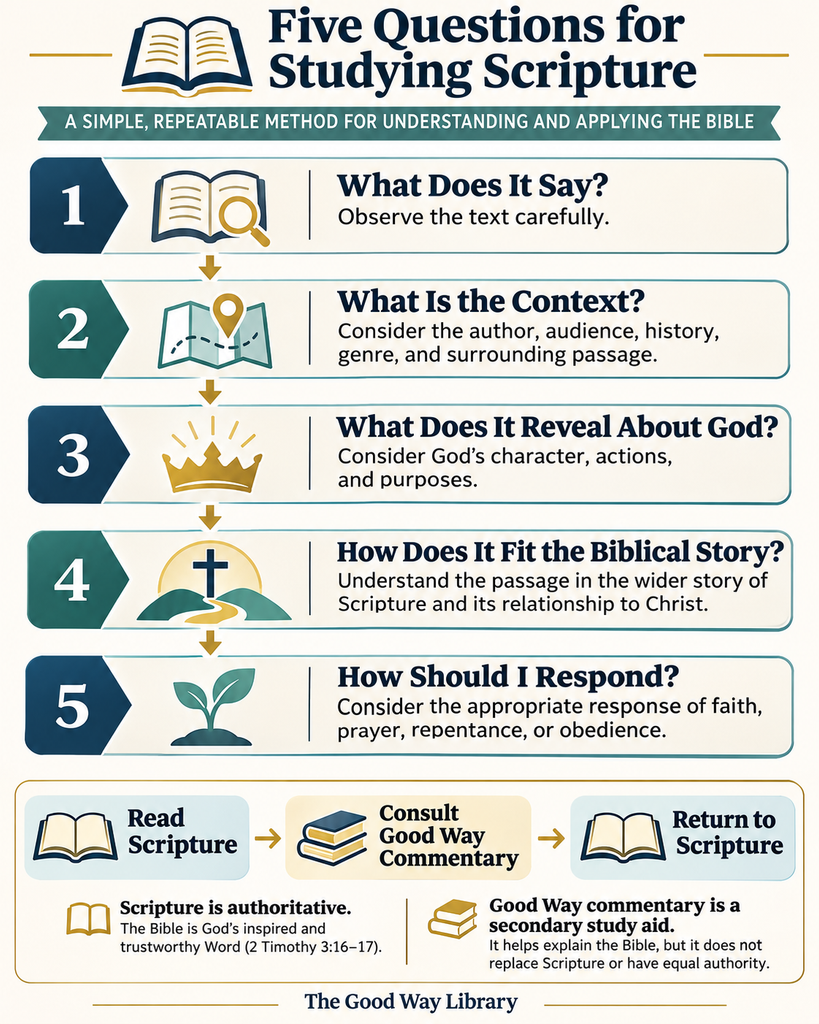
Five Questions to Ask When Reading Scripture
You do not need complicated tools to begin studying the Bible well. Start with an open Bible, a willingness to learn, and five questions.
- What does the passage say? Read the entire paragraph or narrative. Notice the main subject, repeated words, important statements, promises, warnings, and commands. Avoid rushing to application before understanding what is written.
- What is the context? Consider who wrote the passage, its original audience, and its purpose. Read what comes before and after it, and pay attention to the kind of literature you are studying.
- What does this reveal about God? Look for what the passage teaches about God’s character, his saving purposes, Jesus Christ, the Holy Spirit, and his relationship with humanity. Let the text determine its own emphasis.
- How does this fit the larger biblical story? Consider how the passage relates to creation, covenant, redemption, and God’s purposes fulfilled in Christ. Follow genuine biblical connections rather than inventing symbolic meanings.
- What response does this truth call for? Does the passage invite faith, repentance, worship, gratitude, obedience, wisdom, or loving service? Sometimes the response is to trust a promise. At other times, a concrete change in conduct is necessary.
These questions are not a formula that makes every difficult passage instantly understandable. Rather, they provide a reliable starting point for careful reading. With practice, they will become increasingly natural.
Let’s Practice: Studying James 1:19–27
Now we will apply these five questions to a real passage.
Open James 1:19–27 and read the entire section before continuing. Then follow the explanation below, comparing each observation with the biblical text.
1. What does the passage say?
James instructs believers to listen carefully, exercise restraint in anger, receive God’s Word humbly, and put what they hear into practice. He compares a person who hears without obeying to someone who looks into a mirror and then forgets what was seen. Finally, he connects genuine religion with controlled speech, care for vulnerable people, and moral integrity.
The passage is not merely about listening to sermons. It concerns receiving God’s truth in a way that changes how we live.
2. What is the context?
James writes to believers facing various trials and temptations. Earlier in chapter 1, he urges them to seek God’s wisdom and explains that every good gift comes from him. Verse 18 describes God giving his people new birth through the word of truth.
That context matters because the call to obey follows an explanation of God’s gracious work. James is not teaching that people can manufacture new birth by doing enough good deeds. He is explaining what it looks like to receive God’s Word sincerely.
The following chapter develops this further by addressing favoritism and explaining how genuine faith becomes evident through action.
3. What does the passage reveal about God?
God cares about the truthfulness and integrity of his people. He is concerned not only with what we profess but also with how we speak, respond to others, and treat those who are vulnerable.
His Word exposes our needs, instructs our conduct, and directs believers toward a life shaped by his character.
4. How does this relate to Christ and the larger biblical story?
James identifies himself at the beginning of the letter as a servant of God and of the Lord Jesus Christ. His teaching agrees with Jesus’ commands concerning sincere obedience, mercy, truthful speech, and love for our neighbors.
James also connects obedience with the new life God gives. His instructions therefore belong to the response of those who have received God’s truth, not to an alternative path of earning salvation.
5. What response does this truth call for?
Perhaps you struggle with interrupting others or reacting quickly when frustrated. Scripture calls you toward careful listening and restraint. Perhaps someone vulnerable needs practical help, and James reminds you that genuine Christian faith must not neglect mercy.
Or perhaps you have repeatedly heard a biblical teaching while refusing to consider what obedience would require.
The appropriate response is not simply to underline another verse. It is to turn toward Christ, acknowledge the truth, ask for his help, and act faithfully.
It is important to recognize that Scripture communicates God’s unchanging truth, yet that same truth may speak to different people in different ways. One person may be convicted of a particular sin, while another may find encouragement, direction, or a call to serve others. Our circumstances, struggles, and stages of spiritual growth differ, so the same passage may reveal different areas of our lives that need attention. The meaning of Scripture does not change with the reader, but its application can vary. We should therefore remain open to the fullness of what God teaches through his Word, rather than assuming that what stands out to us personally is all the passage has to offer.
This exercise demonstrates how a passage becomes clearer when its words, context, theology, and application are considered together. You can use the same approach in Genesis, Psalms, the Gospels, Paul’s letters, and the rest of Scripture.
Reading, Hearing, Studying, and Remembering God’s Word
Christians encounter Scripture in several complementary ways. Each helps us give attention to God’s truth, although none should become a test of our spiritual worth.
- Reading | Regular reading helps us become familiar with biblical books and understand how their messages unfold. Reading complete chapters and books guards against an understanding built entirely on isolated verses.
- Hearing | Scripture is also meant to be received in Christian fellowship. Public reading, faithful preaching, church teaching, and conversations with mature believers help us learn from one another.
- Studying | Careful study allows us to examine context, compare related passages, investigate difficult questions, and develop a more accurate understanding of what God has revealed.
- Meditating | Biblical meditation means thoughtfully returning to God’s Word, considering its meaning, and reflecting on how it directs our faith and conduct. It is an intentional focus on revealed truth rather than an attempt to receive hidden messages.
- Memorizing | Remembering Scripture helps us carry God’s truth into ordinary circumstances. A familiar passage can remind us of Christ’s promises, correct a mistaken attitude, or strengthen us when we face temptation.
Psalm 119:9–18 brings several of these practices together. The psalmist seeks God, treasures his Word, meditates on his instructions, and asks for understanding. In verse 11, he explains that hiding God’s Word in his heart serves the purpose of resisting sin.
Then, in verse 18, he asks God to open his eyes so that he may understand the wonderful things in his law. The writer desires Scripture while recognizing his dependence upon God for understanding.
That is a healthy attitude for every disciple.
You may benefit from reading a chapter each morning. Someone else may listen to Scripture while traveling to work, while another person may need to read a shorter passage because of family responsibilities, illness, or reading difficulties.
The particular schedule matters less than receiving God’s Word faithfully. If you miss a day, simply return to Scripture without treating the interruption as a spiritual failure.
A manageable reading rhythm that repeatedly brings you to Christ is more valuable than an ambitious schedule that becomes a source of pride or condemnation.
For those who would like a longer reading journey, The Good Way Bible Challenge provides an optional plan for reading all 66 canonical books in approximately one year. You may adjust the pace to fit your circumstances.
You can also continue reading through the Gospel of John alongside this course. Its account of Jesus’ life, teachings, death, and resurrection provides a wonderful way to become more familiar with the Savior. Returning to John 13–17 is especially helpful as you learn to abide in him.
Scripture, the Holy Spirit, and Wise Discernment
How does God guide us through Scripture?
The Holy Spirit works within believers, helping them understand and respond to God’s truth. In John 14:26, Jesus promised the apostles that the Holy Spirit would teach them and bring his words to their remembrance. This promise has particular significance for the apostolic witness to Christ.
More broadly, the New Testament teaches that the Spirit opens believers’ understanding, convicts them of sin, strengthens faith, and forms Christian character. As we read Scripture prayerfully, we depend upon his work rather than assuming we can produce spiritual understanding through intelligence alone.
However, we must distinguish the authority of Scripture from our personal impressions.
For example, while reading a passage about forgiveness, you might become convinced that you need to apologize for something you said. That conviction may agree with biblical teaching and deserve a thoughtful response.
But suppose you experience a strong inner impression that God wants you to abandon important responsibilities or make a major financial decision immediately. The intensity of that feeling does not establish that God has spoken a new command.
God’s written Word is the authoritative standard by which teachings, impressions, and proposed actions must be examined.
We can pray for wisdom, study relevant biblical principles, consider the circumstances, and seek guidance from trustworthy Christians. The Holy Spirit forms wisdom and discernment without requiring us to treat every feeling as divine revelation.
This is one reason Christian fellowship matters. In Acts 17:10–12, the Bereans examined the Scriptures while receiving Paul’s teaching. Their example reminds us that even respected teachers should be heard with a willingness to test what is taught against God’s Word.
That includes pastors, disciplers, websites, and commentaries.
A trustworthy Christian mentor should welcome thoughtful biblical questions rather than demand unquestioning agreement.
Christians Before Us: Scripture in the Early Church
From its earliest generations, the Christian church placed great importance on reading, understanding, and obeying Scripture. Around AD 155, Justin Martyr described Christian worship in his First Apology, chapter 67. Believers gathered to hear readings from the apostolic accounts and the prophets, followed by instruction, encouragement, and prayer. Justin also described the congregation’s care for widows, orphans, and others in need. Scripture was not merely something to hear; its teachings were meant to shape how Christians lived and treated others.
In the fourth century, John Chrysostom, a prominent preacher in the early church, encouraged ordinary Christians to study Scripture for themselves. In his Homilies on the Gospel of John, he urged believers to read upcoming Gospel passages at home, consider their meaning, and identify anything they found difficult to understand. They would then arrive at church better prepared to learn. His example reminds us that careful Bible study is not reserved for pastors, scholars, or theologians. Every Christian should seek to grow in understanding God’s Word.
Augustine of Hippo (354–430) provides another powerful example. In his Confessions, Book VIII, chapter 12, Augustine described a moment of deep spiritual struggle when he opened the apostle Paul’s letter to the Romans and read Romans 13:13–14. The passage confronted the sinful desires and divided loyalties that had troubled him. Rather than treating Scripture as interesting information, Augustine recognized the need to turn decisively toward Christ. His experience illustrates that understanding God’s Word should lead us toward repentance, faith, and obedience, not merely greater knowledge.
These historical examples demonstrate that Christians have long approached Scripture as something to read, understand, remember, and live out in their life. As you develop your own habits of Bible study, remember that the goal is not simply to know more about the Bible, but to know Christ more deeply and live faithfully according to his Word. Study carefully, learn alongside other believers, and ask God to help you put what you discover into practice.
What Is True in Christ
Jesus Christ did not treat Scripture as merely a collection of religious teachings or moral advice. Throughout his ministry, he affirmed its authority, explained its meaning, and demonstrated what faithful obedience looks like. When tempted in the wilderness, Jesus responded with Scripture (Matthew 4:1–11). After his resurrection, he explained how the Law of Moses, the Prophets, and the Psalms pointed toward him and God’s unfolding plan of redemption (Luke 24:44–47). If we want to understand Scripture rightly, we must learn to approach it with the same reverence for God’s Word that Jesus demonstrated.
The Bible also teaches that Scripture ultimately directs us toward Jesus Christ. In John 5:39–40, Jesus confronted people who diligently searched the Scriptures but refused to come to him for life. They possessed considerable biblical knowledge yet failed to recognize the Savior to whom the Scriptures testified. This is an important warning for every Christian. We can memorize passages, explain doctrines, and become familiar with biblical history while neglecting the personal faith, repentance, and obedience to which God’s Word calls us. Knowing the words of Scripture should lead us toward deeper knowledge of the Lord who is revealed through them.
This is all closely connected to what the Bible calls wisdom. Biblical wisdom is more than knowing facts or remembering verses. It involves understanding God’s truth and learning to apply it faithfully to the circumstances, decisions, and challenges of everyday life. A wise person does not merely ask, “What does Scripture say?” but also, “How should this truth shape what I think, say, and do in this situation?” Proverbs repeatedly connects wisdom with the fear of the Lord, discernment, and righteous living (Proverbs 1:7; 2:6–9). As we grow in our understanding of God’s Word and learn to apply it with discernment, we grow in biblical wisdom.
Learning to Follow Jesus Through The Word
Remain in Christ’s Word
In John 8:31, Jesus says:
“If you remain in my word, then you are truly my disciples.”
Jesus speaks these words during a conversation about belief, truth, and freedom from slavery to sin. Remaining in his Word means continuing to receive his teaching, trust him as Lord, and allow his truth to govern our lives.
Likewise, in Luke 6:46–49, Jesus challenges those who call him Lord while refusing to do what he says. He compares the person who hears and obeys his words to a builder whose house rests on a secure foundation.
These are teachings from Jesus himself. He calls his followers to remain in his Word and put his commands into practice.
The apostles reinforce these commands in their writings. James teaches believers to become doers of the Word, while the example of the Bereans encourages careful examination of Scripture. These are apostolic instructions and examples that support Jesus’ teaching.
For a disciple, obedience is not separate from trusting Christ. It is a response that flows from genuine faith and dependence upon the Holy Spirit.
Bring God’s Word Into Ordinary Life
Imagine beginning your workday already burdened by responsibilities. You read a passage concerning God’s faithfulness and take a moment to consider its meaning. Instead of rushing away, you pray about the responsibilities ahead and entrust them to the Lord.
Later, a difficult conversation arises. You remember Jesus’ teaching about love or James’ instruction concerning speech and anger. You ask God for wisdom, listen carefully, and choose words that are truthful rather than unnecessarily hurtful.
That evening, perhaps another passage brings an attitude or decision to your attention. You may need to confess a sin, seek counsel, repair something where appropriate and safe, or simply thank God for his faithfulness.
This is how Scripture begins to shape ordinary Christian life. You are bringing God’s truth into the circumstances in which you actually live.
Some days this will feel natural. Other days it will require patience, effort, and repentance. Your confidence, however, rests in Christ and the Spirit’s continuing work rather than in the quality of your performance.
Help Someone Else Encounter Scripture
There is also an outward purpose to knowing God’s Word.
Imagine that a friend is discouraged and asks why Christians have hope. You do not need to deliver an elaborate theological presentation. Instead, you might invite them to read a short passage from the Gospel of John with you.
Read it together and ask what it reveals about Jesus. Listen to their questions and explain what you understand. If you encounter something difficult, be willing to admit that you need to study further.
This is a simple expression of Christian love and witness. The goal is not to demonstrate that you know more Scripture than another person. It is to help someone encounter the truth of God’s Word and consider the person of Jesus Christ.
You are not responsible for producing another person’s conversion. You are responsible for speaking truthfully, showing love, and faithfully using the opportunities God provides.
Even before completing this course, you can begin encouraging others through Scripture.
For the Discipler: Walking Through This Step Together
Before You Meet | Read 2 Timothy 3:14–17, Psalm 119:9–18, and James 1:22–25. Review the surrounding argument of 2 Timothy 3, then study James 1:19–27 using the five questions taught in this lesson. Consult the Good Way commentary afterward, particularly its Walkthrough and Leading sections. Prepare to explain how Scripture’s authority serves knowing Christ and faithful living rather than simply accumulating religious information.
During the Meeting | Begin by asking about the learner’s experience with the Bible without assuming familiarity with biblical books or vocabulary. Read the principal passage together and identify Paul’s reasons for trusting Scripture. Then open James 1:19–27 and work through the five reading questions conversationally. Let the learner make observations before offering your explanations. If time allows, consult the Good Way commentary together and compare its interpretation with the text. Note where things spoke to both of you differently than what we may have addressed.
What to Watch For | Some learners may feel discouraged by reading difficulties, unfamiliar terms, or previous experiences of being judged for limited biblical knowledge. Others may confuse a personal impression with a passage’s meaning or apply an isolated promise without considering its context. Respond patiently, avoid overwhelming them with references, and never equate reading speed with holiness. Welcome honest questions and seek trustworthy pastoral guidance when necessary.
Before Moving Forward | Invite the learner to explain 2 Timothy 3:14–17 in their own words and demonstrate the five questions on a short passage. Discuss a manageable way to continue reading Scripture, and identify one appropriate response of faith or obedience. The goal is growing understanding and trust, not passing an examination or maintaining a perfect reading schedule.
Discuss Together
Read the relevant passages again as needed. Discuss these questions openly with your discipler, or consider them in writing if you are studying independently.
- Applying Biblical Context: Suppose someone quotes Philippians 4:13 and claims it guarantees that Christians will succeed at anything they attempt. How would you examine Philippians 4:10–13 to determine what Paul actually means? How could you explain the passage accurately and graciously to that person?
- The Authority of Scripture: What does 2 Timothy 3:14–17 teach about the origin and purpose of Scripture? Why are its divine inspiration and authority essential for faithful Christian living?
- Understanding Biblical Context: Why is it important to consider a passage’s historical setting, surrounding verses, intended audience, and literary context? How can these details help prevent misunderstandings?
- Hearing and Obeying Scripture: What does James 1:19–27 teach about putting God’s Word into practice? How should genuine faith shape our speech, compassion, and obedience without turning good works into a means of earning salvation?
- The Bible’s Larger Story: How do creation, the fall, God’s promises, Jesus Christ’s saving work, and the hope of new creation fit together? Why does understanding this larger story help us interpret individual passages?
- Reading to Know Christ: What is the difference between reading Scripture merely as an obligation and reading it to know and follow Jesus? How can we develop consistent habits without attempting to earn God’s approval?
- Handling Difficult Passages: How should Christians respond when they encounter Scripture they struggle to understand or accept? What roles should careful study, prayer, comparison with other passages, and wise counsel play?
- Sharing Scripture With Others: How can you use Scripture to encourage someone who is struggling or growing in faith? What should you consider when selecting a passage, explaining it accurately, and pointing someone toward Jesus Christ?
Put It Into Practice
Deeply Study a Passage for Yourself
Read James 1:19–27 again before opening a commentary. Use the five questions from this lesson to examine the passage, writing a few notes or discussing your observations with your discipler.
Afterward, open the Good Way James 1 commentary linked below. Read its Walkthrough for verses 19–27 and compare the explanation with what you observed. Notice one place where your understanding was confirmed, deepened, or corrected, then return to the biblical text to evaluate what you learned.
Establish a Manageable Scripture-Reading Rhythm
Consider when and how you can give meaningful attention to God’s Word. You may continue reading through the Gospel of John, begin another biblical book, or use a reading plan such as The Good Way Bible Challenge.
Choose a realistic approach that encourages understanding rather than hurried completion. As you read, ask God to help you know Christ more faithfully and respond to what you learn.
Invite Someone to Read Scripture With You
Think of someone who might appreciate reading a short biblical passage together. It could be a fellow Christian, a friend exploring Christianity, or someone who has recently asked a question about faith.
If the opportunity is appropriate, invite them to read a short selection from the Gospel of John. Listen carefully, ask thoughtful questions, and allow Scripture to guide the conversation. If no such opportunity is currently available, pray for someone you would like to encourage and remain attentive to ways you can lovingly serve them.
If You Are Studying Alone
You can practice everything in this lesson independently. Read the principal passage and both companion readings, then work through the James 1 exercise before consulting the Good Way commentary. Make sure to write out your answers to the discussion questions.
You may find it helpful to keep a notebook with the five study questions and write a short response after each passage. When something remains confusing, read the surrounding chapters, seek reliable Christian teaching, and consult a pastor or mature believer when possible.
Remember that Scripture is also meant to be received within the worship and fellowship of the church. Independent study is valuable, but it should not become permanent separation from Christian community. Iron sharpens iron.
Suggested Prayer
Father in heaven, thank you for giving us your Word and revealing yourself through Jesus Christ. Thank you that we do not have to discover salvation through our own wisdom or effort. You have made your saving purposes known through Scripture and fulfilled your promises in your Son.
Teach me to approach the Bible with humility, attention, and faith. Help me understand what you have spoken, recognize what is true, and receive correction without fear or pride. By your Holy Spirit, give me wisdom to understand your Word and a willing heart to obey it.
Keep me from treating Scripture as merely a collection of facts or religious obligations. When I encounter difficult passages, give me patience. If your Word exposes sin, lead me to honest repentance. When it reveals your promises, strengthen my confidence in your faithfulness.
Above all, help me to know Jesus more deeply, trust his finished work, and live according to the grace you have given. As I learn, help me share your truth with others in humility, love, and patience. In the name of Jesus Christ, my Savior and Lord, amen.
Scripture to Remember
2 Timothy 3:16 (WEBU)
“Every Scripture is God-breathed and profitable for teaching, for reproof, for correction, and for instruction in righteousness,”
Read 2 Timothy 3:16–17 together and consider memorizing both verses.
These verses remind us that Scripture comes from God and equips his people for faithful living. Memorization is not a test of spiritual worth, but a way to carry God’s truth with us throughout ordinary life.
Continue Studying With Good Way
The following resources will help you develop a deeper understanding of Scripture and strengthen your daily Bible reading. Begin with Scripture itself, then use these commentaries and study tools to clarify the text, recognize its central teachings, and apply God’s Word to your life.
- 2 Timothy 3 Commentary: Last Days, Scripture, and Perseverance | Begin here to understand the divine authority, inspiration, and usefulness of Scripture. Pay special attention to verses 14–17, which explain how God’s Word equips believers for faithful Christian living. The Leading section also offers guidance for teaching Scripture to others.
- James 1 Commentary: Trials, Wisdom, and True Religion | Explore the relationship between hearing God’s Word and putting it into practice. The discussion of verses 19–27 is especially helpful for understanding how careful listening, obedience, and genuine faith belong together. Use this commentary to deepen your understanding after completing the lesson’s Bible reading exercise.
- The Book of John Overview: The Son Who Gives Life | Discover the Gospel of John’s structure, historical setting, major themes, and presentation of Jesus Christ. This overview provides a helpful foundation for reading through John during the discipleship course and learning to recognize how Scripture reveals Christ’s identity, teaching, and saving work.
- The Good Way Bible Challenge: Read the Whole Bible in One Year | Develop a consistent Bible reading habit with a structured plan covering all 66 books of Scripture. This optional resource also explains how to use Good Way’s chapter commentaries, summaries, and study features to strengthen your understanding as you read through the Bible.
The Good Way Library’s resources are intended to support your personal study of Scripture, not replace it. As you read, ask God for understanding, examine each passage in its context, and consider how His Word reveals Jesus Christ and teaches you to follow Him faithfully.
Before the Next Step
You have now learned why Scripture matters and how to begin reading it with greater care. God has not given us his Word simply to fill our minds with information. He has revealed his truth so that we may know him through Jesus Christ, grow in faith, recognize error, receive correction, and learn to walk according to his will.
As you continue studying, remember that you are not seeking to earn God’s love through Bible reading. If you belong to Christ, you are learning to receive and live according to the grace already given to you.
Keep your Bible open, ask honest questions, and return to the passages that challenge or encourage you. Seek wisdom from mature Christians, and allow Scripture to direct your attention continually toward Jesus.
But knowing God’s Word also raises another important question: If God speaks to us through Scripture, how should we speak to him?
That is where our next lesson begins.
Step 6: Live With God in Prayer will explore Jesus’ teaching in Matthew 6:5–13. We will learn how to approach our heavenly Father through Jesus Christ, bring our needs before him, worship and thank him, confess our sins, pray for others, and continue in fellowship with God throughout ordinary life.
Before moving forward, read Matthew 6:5–13 and consider what Jesus teaches about sincere prayer.
Our journey continues not with another demand to prove ourselves, but with an invitation to draw near to the God who has already drawn near to us through his Son.
Partner With The Good Way Library
The Good Way Library is supported entirely by everyday readers like you. If this resource has helped you grow in your understanding of God’s Word and the Christian faith, please consider supporting this work with a one-time or monthly gift. Please also pray for our ministry and help us spread the word by sharing The Good Way Library with your church, friends, and family. Together, we can expand completely free access to faithful biblical teaching and help strengthen shared understanding and unity across the Christian church.