
Step 6: Live With God in Prayer
The Good Way Discipleship Course | Step 6 of 12
Communion With the Father Through the Son in the Spirit
Central Truth: Prayer is not a technique for obtaining God’s favor or controlling his decisions. It is honest fellowship with the Father through Jesus Christ, with the help of the Holy Spirit.
Learning how to pray as a Christian begins with Jesus, not with finding impressive words. We pray because the living God has made himself known and invites us to bring our lives before him. We can worship him, ask for wisdom, confess wrongdoing, thank him for his kindness, and remember others in his presence.
Yet prayer can feel difficult. You may wonder what to say, struggle to concentrate, or feel disappointed when circumstances do not change. Perhaps prayer has become a routine you perform without much thought. In this sixth step of The Good Way Discipleship Course, we will learn from Jesus why prayer matters, what to pray, and how to continue trusting God in ordinary life.
Begin With Scripture
Principal reading: Matthew 6:5–13. Read this entire passage before studying the explanation below. Then read Matthew 6:1–18 to see how Jesus connects prayer with giving, fasting, and devotion that seeks the Father’s approval rather than public praise. Matthew 6 belongs to the Sermon on the Mount (Matthew 5–7), where Jesus teaches the character and conduct of those who follow him.
Required companion readings: Open both passages during this step. They are part of the lesson, not merely references to glance over.
- Luke 11:1–13: One of Jesus’ disciples asks him to teach them to pray. Jesus gives a pattern of prayer and explains why his followers can ask persistently, trusting the Father’s goodness rather than trying to wear him down.
- Philippians 4:4–7: Paul calls believers to bring their concerns to God with thanksgiving. His teaching shows how prayer and God’s peace belong together when life remains uncertain.
For further reading, Psalm 27 shows prayer amid fear and longing; John 17 records Jesus praying for his people; and Romans 8:26–27 explains the Spirit’s help in our weakness. If you are reading the Gospel of John throughout the course, continue at a comfortable pace and notice how Jesus speaks with his Father.
Main Teaching: How to Pray as a Christian
1. Come Before the Father, Not an Audience (Matthew 6:5–8)
Jesus begins with two warnings. Some people prayed in public because they wanted others to admire them. Others treated repeated words and lengthy speeches as though these could secure an answer from God. In both cases, attention had shifted from the Father to the person praying.
Jesus tells his followers to pray privately, where there is no audience to impress. He is not forbidding public prayer, since he prayed with others and the early church gathered to pray. He is exposing the desire to use prayer as a religious performance. A person who prays simply and sincerely may be following Jesus more faithfully than someone whose words sound impressive.
Jesus also warns against vain repetition, not every repeated prayer. Repeating the Lord’s Prayer thoughtfully can be valuable; repeating words as a way to manipulate God is not. The reason Jesus gives is wonderfully reassuring: the Father knows what his children need before they ask (Matthew 6:8). Prayer does not inform an uninformed God. It brings us into truthful dependence upon the One who already knows us.
You do not need specialized vocabulary or a particular emotion to begin. You can speak reverently and plainly, trusting God’s character rather than the quality of your sentences.
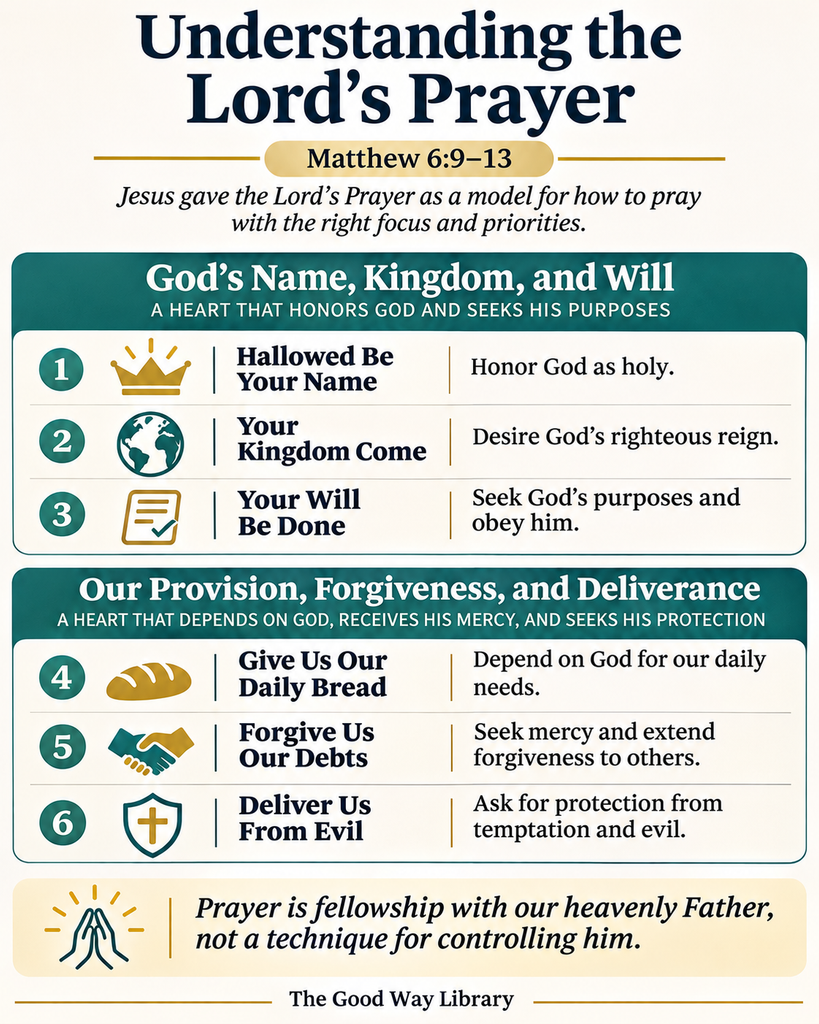
2. Put God’s Name, Kingdom, and Will First (Matthew 6:9–10)
Jesus begins the Lord’s Prayer by teaching his disciples to address God as their heavenly Father. For those who belong to Christ, this is the language of a real relationship established by grace. Yet the Father is also holy and sovereign. We come with both confidence and reverence, knowing he is near to his people without becoming subject to their demands.
The first requests concern God’s name, kingdom, and will. We ask that he be honored, that his righteous reign be known, and that his purposes be accomplished on earth. These requests turn us outward from our immediate concerns and remind us that God’s glory matters more than our preferences. They also invite personal obedience: we cannot sincerely seek his will while deliberately treating his commands as unimportant.
Imagine facing a difficult decision at work or in your family. You can ask God for a good outcome and also ask him to help you act truthfully, love others, and make a wise decision. Prayer brings our desires before God while teaching us to trust his wisdom above our own.
3. Ask for Daily Bread (Matthew 6:11)
Jesus teaches us to ask for the provision we need today. Daily bread points first to ordinary necessities, including food and the means of sustaining life. This is a reminder that our Father cares about daily responsibilities, not only matters we might label spiritual. Work, family needs, financial pressures, and material concerns can all become subjects of prayer.
Asking God to provide does not eliminate the need to work, plan responsibly, seek assistance, or care for others. It acknowledges that every good gift ultimately comes from him. Later in Matthew 6, Jesus calls his followers to seek God’s kingdom rather than let anxiety over tomorrow rule them (verses 25–34). He promises the Father’s care, not an earthly life without hardship or deprivation.
This petition also teaches gratitude. We can thank God for what he has provided while honestly asking for help where needs remain unmet. Trust does not require denying that a problem is real.
4. Seek Forgiveness and Extend Mercy (Matthew 6:12; 6:14–15)
Jesus includes the confession of sin in the prayer. We owe God faithful love and obedience, yet we fall short in thought, word, and action. His language of debts points to our moral obligation before him. We must not hide sin behind religious appearances, nor should we treat confession as a way of earning his mercy.
The Christian’s hope rests in Jesus Christ, who died for sinners and rose again. Those who repent and trust him receive forgiveness by grace. Yet believers continue to struggle with sin and need to confess honestly, turn away from what is wrong, and learn obedience through the Spirit. Confession does not repeat Christ’s sacrifice; it is a truthful return to the Savior whose saving work is sufficient (1 John 1:5–2:2).
Jesus immediately connects God’s forgiveness with our willingness to forgive others. In verses 14–15, his warning is serious: a heart determined to withhold mercy contradicts the life of repentance and forgiveness that he commands. Forgiving others does not purchase salvation, but receiving grace must shape how we treat those who have wronged us.
Forgiveness does not mean pretending harm was acceptable. It does not require restored trust, removed consequences, or contact with an unsafe person. Abuse, violence, and coercion call for protection, appropriate boundaries, accountability, and qualified help. Christian mercy and truthful concern for safety belong together.
5. Ask for Protection and Give God the Glory (Matthew 6:13)
Jesus teaches his followers to ask for protection from temptation and deliverance from evil. He knows that disciples face weakness, sinful desires, and real spiritual opposition. James 1:13 makes clear that God does not tempt people to do evil. We therefore pray for his preserving help, wise judgment, and strength to resist sin, rather than imagining that he delights in leading us toward wrongdoing.
Suppose you expect a conversation that might provoke anger. You can ask God for patience and honesty, then respond responsibly by listening, choosing truthful words, or taking an appropriate pause. Prayer is not a substitute for obedience. It is one way we acknowledge our dependence on the Lord as we seek to obey.
The WEBU concludes Matthew 6:13 with praise of God’s kingdom, power, and glory. Some Bible editions note that ancient manuscript witnesses differ about this closing doxology. Christians have long used these words in worship because they express biblical truth. Whether a church includes them when praying aloud, the petitions themselves direct us to the Father whose reign and goodness deserve our trust.
6. Learn the Many Expressions of Prayer
The Lord’s Prayer gives us a pattern of priorities rather than a rigid script for every conversation with God. Elsewhere, Scripture shows believers praying in joy, fear, sorrow, gratitude, and repentance. These expressions can help us find honest words, but we do not need to include every one of them each time we pray.
- Worship: Praise God for who he is, including his holiness, goodness, faithfulness, and greatness (Psalm 27).
- Thanksgiving: Recognize God’s gifts and respond with gratitude even while bringing him genuine concerns (Philippians 4:4–7).
- Confession: Acknowledge sin truthfully and seek mercy rather than offering excuses (Psalm 51; 1 John 1:9).
- Petition: Ask for wisdom, provision, strength, and help in your own circumstances (Matthew 6:11–13).
- Intercession: Pray for other people, including those in need and those who do not yet know Christ (1 Timothy 2:1–4).
- Lament: Bring sorrow, fear, and painful questions to God without pretending to feel cheerful (Psalm 27; Psalm 13).
Some days you may have much to say; on others, a simple request for help may be all you can express. David’s psalms show that genuine confidence in God can exist alongside fear or grief. Honesty before the Lord is better than performing feelings we do not have.
7. Pray Throughout Ordinary Life and Listen Through Scripture (Luke 11:1–13; Philippians 4:4–7)
Jesus encourages persistent prayer in Luke 11. His example of a midnight visitor and his teaching about a father’s good gifts call disciples to keep asking with confidence in God’s character. Luke concludes this section by emphasizing the Father’s gift of the Holy Spirit. We are not trying to overcome divine reluctance by repeating a request enough times; we are depending upon a good Father.
Longer, unhurried times of prayer and Scripture reading are valuable, but prayer can also accompany your daily responsibilities. You might ask for wisdom before a conversation, thank God during a quiet moment, or pray for patience while caring for a family member. A sentence such as Father, help me act with kindness in this situation can be a sincere expression of faith. Brief prayers need not replace deeper attention to God, and neither should become a measure of spiritual worth.
Listening to God begins with giving careful attention to what he has revealed in Scripture. The Holy Spirit helps believers understand biblical truth, recognize sin, remember Christ’s promises, and grow in wisdom. We can pause after reading, reflect on the passage in context, and ask how to respond. A private feeling or impression, however strong, does not have the authority of Scripture; important decisions also call for sound judgment and appropriate counsel from mature Christians.
Paul’s instruction in Philippians 4 connects prayer and thanksgiving with the peace of God guarding believers in Christ. He does not say that every difficult circumstance will immediately change. Prayer directs us to the Lord whose presence and faithfulness remain when our situation is unsettled.
8. Keep Praying When the Answer Is Difficult
It is painful to ask God for something good and not receive the outcome we hoped for. Perhaps an illness continues, a relationship does not improve, or a burden grows heavier. Scripture does not teach that disappointment automatically means we lacked faith or chose the wrong words. Nor does it authorize us to claim we know God’s hidden reason for every hardship.
Jesus prayed in Gethsemane before his crucifixion, bringing his real suffering before the Father while submitting to the Father’s will (Matthew 26:36–46). Paul repeatedly asked for an affliction to be removed, but received assurance of Christ’s sustaining grace instead (2 Corinthians 12:7–10). These passages teach us to ask boldly without claiming control over the answer. We may continue praying, seek help, receive appropriate care, and ask fellow Christians to support us.
When words are difficult, the Psalms provide prayers of lament, and Romans 8:26–27 teaches that the Holy Spirit helps believers in weakness. Faith does not require pretending that suffering is painless. The Lord welcomes truthful prayer, and our hope rests in his character rather than our ability to understand every circumstance.
Christians Before Us: The Lord’s Prayer Across Generations
From the earliest generations of Christianity, believers treasured the Lord’s Prayer as a guide for both personal devotion and gathered worship. The Didache, an early Christian instructional writing from the first or second century, includes the Lord’s Prayer in chapter 8 and encourages Christians to pray it three times daily. This provides a remarkable glimpse into how early believers organized their lives around prayer. Although Scripture does not require Christians to follow this particular schedule, the practice demonstrates how seriously the early Church took Jesus’ instruction to pray.
Early Christian teachers also devoted considerable attention to the prayer’s meaning. Tertullian, writing around the beginning of the third century, explained the Lord’s Prayer in his work On Prayer, emphasizing how its brief petitions contain profound spiritual teaching. Cyprian of Carthage, writing in the third century, developed these themes further in On the Lord’s Prayer. He especially emphasized that Jesus taught believers to pray “Our Father” rather than merely “My Father.” Prayer is therefore not only about our individual needs but also about our shared life as members of Christ’s Church. When we ask for daily bread, forgiveness, and deliverance from evil, we remember the needs of our brothers and sisters as well as our own.
These ancient writings remind us that we belong to a long fellowship of Christians who have sought to follow Jesus in prayer. Across centuries, cultures, and Christian traditions, believers have continued to pray the words their Savior taught. Their examples can encourage us to develop faithful habits of prayer, whether privately, with our families, or alongside our churches. Yet Scripture remains our final authority, and no particular historical practice should become a requirement Jesus never established. The goal is not simply to repeat familiar words but to approach our heavenly Father with sincere faith, understanding, humility, and love.
What Is True in Christ
Prayer is one of the great privileges of belonging to Jesus Christ. Through him, believers are welcomed into fellowship with their heavenly Father. We do not need to earn God’s attention through impressive words, lengthy prayers, or perfect obedience. Hebrews 4:14–16 teaches that because Jesus is our great high priest, we can approach God’s throne with confidence to receive mercy and grace. This confidence does not come from our spiritual accomplishments but from Christ, who has reconciled us to God.
We also have the help of the Holy Spirit when we pray. Romans 8:26–27 teaches that the Spirit helps us in our weakness and intercedes for God’s people according to his will. There will be times when we struggle to find the right words, feel overwhelmed by our circumstances, or do not know what to ask. In these moments, we can still turn to God. Ask the Holy Spirit to pray for you. Prayer is not a performance in which we must impress him. It is a living expression of our dependence on him. We pray to the Father through the Son, with the help of the Holy Spirit, worshiping the one triune God.
Christ also teaches us to trust the Father’s wisdom rather than demand our preferred outcomes. Jesus himself prayed, “Not my will, but yours, be done” (Luke 22:42). We can bring our needs, fears, desires, and requests to God with confidence that he hears his children. Yet faithful prayer does not guarantee that every request will be granted as we expect. Jesus himself demonstrated this for us to learn form in the garden of Gethsemane. Sometimes God’s answers differ from our desires, and sometimes we must continue praying while we wait. Through prayer, we learn not only to ask God for help but also to surrender our desires to his wisdom and grow in trust and obedience.
If you belong to Christ, you do not have to wait until you feel spiritually strong to pray. You can come to your Father in gratitude, sorrow, confusion, repentance, or joy. If you are still exploring Christianity, you can honestly ask God for understanding as you consider who Jesus is and what he calls you to believe. The purpose of prayer is not to prove how spiritual we are, but to seek God sincerely, depend on his grace, and deepen our fellowship with him.
Learning to Follow Jesus In Prayer
Jesus teaches that prayer is more than speaking words to God. It belongs to a life of faith, trust, humility, and obedience. As we grow in our relationship with Christ, prayer should increasingly shape how we respond to difficulties, treat other people, and carry out our daily responsibilities.
Pray With Sincerity and Trust
In Matthew 6, Jesus gives clear instructions concerning prayer. He teaches His followers to pray sincerely rather than seeking admiration, approach the Father with confidence, forgive others, and seek God’s kingdom and will. His surrounding teaching also calls believers to practice generosity and fasting without seeking public recognition and to trust their heavenly Father rather than being controlled by anxiety.
These teachings remind us that prayer is an expression of our relationship with God, not a religious performance. We can approach Him honestly with our needs, concerns, gratitude, and confession because He is our loving Father. Our confidence rests in Jesus Christ and His saving work, not in the length, frequency, or eloquence of our prayers.
Let Prayer Shape Your Actions
Prayer and practical obedience belong together in the Christian life. When we ask God to help us speak patiently, we should also consider how we will respond when a conversation becomes difficult. When we confess wrongdoing, we should consider whether an appropriate and safe act of repentance or repair is needed.
Likewise, praying for someone who is suffering should encourage us to consider whether we can offer practical assistance. This might involve preparing a meal, providing encouragement, listening compassionately, or helping with an ordinary responsibility.
These actions do not earn God’s favor or guarantee that our prayers will be answered as we desire. Rather, they reflect the work of God’s grace as the Holy Spirit teaches us to love and obey Christ. Prayer draws us toward God, and dependence upon Him should increasingly shape the way we live.
Understand the Place of Fasting
Fasting is an important spiritual discipline that Christians should take seriously. In Matthew 6:16–18, Jesus said “when you fast,” not “if you fast.” Just as he expected his followers to pray, he expected them to fast. Jesus also taught that after the bridegroom was taken away, his disciples would fast (Matthew 9:14–15). The early Church continued this practice, joining fasting with worship, prayer, and seeking God’s direction (Acts 13:2–3; 14:23). Fasting was not an obscure tradition reserved for unusually devoted believers. It was a recognized part of the Christian life.
Biblical fasting involves willingly abstaining from food for a period of time to devote ourselves more intentionally to God. Throughout Scripture, fasting accompanies repentance, humility, earnest prayer, and dependence upon the Lord. By temporarily setting aside a legitimate physical need, we deliberately turn our attention toward our greater spiritual need for God. Fasting reminds us that we do not live by bread alone (Matthew 4:4). It can help us recognize our dependence on earthly comforts, examine our hearts, and seek the Lord with greater seriousness. Christians should therefore be encouraged to make fasting a meaningful part of their spiritual lives rather than neglect it altogether.
However, Jesus also warned that fasting must be sincere rather than a performance for others (Matthew 6:16–18). We do not fast to impress people, earn salvation, or pressure God into granting our requests. We fast because we love him, need him, and desire to seek him more earnestly. Scripture does not prescribe one universal fasting schedule for every Christian, and legitimate medical or nutritional limitations must be respected. Those who cannot safely abstain from food should not endanger their health or disregard medical guidance.
As you grow in discipleship, consider how fasting can become a regular and intentional part of your walk with Christ. If you are medically able, you might begin by setting aside a meal and devoting that time to Scripture, prayer, repentance, and seeking God’s will. Do not neglect fasting simply because it requires sacrifice or feels unfamiliar. Like prayer, it is a discipline that can help us grow in humility, self-control, and dependence upon God. Although this course does not prescribe a mandatory fasting schedule, we strongly encourage believers to embrace this biblical practice as part of a faithful and growing relationship with Jesus Christ. Consider how you could integrate fasting at some point through the remainder of your discipleship course, if your health allows.
Pray for Others and Serve in Love
The apostles extend Jesus’ teaching by encouraging Christians to pray for others, including church leaders, gospel workers, and people in positions of authority (1 Timothy 2:1–4; Ephesians 6:18–20). Prayer should therefore reach beyond our personal concerns and reflect God’s love for people throughout the world.
As you develop this habit, remember that you are not responsible for producing particular outcomes. You cannot control another person’s response to Christ or guarantee that difficult circumstances will change. Your responsibility is to pray faithfully, love sincerely, and respond wisely to the opportunities God places before you.
As we learn to pray, we also learn to trust our heavenly Father and follow Jesus more faithfully. Prayer and fasting are important expressions of our dependence upon God, helping us seek him sincerely and grow in fellowship with him. These practices help us turn our attention toward the Lord who has already shown us grace through Jesus Christ.
For the Discipler: Walking Through This Step Together
Before You Meet | Read Matthew 6:5–13, Luke 11:1–13, and Philippians 4:4–7. Notice how Jesus begins with the Father’s character and how Paul connects prayer with thanksgiving in uncertainty. Review The Good Way Library’s Matthew 6 commentary, especially the Walkthrough and Leading sections. Prepare one ordinary example of trusting God in prayer without presenting your experience as the model everyone must copy.
During the Meeting | Start by asking what the learner understands about prayer and what questions they have. Read Matthew 6 together, then trace the requests concerning God’s name, kingdom, will, provision, forgiveness, and protection. Use the single discussion section below. Close with a brief prayer grounded in the passage, inviting the learner to pray aloud, silently, or by following the Scripture. No one needs to perform.
What to Watch For | Never judge a person’s faith by eloquence, emotional intensity, length of prayer, or the outcomes they report. Allow honest questions about disappointment, grief, or silence. Do not claim to know God’s hidden purposes or make private impressions authoritative.
Before Moving Forward | Invite the learner to explain why prayer is fellowship with the Father rather than a way to control him. Identify one natural occasion for brief prayer and one person to remember in intercession. If important questions remain, make room to continue studying before introducing the Spirit’s ministry in Step Seven.
Discuss Together
Read the relevant passages again as needed. Discuss these questions openly with your discipler, or consider them in writing if you are studying independently.
- The Priorities of Prayer: Why does Jesus place God’s name, kingdom, and will before our daily needs in Matthew 6:9–13? How might this pattern change the way you pray about a particular concern?
- Sincerity Before God: What two problems does Jesus identify in Matthew 6:5–8? How does knowing that our Father already understands our needs help us pray sincerely rather than seeking attention or relying on repeated words?
- Trusting God’s Answers: How can Christians pray confidently while accepting that God may answer differently than they hope? What does Luke 11:1–13 teach about our heavenly Father’s goodness?
- Confession and Forgiveness: Why should Christians continue confessing sin when Christ’s saving work is sufficient? How should God’s forgiveness shape our treatment of others, and why does forgiveness not necessarily require immediately restoring trust?
- Prayer in Everyday Life: What does sincere prayer look like during ordinary responsibilities? How can brief prayers express genuine dependence upon God without becoming mechanical routines or religious performances?
- Prayer During Difficult Seasons: How can the Psalms help us bring grief, disappointment, and uncertainty before God? How might praying for others also encourage us to demonstrate Christ’s love through practical action?
Put It Into Practice
Pray Through Jesus’ Pattern
Read Matthew 6:9–13 several times during the coming week. As you reflect on the Lord’s Prayer, consider what Jesus teaches about approaching God as Father, honoring His name, seeking His kingdom, depending upon His provision, receiving forgiveness, and resisting temptation.
Choose a time to pray through the passage slowly. You may use Jesus’ words directly or express each petition faithfully in your own words. Consider how each part of the prayer reveals something about God’s character, His priorities, and your relationship with Him.
If you have a discipler, discuss what you have learned about prayer and whether any part of Jesus’ teaching challenges or encourages you. Remember that the purpose is not to recite the words perfectly, but to grow in sincere communication with your heavenly Father.
Pray in an Ordinary Moment
Choose one natural transition during your day when you can intentionally turn your attention toward God. This might be when you begin work, prepare a meal, travel somewhere, or get ready for sleep.
During that moment, offer a simple and genuine prayer. Thank God for something He has provided, ask for wisdom concerning a decision, confess a concern, or entrust a difficulty to His care. You do not need elaborate words or a particular emotional experience to approach Him.
As you practice, remember that prayer is an expression of your relationship with God rather than a religious performance. Avoid turning these moments into a rigid schedule or measuring your faithfulness by an unbroken streak. Instead, allow prayer to become a natural part of walking with Christ throughout the day.
Pray With and for Others
During the coming week, intentionally pray for people beyond your immediate concerns. Begin by remembering two individuals who may need encouragement, guidance, salvation, or strength. Then pray for gospel workers, a need within your local church, and people experiencing suffering or hardship in other nations.
If you have a discipler, spend some time praying together during your next meeting. You may pray aloud, take turns, or remain quietly before God. The purpose is to share in prayer without pressure to speak eloquently or disclose matters you would prefer to keep private.
As you pray, consider whether there is also an appropriate way to demonstrate Christ’s love through practical action. You might encourage someone, offer assistance, or reach out to a person who is struggling.
Prayer and loving service belong together in the Christian life. Trust God with the needs you cannot resolve, and remain willing to act faithfully where He has given you an opportunity to help.
If You Are Studying Alone
Read the three required passages and answer the discussion questions in writing if that helps you think carefully. A simple prayer journal may help you remember Scripture, people, and concerns, but it is optional and is not a scorecard for God’s faithfulness. Seek opportunities for prayer and worship with a healthy local church, and consider asking a mature Christian to pray with you. Pray often in intercession for others for the remainder of this course, and for God to open a door for you to have other Christians to participate with in the Body of Christ.
Suggested Prayer
Heavenly Father, thank you for making a way for sinners to approach you through Jesus Christ. You know what I need before I speak, yet you invite me to pray. Teach me to honor your name, seek your kingdom, and desire your will. Provide for my needs today and help me receive your gifts with gratitude. Forgive my sins and form in me a heart that shows mercy without ignoring truth or safety. Protect me from temptation and help me obey your Word. When I feel weak or disappointed, give me courage to be honest with you and to trust your goodness. By your Holy Spirit, help me remember Christ’s promises, pray for others, and love the people you place in my life. In Jesus’ name, amen.
Scripture to Remember
Matthew 6:9–10 (World English Bible, Updated)
“Our Father in heaven, may your name be kept holy. Let your Kingdom come. Let your will be done on earth as it is in heaven.”
These words remind us that prayer begins with God’s holiness and purposes. They can guide us toward trusting our Father before we ask him to change our circumstances. It should center us on what is truly important in the grand scheme of everything.
Continue Studying With Good Way
Read Scripture first, then use these published Good Way commentaries to explore difficult verses, compare related passages, and consider faithful application.
- Matthew 6 Commentary: Hidden Righteousness and Kingdom Trust: Follow the Lord’s Prayer in its Sermon on the Mount setting, then examine its Walkthrough, Application, Interpretive Options, and Leading sections.
- Luke 11 Commentary: Prayer, Signs, and Woes: Study Jesus’ teaching about persistent requests, the Father’s goodness, and the gift of the Holy Spirit.
- John 14 Commentary: The Way, Spirit, and Peace: Understand prayer in Jesus’ name, access to the Father through the Son, and the Spirit’s continuing help.
Before the Next Step
You do not have to master prayer before you can speak with God. Jesus teaches you to come sincerely, to honor the Father, to ask for daily provision, to seek mercy and protection, and to trust God even when you cannot see what he is doing. Those who belong to Christ approach God through his finished saving work, not through the perfection of their words. Their growing life of prayer is one expression of the Holy Spirit’s transforming grace.
Next: Step 7, Walk by the Spirit. Before beginning, read Galatians 5:13–26. We will learn more about the Holy Spirit who indwells believers, helps them depend upon Christ, and produces the fruit of godly character. The God to whom we pray is also the God who strengthens his people to live in obedience and love.
Partner With The Good Way Library
The Good Way Library is supported entirely by everyday readers like you. If this resource has helped you grow in your understanding of God’s Word and the Christian faith, please consider supporting this work with a one-time or monthly gift. Please also pray for our ministry and help us spread the word by sharing The Good Way Library with your church, friends, and family. Together, we can expand completely free access to faithful biblical teaching and help strengthen shared understanding and unity across the Christian church.