
Step 10: Belong to Christ’s People
The Good Way Discipleship Course | Step 10 of 12
Baptism, Worship, Fellowship, and Gifts
Christian discipleship is deeply personal, but it was never intended to be lived alone. Jesus Christ calls us into fellowship with himself, and he also gathers his followers into a community where they worship, learn, pray, serve, and care for one another. The church is not simply a building or an organization. It is a people who belong to Jesus Christ.
In earlier lessons, we explored the gospel, our new life in Christ, abiding in him, Scripture, prayer, the Holy Spirit, repentance, and Christian love. Now we will consider how those truths take shape in the shared life of God’s people.
The Central Truth: Jesus gathers his disciples into his church, where believers receive biblical teaching and pastoral care, participate in baptism and the Lord’s Supper, worship together, use their gifts to serve others, and grow toward maturity in Christ.
Why Christians Need the Church
Imagine a Christian who faithfully reads the Bible, prays each morning, and sincerely desires to follow Jesus. Yet this person rarely spends time with other believers. They have no congregation to worship with, no pastor to seek guidance from, and few opportunities to serve fellow Christians.
Such a person may genuinely love Christ. However, something important is missing from their experience of discipleship.
Throughout the New Testament, we find Christians learning and growing together. They gather around the apostles’ teaching, pray for one another, share their resources, encourage the discouraged, correct error, and celebrate the grace of God. Their lives become connected through their common relationship with Jesus.
That does not mean every congregation is healthy or that church life is always easy. Christians remain imperfect people who need forgiveness, patience, correction, and the continuing work of the Holy Spirit. Even the earliest churches experienced disagreements, selfishness, false teaching, and serious failures.
Nevertheless, Scripture presents the church as an essential part of God’s purposes for his people. The question is not whether Christians can ever learn or pray alone. Of course they can. The question is whether following Jesus was meant to remain an entirely private experience.
Christ calls his people into fellowship with one another, under his authority and united by his Spirit.
Begin With Scripture
Before studying this lesson, open your Bible and read the following passages. If you are meeting with a discipler, consider reading them aloud together.
Primary Reading: Acts 2:37–47
Read Acts 2:37–47 (WEBU) in its entirety.
This passage describes the response to Peter’s preaching on the day of Pentecost and introduces the shared life of the first Christian community in Jerusalem.
As you read, pay attention to three questions:
- Their response to Christ: What happens when the people hear Peter’s message about Jesus?
- Their new community: What activities characterize the believers who are baptized and gathered together?
- God’s continuing work: Who is ultimately responsible for the growth of the church?
Read the passage again before continuing. Notice that Christian fellowship develops from the proclamation of Jesus Christ and the work of the Holy Spirit.
Companion Readings
Ephesians 4:1–16: Paul describes the church as one body under Jesus Christ. Notice how humility, patience, sound teaching, and different gifts contribute to the maturity of the whole body.
Hebrews 10:19–25: Observe how the writer connects our confidence in Christ’s sacrifice with drawing near to God, holding firmly to hope, and encouraging one another through regular Christian fellowship.
These passages explain why the pattern in Acts 2 matters beyond the first congregation in Jerusalem. The church is not merely an interesting feature of early Christian history. It is part of how believers continue growing together in the grace of Jesus Christ.
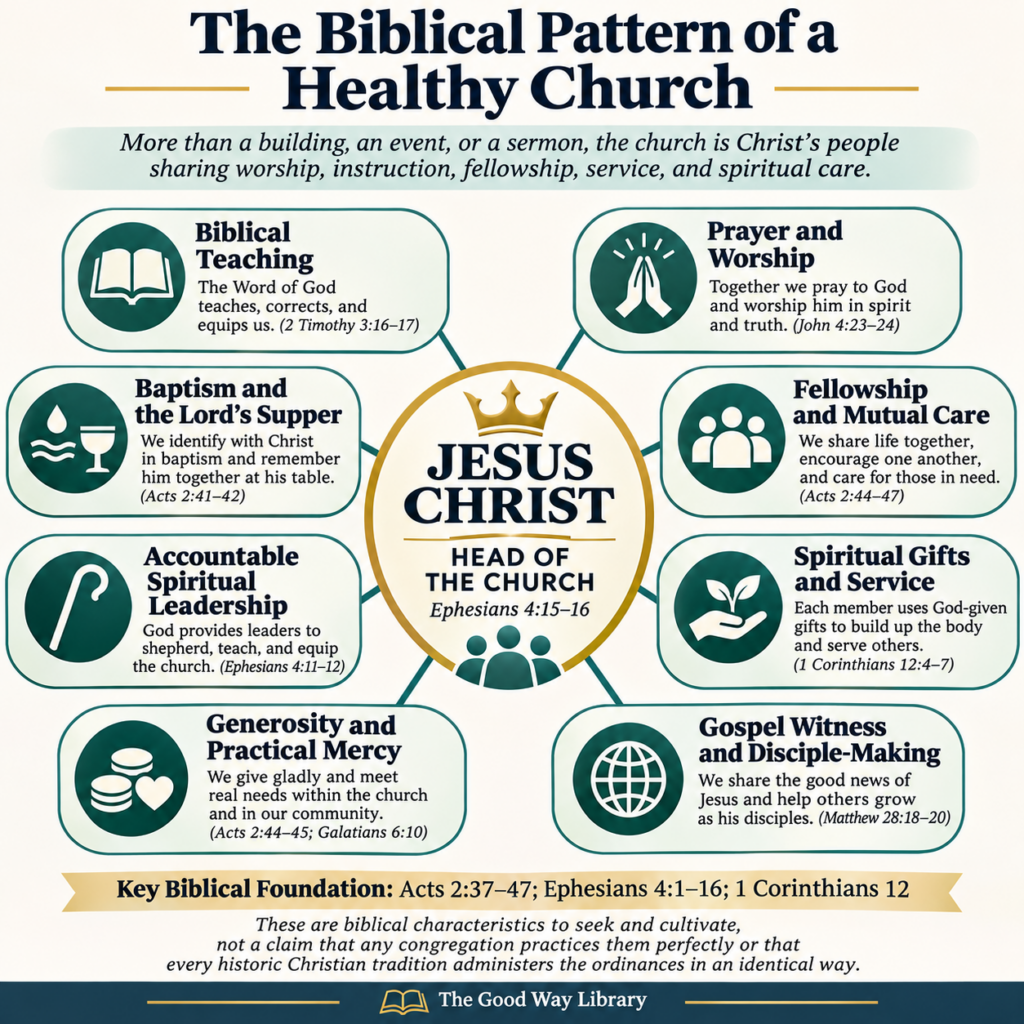
Main Teaching: Life Together in Christ’s Church
The Holy Spirit Forms a People, Not Just Individuals
To understand Acts 2:37–47, we must begin with what happens earlier in the chapter.
Jesus has risen from the dead and ascended into heaven. Before his ascension, he promised that the Holy Spirit would empower his followers to bear witness to him, beginning in Jerusalem and extending throughout the world (Acts 1:8).
On the day of Pentecost, that promise begins to unfold. The Holy Spirit comes upon the gathered disciples, and they begin speaking in languages understood by people from many nations. The event attracts a crowd, and Peter stands before them to explain what has happened.
Peter proclaims that Jesus of Nazareth was crucified, that God raised him from the dead, and that the risen Jesus has been exalted as Lord and Christ. His message is not primarily about forming a new religious organization. It is about the person and saving work of Jesus Christ.
When the people recognize the significance of what they have heard, they are deeply convicted. They ask Peter and the other apostles what they should do.
In Acts 2:38–39, Peter calls them to repent and be baptized in the name of Jesus Christ. He also speaks of forgiveness, the gift of the Holy Spirit, and God’s promise extending to those whom the Lord calls.
About three thousand people receive the message and are baptized that day.
Then something remarkable happens. These new believers do not simply return to isolated lives with a private religious experience. They become part of a shared Christian community.
Acts 2:42 (WEBU) explains:
They continued steadfastly in the apostles’ teaching and fellowship, in the breaking of bread, and prayer.
This verse provides one of the clearest pictures of the church’s earliest shared life. The believers received the apostolic message, learned together, shared fellowship, broke bread, and prayed.
The church begins with what God has done through Jesus Christ, not with what religious people have organized for themselves.
The Father sent the Son to accomplish salvation. The risen Son poured out the promised Holy Spirit. Through the proclamation of the gospel, the Spirit gathered people into a community that belonged to Christ.
That same theological foundation remains important today.
A church is not simply a collection of people with similar moral values, political preferences, personalities, or social interests. It is a community gathered around the Lord Jesus Christ and his gospel.
What Made the First Christian Community Different?
Acts 2:42–47 describes several practices that characterized the believers in Jerusalem. Their shared life reflected the saving grace they had received through Jesus Christ.
- Apostolic Teaching: They continued learning the message given through Jesus’ authorized witnesses. Their faith was grounded in the truth about Christ rather than private speculation.
- Fellowship: Their lives became connected through shared faith, friendship, encouragement, and responsibility for one another.
- Breaking Bread: They shared meals, while the language of breaking bread also connects with the early Christian practice of remembering Christ through the Lord’s Supper.
- Prayer and Worship: They prayed together, praised God, and continued gathering regularly in Jerusalem.
- Generosity and Care: They shared material resources so that people facing genuine needs could receive assistance.
- Witness and Growth: Their shared life accompanied the continuing spread of the gospel as the Lord added people to the church.
These practices reveal a community whose relationship with Jesus affected far more than private beliefs. Their faith influenced their time, possessions, friendships, worship, and concern for people in need.
Yet we should not imagine that Acts 2 describes a perfect church. Later chapters of Acts reveal dishonesty, complaints over the distribution of assistance, disagreements, and difficult decisions. The New Testament letters likewise address divisions, immorality, false teaching, and failures of love within Christian congregations.
These problems do not invalidate the importance of the church. They remind us that Christian communities require the same grace, repentance, truth, and spiritual growth that individual believers need.
Acts 2 also describes an extraordinary period of apostolic signs and the rapid establishment of the Jerusalem church. We should not assume that every congregation must reproduce every miraculous event in precisely the same way.
For example, the believers’ generosity does not establish compulsory communal ownership as a requirement for all Christians. Acts 5:4 indicates that individuals retained responsibility over their property and its proceeds. The important principle is willing generosity and responsible care for those in need.
The enduring lesson is not that every church must look exactly like first-century Jerusalem. It is that Christ’s people should be devoted to biblical teaching, worship, fellowship, prayer, and practical love.
Baptism: A Command of Jesus and a Beginning of Church Life
Baptism is one of the most important practices associated with Christian discipleship.
We first encountered it in Step One, when Jesus gave the Great Commission. In Matthew 28:18–20, the risen Christ commands his followers to make disciples among the nations, baptizing them in the name of the Father, Son, and Holy Spirit and teaching them to observe everything he commanded.
This is a direct command from Jesus!
In Acts 2, Peter calls his hearers to repent and be baptized. Those who receive the apostolic message are baptized and added to the Christian community. Baptism therefore belongs closely to the proclamation of the gospel, the response of faith, and identification with Christ and his people.
Romans 6:1–14 explains the believer’s union with Christ in his death and resurrection, using baptism as an important reference point. Jesus died for sinners and rose bodily from the dead. Those who genuinely belong to him are called to live according to the new life they have received.
Baptism visibly directs our attention toward Christ and his saving work. It is not an achievement that makes someone spiritually impressive, nor should it be dismissed as an unimportant religious custom.
Why Do Christians Differ About Baptism?
Historic Christian traditions agree that baptism is important because Christ commanded it. However, they differ in several aspects of its meaning and administration.
Who Should Be Baptized? Some Christian traditions baptize infants within Christian households, understanding baptism in connection with God’s covenant promises and the church. Others practice baptism upon a personal profession of faith, emphasizing repentance and conscious trust in Jesus.
How Should Baptism Be Administered? Some churches practice immersion in water, while others also recognize pouring or sprinkling. Their approaches reflect different understandings of biblical language, historical practice, and the significance of baptism.
How Does Baptism Relate to Salvation? Christians also differ over baptism’s sacramental character and its relationship to forgiveness, regeneration, and faith. Some understand baptism as a means through which God gives grace. Others emphasize its role as a sign and public testimony of the saving work received through faith.
These differences deserve careful biblical study. They should not be ignored, but neither should they obscure the central gospel of Jesus Christ.
The Good Way Discipleship Course affirms salvation by God’s grace through faith in Christ. Baptism is not a human achievement through which someone purchases divine acceptance. At the same time, Jesus’ command should be taken seriously rather than treated as optional decoration.
If you have not been baptized, an appropriate next step is to speak with a faithful pastor or church leader. Ask how your congregation understands and practices baptism, and examine the relevant Scriptures together.
If you are still exploring Christianity, you do not need to pretend that you have already come to saving faith. Continue learning about Jesus, repentance, and belief while asking honest questions about baptism.
The Lord’s Supper: Remembering Christ Together
Alongside baptism, Christians have practiced the Lord’s Supper since the earliest generations of the church. It is also called Communion or the Eucharist, a word associated with thanksgiving. Christian traditions sometimes call baptism and the Lord’s Supper ordinances, while others call them sacraments.
The foundation of the Lord’s Supper comes from Jesus himself.
During his final meal with his disciples before his crucifixion, Jesus took bread and a cup and connected them with his body and blood. He instructed his followers to continue this remembrance (Luke 22:14–20).
Paul later explains the practice in 1 Corinthians 11:23–26. The bread and cup direct believers toward Jesus’ sacrificial death and the new covenant established through his blood. As Christians participate, they proclaim the Lord’s death and look forward to his return.
The Lord’s Supper is therefore not merely an ordinary meal with religious language added to it. It is a solemn and thankful act centered upon the saving work of Christ.
The context of 1 Corinthians 11 also teaches us something important about church life. Some believers in Corinth were treating others selfishly when they gathered. Their behavior humiliated people with fewer resources and contradicted the fellowship they claimed to share.
Paul corrects them because their manner of gathering was inconsistent with the meaning of the Lord’s Supper. We cannot rightly celebrate Christ’s self-giving love while deliberately despising or mistreating others within his body.
Self-Examination Before Communion
The Lord’s Supper also calls believers to reverence and honest self-examination. In 1 Corinthians 11:27–32, Paul warns against eating the bread or drinking the cup in an unworthy manner. His concern includes the Corinthians’ divisions, selfishness, and failure to recognize the seriousness of what they were doing. He therefore instructs believers to examine themselves before participating.
Christians should approach the Lord’s Table with faith, repentance, gratitude, and proper regard for Christ and his people.
This warning does not mean that Christians must become sinlessly perfect before receiving Communion. The distinction is between approaching the Lord’s Supper in an unworthy manner and imagining that only morally flawless people may participate. The Supper directs believers toward Christ, whose sacrifice is the foundation of their forgiveness and hope. Participants should follow the biblical teaching and appropriate pastoral guidance of their local congregation, recognizing that historic Christian traditions differ in their understanding and administration of the sacrament.
Different Christian Understandings of Communion
Historic Christian traditions agree that the Lord’s Supper was established by Jesus and belongs to the church’s worship. They do, however, differ concerning Christ’s presence and the precise nature of what believers receive.
Some emphasize a sacramental participation in Christ’s body and blood. Others explain Christ’s presence as a true spiritual communion with the risen Lord. Still others place particular emphasis on the meal as a remembrance and proclamation of his finished sacrifice.
These differences have been discussed throughout Christian history. They should be approached with biblical seriousness and charity rather than dismissed as meaningless or allowed to overshadow the gospel.
Christians also differ in how frequently Communion should be celebrated and the qualifications for participation.
Rather than attempting to administer the Lord’s Supper independently as a course activity, participate through a faithful local congregation under appropriate pastoral guidance. If you are uncertain about baptism or Communion, ask a church leader to explain the congregation’s practice and the biblical reasons behind it.
Both baptism and the Lord’s Supper direct our attention away from personal achievement and toward Jesus Christ, his saving work, and our shared life as his people.
Worship and Teaching: Gathering Around the Living God
The earliest believers devoted themselves to the apostles’ teaching, prayer, and praise. They gathered publicly and shared meals in their homes. Their worship was not simply a social occasion. They came together as people who belonged to the living God.
Christian worship continues to have this same purpose. We gather to honor God, hear his Word, pray, give thanks, remember Christ, and encourage one another in faithful living.
In John 4:21–24, Jesus explains that true worship is not ultimately controlled by a particular geographical location. He teaches that those who worship the Father must worship in spirit and truth.
Christian worship must therefore involve more than outward attendance, impressive music, or religious ceremony. It should be sincere and grounded in the truth God has revealed.
At the same time, sincerity does not make biblical instruction unnecessary. A congregation should faithfully teach Scripture and confess Jesus Christ according to the gospel.
The New Testament gives us several important elements of gathered Christian worship:
- Scripture and Teaching: The Bible is read, explained, and applied so that believers can understand God’s truth and follow Christ.
- Prayer and Praise: Christians worship the Father through Jesus Christ in the Holy Spirit, bringing thanksgiving, confession, and requests before God.
- Baptism and the Lord’s Supper: The congregation receives and practices what Christ established, according to its understanding of Scripture.
- Fellowship and Encouragement: Believers strengthen one another through conversation, hospitality, prayer, and mutual care.
- Giving and Service: Christians share their resources and abilities to support the work of the church and respond to genuine needs.
Not every congregation will express these elements through the same order of worship, musical style, or organizational structure.
Some churches are highly liturgical, using established prayers and ordered forms of worship. Others follow simpler services centered upon biblical preaching, congregational singing, and prayer. Christians may disagree about which practices should be included and how they should be conducted.
These differences require discernment, but the central concern remains the same: the congregation should direct its attention toward God through Jesus Christ, faithfully receive Scripture, and build up his people.
The Church Is One Body With Many Members
The New Testament describes the church using several images, including God’s household, a spiritual building, and the body of Christ. The image of a body is especially important because it explains how individual believers belong together while having different responsibilities.
In 1 Corinthians 12, Paul teaches that the Holy Spirit gives different gifts for the good of the whole church. Some believers are equipped to teach, others to encourage, others to lead, and others to provide practical help or service.
The particular gifts differ, but their purpose is shared.
Paul compares the church to a human body containing many members. A hand cannot function as the entire body, and an eye cannot declare that the rest of the body is unnecessary. Likewise, Christians should not measure their spiritual importance by comparing their abilities or responsibilities with those of others.
A person who teaches Scripture publicly may serve a valuable role. So may someone who quietly visits a lonely church member, prepares food for a family in need, helps maintain the building, welcomes visitors, or prays faithfully for others.
Spiritual gifts are given for service, not for creating a hierarchy of personal importance.
Paul develops this further in Ephesians 4:1–16. He calls Christians to humility, patience, love, and unity in the Holy Spirit. He then explains that the risen Christ gives gifted servants to equip his people for ministry.
The goal is not that a few impressive individuals perform all the work while everyone else observes. Rather, the whole church grows toward maturity as its members contribute to one another’s good.
Ephesians 4:15–16 describes the body growing under Christ its head as each part works in its proper place.
This means church participation is about more than receiving something for yourself. Christians gather to be taught and encouraged, but they also have opportunities to strengthen others.
How Can You Recognize Your Place in the Church?
You do not need to discover a single extraordinary ability before you can serve.
Some Christians find it helpful to consider their spiritual gifts through study, prayer, and conversations with church leaders. However, no brief questionnaire can infallibly identify what the Holy Spirit has given someone.
A more reliable approach is to remain attentive to Scripture, learn about the needs of your congregation, receive wise encouragement, and participate in appropriate opportunities for service.
You may discover that you are effective at explaining Scripture, organizing practical assistance, offering hospitality, encouraging discouraged people, or helping with ordinary responsibilities. Your abilities may become clearer through faithful service over time.
Christians differ over whether particular miraculous or revelatory gifts continue in the same way today. Those questions deserve respectful biblical consideration. However, believers across these traditions can agree that the Holy Spirit gives gifts for the good of Christ’s people and that love is essential to their proper use.
Paul makes that connection immediately after 1 Corinthians 12, when he begins his well-known teaching about love in chapter 13. Without love, even impressive religious activity fails to accomplish what Christian service should express.
The Church Should Be a Place of Mutual Care
Acts 2 describes believers sharing possessions and responding to material needs. Their generosity reveals that Christian fellowship extended beyond attending the same religious gathering. They recognized responsibilities toward one another.
This principle appears throughout the New Testament. Christians are instructed to encourage those who are discouraged, help those in need, pray for one another, bear burdens, and respond to wrongdoing with truth and humility.
A healthy congregation should not expect every member to carry every burden personally. Instead, believers serve together according to their abilities, responsibilities, and circumstances.
Some people can contribute financially. Others can provide transportation, practical labor, prayer, companionship, teaching, or other forms of assistance.
A person facing illness, disability, unemployment, grief, or financial hardship may need to receive help rather than provide it for a season. This does not make them a less valuable member of Christ’s body.
In fact, 1 Corinthians 12 emphasizes the importance of honoring members who might otherwise be overlooked. Christian fellowship should be marked by both giving and receiving care.
It should also include responsible correction. Scripture does not call churches to ignore destructive conduct, conceal wrongdoing, or tolerate abusive leadership in the name of unity.
In Matthew 18:15–20, Jesus teaches about addressing sin within the community of believers. His teaching encourages truth, accountability, and appropriate processes for correction. It must not be misused to require private confrontation with someone who is dangerous or abusive.
Serious wrongdoing may require action by appropriate church authorities, qualified professionals, or civil authorities. Christian love and biblical accountability must never become excuses for protecting those who cause harm.
What Makes a Healthy Christian Church?
If you are looking for a congregation, you may wonder how to recognize a healthy one.
No church will be perfect. Every congregation includes people who still need spiritual growth, repentance, and grace. However, Scripture provides principles that can help us distinguish faithful Christian fellowship from unhealthy religious control.
Consider these characteristics when learning about a congregation.
- Faithful Biblical Teaching: A healthy church recognizes Scripture as authoritative and teaches the gospel of Jesus Christ. It confesses the triune God and Jesus Christ as truly God and truly human, whose death and resurrection accomplish salvation for sinners.
- Christ-Centered Worship: The congregation directs worship toward God rather than making a pastor, personality, performance, or organization the center of attention.
- Accountable Leadership: Church leaders should demonstrate humility, integrity, and willingness to receive correction. Their authority remains subject to Scripture, and they should not operate without appropriate accountability.
- Genuine Fellowship: Members should have meaningful opportunities to know, encourage, pray for, and care for one another. Hospitality and concern for vulnerable people matter.
- Responsible Stewardship: Financial giving should be handled transparently, without manipulation or pressure. Members should not be told that donations purchase spiritual favor or guarantee material blessings.
- Healthy Safeguarding: A faithful congregation should take abuse, exploitation, threats, and serious wrongdoing seriously. It should maintain appropriate safeguards and cooperate with lawful reporting and professional assistance when required.
- Opportunities for Service: Members should be encouraged to use their abilities to serve others without being pressured into responsibilities they are unprepared or unable to fulfill.
These characteristics are more important than impressive facilities, large attendance numbers, or polished programs.
There are also warning signs that deserve attention. A church may become spiritually unhealthy when leaders demand unquestioning loyalty, isolate people from their families, use fear to control decisions, discourage legitimate questions, conceal abuse, or claim that disagreement with leadership is necessarily rebellion against God.
These behaviors should not be excused simply because the organization uses Christian language.
Jesus warns about false teachers and the importance of recognizing their fruit in Matthew 7:15–23. The New Testament likewise gives standards for pastoral character and accountability in passages such as 1 Timothy 3 and Titus 1.
If you have experienced spiritual abuse or serious harm within a congregation, your concerns deserve to be taken seriously. Seeking safety, trustworthy pastoral support, and qualified professional assistance may be necessary before pursuing new church relationships.
Belonging to Christ does not require surrendering your conscience or personal safety to another human being.
A healthy congregation should help you grow in trust and obedience toward Jesus, not create unhealthy dependence upon its leaders.
Christians Before Us: The Church Through the Centuries
From the earliest generations of Christianity, believers understood that following Jesus meant belonging to a community of faith rather than pursuing an entirely private spiritual life. Ignatius of Antioch, an early second-century Christian bishop who wrote letters to several churches while being taken to Rome for execution, strongly emphasized the importance of Christian unity and gathered worship. In his Letter to the Ephesians, particularly chapters 5 and 13, he encouraged believers to remain united and assemble regularly for prayer, thanksgiving, and worship. Ignatius lived when Christian communities faced persecution, false teaching, and the possibility of division. He believed that Christians needed one another to remain faithful during these difficulties. Although his writings reflect particular early understandings of church leadership, his broader concern closely resembles the New Testament’s emphasis on fellowship and mutual encouragement. The church is not merely a place where individuals receive religious instruction. It is a community in which believers strengthen one another as they follow Jesus together. Ignatius reminds us that unity, faithful teaching, and regular fellowship have concerned Christians since the church’s earliest centuries.
In the seventeenth century, Philipp Jakob Spener (1635–1705) emphasized the importance of meaningful Christian fellowship and spiritual growth within the church. While serving as a Lutheran pastor in Frankfurt, Germany, he began organizing smaller gatherings of believers in 1670, where Christians could read Scripture, discuss its teachings, and encourage one another toward faithful living. Spener believed that attending public worship and listening to sermons were important, but Christians also needed opportunities to strengthen one another personally. In his influential 1675 work, Pia Desideria, he encouraged greater engagement with Scripture, increased participation by ordinary believers in the life of the church, and a stronger connection between Christian teaching and daily conduct. Spener’s example reminds us that Christian fellowship involves more than gathering in the same building for worship. Believers should seek opportunities to know one another, discuss God’s Word, offer encouragement, and help each other grow in faithfulness to Jesus Christ.
In the seventeenth century, Richard Baxter (1615–1691) demonstrated the importance of personal discipleship and spiritual care within the local church. As a pastor in Kidderminster, England, Baxter believed that preaching alone was insufficient for the spiritual growth of a congregation. He devoted considerable time to visiting households, teaching Scripture, answering questions, and encouraging believers toward repentance and faithful living. His influential book The Reformed Pastor emphasized the responsibility of church leaders to know and care for those entrusted to them. Baxter understood that belonging to a church means more than attending worship services. Christians are called to receive sound teaching, share one another’s burdens, and use their gifts to strengthen the body of Christ. His example reminds us that a healthy church is a community where believers are known, encouraged, and helped toward spiritual maturity. As Ephesians 4:11–16 teaches, Christ builds up his church as its members grow together in truth and love. We are not simply called to attend Christ’s church, but to participate faithfully in its life and encourage one another in the Lord.
What Is True in Christ
The church occupies an extraordinary place in the purposes of Jesus Christ. Scripture does not present it merely as a religious organization that Christians establish to support their personal spiritual lives. Rather, the New Testament reveals that Christ identifies himself with his people, reconciles those who were once divided, and continues exercising authority over the congregations that bear his name. Understanding these truths changes how we view the church, how we treat fellow believers, and how we respond to the responsibilities of Christian fellowship.
Jesus Identifies Himself With His People
One of the most remarkable demonstrations of Christ’s relationship with his church appears in Acts 9:1–5. Before his conversion, Saul was actively persecuting Christians. He threatened believers, supported their imprisonment, and sought to stop the spread of the gospel. Yet when the risen Jesus confronted him on the road to Damascus, he asked why Saul was persecuting him. Consider what this means. Saul had been attacking the followers of Jesus, but Christ identified their suffering so closely with himself that he described the persecution as being directed against him.
Jesus does not regard his church as a distant organization that simply represents his interests. He identifies himself with the people who belong to him. This gives extraordinary significance to how Christians treat one another. When a fellow believer is suffering, that person’s pain should matter to us. When someone within the congregation is overlooked, mistreated, or discouraged, we should not respond with indifference. Our brothers and sisters in Christ are not merely fellow members of an institution. They belong to the Savior we love. This identification does not mean that every church leader, decision, or institution speaks with Christ’s authority. Rather, it reminds us that genuine concern for Jesus should produce genuine concern for his people.
Christ Has Made Former Strangers Into One Household
Ephesians 2:11–22 reveals another remarkable truth about the church. Paul explains that Jesus Christ has brought near those who were formerly separated and has broken down the dividing wall of hostility between Jews and Gentiles. Through his death, Christ has reconciled both to God in one body, creating a new community in which people from different backgrounds share the same access to the Father through the Holy Spirit. Paul then describes believers as fellow citizens and members of God’s household, built upon the foundation of the apostles and prophets, with Jesus Christ himself as the chief cornerstone.
This means the church is something far greater than a gathering of people who happen to share similar interests, personalities, cultures, or social positions. Jesus has brought together people who might otherwise have remained strangers or even enemies, making them members of one spiritual household. Their unity is grounded in him, not in their ability to agree about every secondary matter. This does not erase cultural differences, personal histories, or legitimate disagreements. Instead, it gives Christians a deeper relationship that should shape how they approach those differences. We should not expect every believer to look, think, speak, or worship exactly as we do. The church belongs to Jesus Christ, and he has welcomed people from every nation and background into fellowship through the same gospel. Our responsibility is to receive fellow believers with humility while remaining faithful to the truth he has revealed.
Jesus Remains the Head and Judge of His Churches
Revelation 1–3 provides a powerful picture of the risen Jesus Christ exercising authority over his churches. John sees Christ among seven golden lampstands, which represent seven churches. Jesus then addresses these congregations individually, acknowledging their faithfulness, exposing serious failures, correcting false teaching, and calling them to repentance. Some churches receive encouragement for their endurance, while others are warned that their conduct contradicts the faith they profess. Even established congregations are not beyond correction.
No church belongs ultimately to its pastor, founders, elders, denomination, or financial supporters. Every congregation that claims the name of Christ remains accountable to Jesus Christ himself. This should encourage humility among leaders and spiritual discernment among members. A church may possess impressive buildings, strong attendance, generous resources, or longstanding traditions while still needing serious correction. Likewise, a small or struggling congregation may demonstrate remarkable faithfulness to Christ. Jesus evaluates his churches according to his truth, not merely their outward appearance or public reputation. His authority should therefore shape how congregations teach Scripture, exercise leadership, protect vulnerable people, address wrongdoing, and care for those entrusted to them.
These truths give us a deeper understanding of what it means to belong to Christ’s people. Jesus identifies with his church, reconciles believers into one household, and remains its supreme Lord. We should therefore approach Christian fellowship with reverence, gratitude, humility, and discernment. We must not treat the church as an optional social club, but neither should we confuse loyalty to Jesus with unquestioning submission to a particular institution. Our responsibility is to seek faithful fellowship, love Christ’s people, and help strengthen congregations that remain accountable to his Word.
If you are still exploring Christianity, remember that participating in a congregation does not automatically make someone a Christian. The invitation of the gospel remains personal: repent, believe in Jesus Christ, and follow him. As you consider that invitation, a faithful local church can provide opportunities to hear Scripture, ask questions, observe Christian worship, and learn alongside people who are seeking to follow the same Savior.
Learning to Follow Jesus With Others
Love One Another as Christ Has Loved Us
In Step Nine, we studied Jesus washing his disciples’ feet and teaching them to love one another.
In John 13:34–35, Jesus commands his followers to love one another according to the pattern of his own love. He also teaches that such love will distinguish his disciples before the world.
This command applies directly to the church’s shared life. The congregation should be a place where Christlike love becomes visible through patience, humility, truthfulness, generosity, forgiveness, and concern for others.
Yet love does not mean pretending everything is acceptable. Christians sometimes need correction, protection, reconciliation, and responsible boundaries. Jesus’ love is truthful as well as compassionate.
One practical response is to become more attentive to the people around you at church. Instead of thinking only about what you personally receive from a worship service, consider whether someone might appreciate a conversation, prayer, encouragement, hospitality, or practical assistance.
You do not need a formal ministry title to begin loving others faithfully.
Gather Together and Encourage One Another
Hebrews 10:19–25 connects Christian fellowship to the finished sacrifice and priestly ministry of Jesus.
Because Christ has opened the way for his people to draw near to God, believers are encouraged to hold firmly to their hope and consider how they can strengthen one another.
The passage then warns against neglecting Christian gatherings and calls believers to mutual encouragement.
Hebrews reminds us that Christian gatherings should involve more than occupying the same room. We are to consider one another’s needs, encourage faithfulness, and strengthen love and good works.
If you already attend church, this may mean becoming more intentional about knowing other believers. If you have been disconnected, it may mean beginning a conversation with a pastor or exploring a suitable congregation.
For someone unable to attend physically, it might involve requesting a pastoral visit, arranging a phone conversation with another Christian, or seeking accessible forms of accountable fellowship.
The central concern is not maintaining an attendance record. It is refusing to treat the Christian life as something we should pursue entirely alone.
Let Christ Guide Your Participation
Consider what church participation looks like when approached through dependence upon Jesus rather than religious performance.
Before gathering with other believers, you might pray that the Lord would help you listen attentively to his Word and care for those around you.
During worship, you can bring your attention back to the Father, remembering that your access to him rests upon Jesus Christ. As Scripture is taught, you can consider its meaning and ask the Holy Spirit for wisdom and obedience.
Afterward, perhaps you have an opportunity to speak with someone who is struggling, offer encouragement, or learn about a need within the congregation.
These ordinary moments are meaningful expressions of Christian fellowship.
You do not need to become involved in every available ministry, attend every event, or prove your devotion through constant activity. Faithful participation should be realistic and should honor your responsibilities to family, work, health, and other important areas of life.
The goal is not maximum religious busyness. It is continued fellowship with Christ and responsible love for his people.
Participate in the Church’s Mission
The church also exists as a community through which Christ’s gospel is proclaimed and his love becomes visible in the world.
Jesus’ Great Commission calls his followers to make disciples, baptize them, and teach them to observe his commands. This mission belongs to Christ’s people together, not merely to a few professional ministers.
Local congregations participate in many ways, including prayer, evangelism, teaching, hospitality, charitable service, and support for gospel workers.
You may have an opportunity to help welcome visitors, assist a family experiencing hardship, support a local ministry, pray for missionaries, or encourage someone who is exploring Christianity.
Some forms of service, such as children’s teaching, require appropriate authorization, training, background checks, and safeguarding procedures. Faithful participation includes respecting those responsibilities.
We should also remember that not every Christian is called to perform the same task. The body has many members, and each contributes according to the grace and opportunities God provides.
As you become involved in a congregation, ask where you can serve responsibly and where you can receive fellowship and instruction.
You do not need to wait until the final discipleship lesson to participate in Christ’s mission.
For the Discipler: Walking Through This Step Together
Before You Meet | Read Acts 2:37–47, Ephesians 4:1–16, and Hebrews 10:19–25. Review Matthew 28 and 1 Corinthians 11–12 so you can explain baptism, the Lord’s Supper, church unity, and spiritual gifts. Prepare to describe the common biblical convictions shared across historic Christianity while acknowledging legitimate differences. Familiarize yourself with the Good Way studies, particularly the Acts 2 Walkthrough and Interpretive Options.
During the Meeting | Begin by asking about the learner’s experience of Christian fellowship. Read Acts 2 together and identify what follows the proclamation of the gospel: repentance, baptism, teaching, prayer, generosity, and shared worship. Discuss the distinction between belonging to Christ and participating in a local congregation. Explain baptism and Communion with biblical care rather than trying to settle every denominational disagreement. Help the learner consider one realistic step toward fellowship or service.
What to Watch For | Some learners may have experienced church conflict, spiritual control, or abuse. Do not minimize their concerns or pressure them to join your preferred congregation. Some may also have serious church hurt; demonstrate empathy for this, but gently encourage them to not give up on the great body of Christ. Respect conscience, personal safety, and the need for trustworthy leadership. Never demand private disclosures or promise solutions where you can’t for sure provide them.
Before Moving Forward | Invite the learner to explain why Christian discipleship includes the church and identify the biblical purposes of baptism, Communion, worship, fellowship, and spiritual gifts. If appropriate, encourage a conversation with a pastor or a visit to a healthy congregation. The aim is a responsible next step toward Christian community, not a rushed membership decision.
Discuss Together
Use these questions with your discipler, family, or study group. If you are studying independently, consider writing your responses before continuing.
- Evaluating a Church: Suppose you visit a congregation with energetic worship and friendly people, but its leaders discourage sincere questions and resist accountability. What biblical characteristics should you look for before becoming involved? How would you distinguish healthy spiritual leadership from potential warning signs?
- The Beginning of the Church: What happens in Acts 2:37–47 after Peter proclaims Jesus Christ? What activities characterize the people who receive his message and are baptized?
- Belonging to Christ’s People: Why is Christian discipleship meant to include fellowship with other believers? What can a healthy local church provide that a website, book, or private study cannot fully replace?
- Baptism and Communion: What do Jesus and the apostles teach about baptism and the Lord’s Supper? Why should Christians understand these practices even when different traditions explain certain details differently?
- Worship and Fellowship: What does Hebrews 10:19–25 teach about gathering together and encouraging one another? How does Christ’s saving work provide the foundation for this shared life?
- Spiritual Gifts and Service: How does Paul’s description of the body in 1 Corinthians 12 challenge pride, comparison, or the belief that some Christians have nothing valuable to contribute?
- Your Next Step: What is one realistic way you could participate more meaningfully in Christian fellowship, whether through worship, baptismal instruction, building relationships, or serving someone else?
Put It Into Practice
Consider Your Relationship With a Local Church
If you already participate in a congregation, reflect on whether you are connected with other believers beyond attending services. Consider whether there is a suitable opportunity for fellowship, prayer, or encouragement that would deepen your participation.
If you are not currently connected with a church, begin identifying a congregation where Scripture is faithfully taught and appropriate pastoral accountability is present. You might attend a worship gathering, speak with a pastor, or ask a trustworthy Christian for guidance.
If past harm or present circumstances make attendance difficult, take an appropriate and safe step toward trustworthy Christian support rather than forcing yourself into an unhealthy environment.
Understand Baptism and the Lord’s Supper
Read Matthew 28:18–20 and 1 Corinthians 11:23–26. Consider what Jesus commands and how the apostles explain the significance of these practices.
If you profess faith in Christ but have not been baptized, consider arranging a conversation with a pastor about baptism. If you are already baptized, reflect on how baptism directs your attention toward belonging to Christ and living in the grace he has given.
When participating in Communion, receive it according to the biblical teaching and practice of your congregation. Remember Christ’s saving death and the hope of his return.
Encourage or Serve Someone in Christian Fellowship
Consider one appropriate way to encourage another believer.
You might pray with someone, welcome a visitor, offer practical assistance, share a meal, or ask a church leader about opportunities for service. Choose something suitable for your abilities and circumstances.
If you are presently unable to participate in a congregation, you can still pray for fellow Christians or offer appropriate encouragement to someone you know.
The purpose is not to add another achievement to your discipleship record. It is to allow the love Christ has shown you to become visible in your care for others.
If You Are Studying Alone
You can complete the Scripture readings and reflections in this lesson independently. Read Acts 2:37–47, Ephesians 4:1–16, and Hebrews 10:19–25. Consider the discussion questions and use the Good Way resources to deepen your understanding.
However, this particular lesson emphasizes something that independent study cannot fully provide: ongoing fellowship with other believers.
If possible, contact a local Christian congregation and ask about worship services, biblical teaching, baptism, or opportunities to learn more about the church. You may begin with a simple conversation rather than a commitment to membership.
If your circumstances make in-person attendance difficult, consider asking about accessible worship, pastoral visits, or other appropriate forms of Christian fellowship.
The Good Way Library is here to support your understanding of Scripture, but it is not intended to replace the worship, pastoral care, accountability, and shared life of Christ’s church.
Suggested Prayer
Heavenly Father, thank you for sending your Son, Jesus Christ, to save sinners and gather a people who belong to him. Thank you that salvation rests upon his completed work rather than my ability to earn your favor through religious activity.
Teach me to love the church as Christ loves his people. Help me understand the importance of baptism, worship, the Lord’s Supper, fellowship, and faithful service. Give me humility to learn from others, patience when relationships are difficult, and wisdom to recognize trustworthy Christian leadership.
By your Holy Spirit, help me use whatever gifts and opportunities you have given me for the good of others. Keep me from pride, comparison, selfishness, and spiritual isolation. Teach me to serve without seeking recognition and to receive help when I need it.
Guide me toward healthy Christian fellowship where your Word is faithfully taught, your name is honored, and people are treated with truth and love. Protect those who are vulnerable, bring wrongdoing into the light, and give your people courage to act responsibly.
Help me remember that the church belongs to Jesus Christ. May my participation draw me closer to him and prepare me to encourage others in the faith. In the name of Jesus Christ, my Savior and Lord, amen.
Scripture to Remember
Hebrews 10:24–25 (WEBU):
“Let’s consider how to provoke one another to love and good works, not forsaking our own assembling together, as the custom of some is, but exhorting one another, and so much the more as you see the Day approaching.”
These verses remind us that Christian fellowship involves more than gathering in the same location. Believers are called to consider one another’s needs, encourage faithfulness, and strengthen love and good works.
Read Hebrews 10:19–25 again and notice that this instruction follows the assurance of access to God through Jesus Christ. Our shared life grows from the grace he has already provided.
Continue Studying With Good Way
The following resources will help you understand the biblical foundations of the church, Christian fellowship, and serving others. Begin with Scripture itself, then use these commentaries and historical studies to clarify the text, deepen your understanding of the body of Christ, and consider your place within the local church.
- Acts 2 Commentary: Pentecost and the Spirit | Begin here to explore the coming of the Holy Spirit, Peter’s proclamation of Jesus Christ, repentance, baptism, and the formation of the early church. Pay special attention to verses 37–47, which describe the believers’ devotion to apostolic teaching, fellowship, prayer, and shared life. The Interpretive Options section also addresses important questions about baptism and the practices of the first Christians.
- Ephesians 4 Commentary: Unity in Christ | Discover how Christ builds His church through unity, spiritual maturity, sound teaching, and the participation of every member. The discussion of verses 1–16 is especially helpful for understanding why belonging to a local church involves both receiving spiritual care and contributing to the growth of others. The Application and Leading sections provide further guidance for putting these teachings into practice.
- 1 Corinthians 12 Commentary: Spiritual Gifts and One Body | Learn how the Holy Spirit equips believers with different gifts for the good of the entire church. This chapter emphasizes that every member of Christ’s body has value, purpose, and responsibility. The Interpretive Options section also introduces differing Christian understandings of particular spiritual gifts while keeping the focus on unity and mutual service.
- Apostles’ Creed Explained: Full Text, Meaning, History, and Scripture | Explore one of Christianity’s historic statements of faith and its biblical foundations. The discussion of the holy catholic church and the communion of saints is especially relevant to this lesson, helping explain the unity and fellowship believers share in Christ. The historical sections also provide helpful background on Christian confession, baptismal instruction, and the life of the early church.
As you examine these teachings, consider how Christ calls you to participate faithfully in His church, encourage fellow believers, and use the gifts God has given you to serve others in love.
Before the Next Step
You have now explored why Christian discipleship includes belonging to Christ’s people.
The church is not a collection of perfect Christians. It is a community of people who need the grace of Jesus Christ and the continuing work of the Holy Spirit. Within that community, believers learn Scripture, pray, worship, participate in baptism and the Lord’s Supper, receive pastoral care, and serve one another.
Remember that Christ himself is the head of his church. No congregation, pastor, mentor, or Christian organization can take his place.
If you already belong to a healthy congregation, consider how you might participate more faithfully in its shared life. If you have not yet found a suitable church, continue seeking trustworthy Christian fellowship with patience and discernment.
But another important question remains: What happens when following Jesus becomes difficult?
Christians experience sickness, grief, disappointment, temptation, persecution, conflict, and ordinary seasons of weakness. Belonging to Christ does not guarantee an easy life, nor does participation in a church remove every struggle.
Jesus calls his followers to remain faithful through such experiences, trusting his presence and the hope he has promised.
Step 11: Faithful Through Every Season will explore perseverance, suffering, spiritual struggle, and the hope of resurrection. We will learn how Scripture teaches us to endure hardship without pretending that pain is insignificant or that faithful believers must always feel strong.
Next Reading: James 1:2–18
Before continuing, read this passage and notice how James connects trials, endurance, prayer for wisdom, temptation, and God’s goodness.
As you begin the next step, remember that the Lord who gathers his people is also the Lord who sustains them. We follow Jesus together, supported by his Word, strengthened by his Spirit, and encouraged by the hope of his final victory.
Partner With The Good Way Library
The Good Way Library is supported entirely by everyday readers like you. If this resource has helped you grow in your understanding of God’s Word and the Christian faith, please consider supporting this work with a one-time or monthly gift. Please also pray for our ministry and help us spread the word by sharing The Good Way Library with your church, friends, and family. Together, we can expand completely free access to faithful biblical teaching and help strengthen shared understanding and unity across the Christian church.