
Step 12: Go and Make Disciples
The Good Way Discipleship Course | Step 12 of 12
From Following Jesus to Helping Others Follow Him
You have reached the final lesson of The Good Way Discipleship Course. Throughout this journey, we have explored who Jesus Christ is, what he accomplished through his death and resurrection, and what it means to live in fellowship with him. We have studied his Word, learned to pray, considered the Holy Spirit’s transforming work, and examined the commands that shape Christian life.
Yet the purpose of these twelve lessons was never simply to complete a course. Our goal has been to help you know Jesus more deeply, live from his grace, and learn to follow him faithfully. Now we return to the passage where our journey began: the Great Commission in Matthew 28.
Jesus does not call his followers to keep what they have learned entirely to themselves. He sends his people into the world to proclaim the gospel, baptize disciples, and teach them to observe everything he commanded. As believers grow in Christ, they are also called to help others know and follow him.
The Central Truth: Christian discipleship continues outward through faithful gospel witness, biblical teaching, personal encouragement, and life within Christ’s church. Those who belong to Jesus are called to help others follow him, depending upon his grace and the Holy Spirit rather than their own ability. Completing this course is not the end of discipleship, but an opportunity to begin serving others more intentionally.
Begin With Scripture
Primary Readings: Matthew 28:16–20 and 2 Timothy 2:1–2 (WEBU)
Begin by reading both passages carefully. Matthew 28 records the risen Jesus commissioning his followers, while 2 Timothy 2 shows how faithful Christian teaching can be entrusted from one believer to another.
As you read Matthew 28, consider three important observations:
- Christ’s authority: What does the risen Jesus reveal about himself before giving his commission?
- Christ’s command: What does he instruct his disciples to do, and why do baptism and continued teaching belong together?
- Christ’s promise: What assurance does Jesus give those who carry out his mission?
Then read 2 Timothy 2:1–2. Notice that Paul first directs Timothy toward the grace found in Jesus Christ, then instructs him to entrust faithful teaching to others who will be able to teach still more people.
This order matters. Christian service is sustained by Christ’s grace, not independent human strength. The message we pass along must also remain the apostolic gospel rather than becoming our own collection of religious opinions.
Companion Readings
Read both of these passages as part of this final step.
- Acts 1:6–11: Jesus prepares his apostles for their mission, promises the Holy Spirit’s power, and describes a witness that will extend from Jerusalem to the ends of the earth. This passage connects the Great Commission with dependence upon the Spirit and the worldwide scope of Christian witness.
- Colossians 1:24–29: Paul describes his ministry of proclaiming Christ, warning and teaching people, and laboring toward their maturity in him. Notice that Paul’s goal extends beyond an initial response to the gospel. He desires people to grow toward maturity through God’s power.
These passages help us understand both the beginning and the continuing purpose of disciple-making. We proclaim Jesus Christ so that people may receive the gospel, and we continue teaching believers so that they may grow in faithful obedience.
What It Means to Make Disciples
The Risen Jesus Sends His Followers
Matthew 28 concludes the Gospel with the resurrection of Jesus and the mission he gives his disciples. After Jesus’ crucifixion and burial, the women discover the empty tomb. An angel announces that he has risen, and the risen Christ meets the women and directs his disciples to Galilee.
The eleven disciples travel to the mountain where Jesus has instructed them to meet him. Matthew records that they worship him, although some still hesitate or doubt (Matthew 28:16–17).
This detail is worth remembering. Even after witnessing extraordinary events, the disciples remain people who need Christ’s instruction and presence. Their mission will not depend upon their personal confidence or spiritual perfection.
Jesus approaches them and announces the foundation of everything that follows.
In Matthew 28:18 (WEBU), he says:
All authority has been given to me in heaven and on earth.
Jesus does not begin by asking his disciples to develop an impressive religious organization. He declares that he already possesses all authority. The risen King now commissions his people to carry his message into the world.
This authority belongs to Jesus Christ himself. He is the eternal Son of God who became truly human, lived in righteousness, died for sinners, and rose bodily from the grave. His resurrection confirms his victory over death and the truth of his saving work.
Christian disciple-making therefore begins with the identity and authority of Jesus.
We do not invite people to follow our personalities, adopt our preferences, or become loyal to a particular website or teacher. We direct them toward the Lord who possesses authority over heaven and earth.
The Good Way Library exists to support that purpose through accessible biblical teaching. Our materials can help someone study Scripture, understand Christian doctrine, and grow in faithful obedience. Yet the authority behind discipleship comes from Christ and his Word, not from the course itself.
Make Disciples, Baptize Them, and Teach Them to Obey
Matthew 28:19–20
Jesus commands his followers to make disciples of all nations. His instruction includes going, baptizing, and teaching people to observe everything he commanded.
These responsibilities belong together. They describe a continuing mission through which people are brought into the Christian faith and taught to live as followers of Jesus.
Consider the three connected aspects of the commission.
- Make disciples: Christians are called to proclaim the gospel and invite people to repent, believe in Jesus, and follow him. The mission extends to all nations, crossing cultural, ethnic, and geographic boundaries. No people group is excluded from the invitation to receive the good news of Christ.
- Baptize disciples: Jesus commands baptism in the name of the Father, Son, and Holy Spirit. Baptism belongs to Christian initiation and participation in the life of his church. Christian traditions differ concerning baptism’s proper recipients, significance, and administration, but historic Christianity recognizes the importance of obeying Christ’s command.
- Teach them to observe: Jesus instructs his followers to teach new disciples to obey everything he commanded. Biblical instruction should therefore lead toward a life shaped by faith, repentance, worship, prayer, love, and practical obedience.
Notice especially the third responsibility. Jesus does not command his church merely to explain Christian beliefs. He commands his followers to teach others to observe what he has taught.
Someone may know that Jesus commands forgiveness while struggling to respond to another person without resentment. Another may understand the importance of prayer but have little experience approaching God with personal concerns. A new believer may genuinely trust Christ while needing instruction about baptism, church fellowship, and responsible Christian living.
Discipleship helps connect biblical understanding with faithful obedience.
Throughout this course, we have considered Jesus’ teachings concerning love, prayer, repentance, service, forgiveness, integrity, and perseverance. These commands are not separate from the gospel. They describe the life that grows from belonging to Christ.
Yet we must never reverse the order of salvation and obedience. We do not become acceptable to God by completing a certain number of religious activities. It is clear that we are saved by grace through faith in Jesus Christ, and those who belong to him are called to grow in obedience through the Holy Spirit.
We do not disciple people so they can earn Christ’s acceptance. Instead, we teach them how to live according to the grace they have received in him.
Jesus Promises His Continuing Presence
The Great Commission concludes with one of Jesus’ most encouraging promises. After commanding his disciples to make disciples among all nations, he assures them that he will remain with them.
In Matthew 28:20 (WEBU), Jesus says:
Behold, I am with you always, even to the end of the age.
This promise is just as important in Step Twelve as it was in Step One.
Jesus does not commission his people and then abandon them. Through the Holy Spirit, the risen Christ remains present with those who belong to him. They can pray to him, receive his teaching through Scripture, trust his promises, and depend upon his grace as they seek to obey.
This does not mean disciple-making will always be easy. People may reject the gospel, misunderstand our intentions, struggle with difficult questions, or require years of patient encouragement. We may also discover areas in which we need to grow before we can help others wisely.
Christ’s promise is not that every conversation will lead to conversion or that every discipleship relationship will produce visible success. He promises his continuing presence with his people.
We therefore approach disciple-making with faithfulness rather than anxiety. The mission belongs to Christ, and the results remain in God’s hands.
Every Christian Is Called to Be a Missionary
When we hear the word missionary, we often imagine someone who leaves home, travels to a distant country, learns another language, and dedicates their life to sharing the gospel. This is a wonderful and necessary calling, and Christians should faithfully support those whom God sends into such work. But the mission of Jesus Christ does not belong only to those who travel overseas. Every Christian is called to participate in it.
In Acts 1:8, Jesus tells his disciples that they will be his witnesses in Jerusalem, throughout Judea and Samaria, and to the ends of the earth. The gospel was to spread both locally and across the world. Not every Christian is called to be a foreign missionary, but every Christian is called to be a witness for Christ wherever God has placed them.
Your mission field may be your neighborhood, workplace, school, community, or even your own household. The people you encounter in ordinary life need the same Savior as those living thousands of miles away. You do not need a missionary title, formal theological education, or a plane ticket to begin sharing the gospel and demonstrating the love of Christ.
This does not mean every believer must become a pastor or immediately undertake a formal discipleship relationship. Christians have different gifts, responsibilities, and opportunities. Yet none of us should assume that sharing the good news of Jesus is someone else’s responsibility. We can pray for others, build meaningful relationships, explain the gospel, invite people to study Scripture, serve our neighbors, and help fellow believers grow in faith.
You may never be called to travel across the world as a missionary, but you are called to live as a witness for Jesus Christ in the world immediately around you. Do not overlook the opportunities God has already placed before you while imagining that meaningful Christian mission must happen somewhere else.
Share the Gospel Clearly and Faithfully
1 Corinthians 15:1–4; John 3:1–21
Before you can help someone follow Jesus, you must understand the message you are sharing.
The Christian gospel is not simply an invitation to become a better person, attend church, or adopt religious practices. It is the good news of what God has accomplished through Jesus Christ to save sinners and reconcile them to himself.
In 1 Corinthians 15, Paul reminds believers of the message he originally proclaimed. He explains that Christ died for our sins, was buried, and rose again on the third day according to the Scriptures. The resurrection belongs to the heart of the gospel, not as an optional addition to Christian teaching.
John 3 adds another essential truth. Jesus teaches Nicodemus that people must be born anew through the work of the Spirit. Religious knowledge, moral effort, and outward respectability cannot give someone eternal life. We need God’s saving mercy and must respond to his Son in faith.
A clear explanation of the gospel should communicate several connected truths:
- Who God is: There is one holy, just, merciful, and loving God, eternally existing as Father, Son, and Holy Spirit.
- Our need: All people have sinned and fall short of God’s righteousness. We cannot reconcile ourselves to him through personal goodness or religious effort.
- Who Jesus is: Jesus Christ is the eternal Son of God who became truly human without ceasing to be truly God.
- What Jesus accomplished: He lived in righteousness, died for sinners, and rose bodily from the dead. Through him, God provides forgiveness, reconciliation, and eternal life.
- How we respond: Jesus calls sinners to repent and believe the gospel. Salvation is received by grace through faith in Christ, not earned by works or produced through a particular religious formula.
- What follows: Those who belong to Christ receive the Holy Spirit and begin a new life of worship, repentance, obedience, fellowship, and love.
These truths should shape any explanation you give. However, you do not need to turn every conversation into a lengthy theological presentation.
You might explain the gospel to a friend in ordinary language:
God created us to know him, but our sin separates us from him, and we cannot make ourselves righteous. Jesus Christ, God’s Son, became truly human, lived without sin, died for our sins, and rose again. Through him, God offers forgiveness and eternal life to those who repent and trust in Jesus. We do not earn salvation by becoming good enough. We receive it through faith in Christ, and he gives us the Holy Spirit to begin a new life of following him.
This example is a starting point, not a script that must be memorized word for word. Learn to explain the same truth naturally and answer questions from Scripture.
If someone asks why Jesus had to die, return to the biblical teaching about sin, God’s justice, Christ’s sacrifice, and reconciliation. If they ask why the resurrection matters, explain that Jesus truly conquered death and that the apostles proclaimed him as the living Lord.
The message must remain centered upon Jesus rather than our ability to deliver an impressive explanation.
Speak About What Christ Has Done in Your Life
Personal testimony can be a helpful part of sharing the gospel. When appropriate, you may explain how you came to understand Christianity, why you trust Jesus, and how following him has changed your life.
However, your testimony should never replace the biblical message. The gospel is true because of who Jesus is and what he accomplished, not because someone has experienced an extraordinary conversion story.
Some Christians can identify a particular moment when they first believed. Others came to faith gradually or were raised in Christian homes and cannot identify an exact date. You do not need to manufacture a dramatic account to make your faith meaningful.
An honest testimony may include three simple elements:
- Your understanding before or while coming to faith: What questions, beliefs, or experiences helped you recognize your need for Christ?
- What you learned about Jesus: How did you come to understand his identity, saving work, and the grace he offers?
- How you are learning to follow him: In what ways are Scripture, prayer, repentance, Christian fellowship, and trust in Jesus shaping your life today?
Keep the focus upon Christ. There is no need to describe private sins in unnecessary detail, exaggerate spiritual experiences, or imply that every Christian must have a similar story.
A testimony is most useful when it helps another person understand the Savior rather than become impressed with the speaker.
Learn to Listen Before You Speak
Christian witness is not merely the ability to deliver information. It also involves loving and respecting the person with whom we are speaking.
In Colossians 4:2–6, Paul connects steadfast prayer with wise conduct toward those outside the Christian community. He instructs believers to speak graciously and respond appropriately to each person.
First Peter 3:15 likewise calls Christians to be prepared to explain their hope with gentleness and respect. These passages remind us that our manner matters. Speaking truthfully about Jesus does not require becoming argumentative, forceful, or dismissive.
Before beginning a conversation, consider what the other person actually believes and what questions they may have. Someone grieving a loss may need patient listening before discussing a difficult theological issue. Another person may have honest objections to Christianity or painful memories of religious misconduct.
We should not assume that every question hides rebellion or that every hesitation means someone has rejected Christ.
A thoughtful gospel conversation often follows a natural progression:
- Listen carefully. Learn what the person believes, what concerns them, and whether they are interested in discussing Christianity.
- Speak about Jesus. Explain the gospel clearly and connect your answers to Scripture.
- Welcome questions. Admit when you do not know something. Return to the biblical text or seek help rather than inventing an answer.
- Offer a suitable next step. If the person is interested, invite them to read a Gospel passage, attend a church gathering, or continue the conversation.
- Remain patient. Respect their freedom to respond honestly. Do not pressure them into a profession of faith simply to complete a conversation.
Prayer belongs throughout this process. Ask God for wisdom, courage, love, and opportunities to speak faithfully. The Holy Spirit works in ways that our persuasive ability cannot accomplish.
Remember that conversion is God’s work. We proclaim the gospel, explain its meaning, and invite people to respond, but we cannot manufacture genuine faith in another person’s heart.
From One Conversation to Lifelong Discipleship
In 2 Timothy 2:1–2, Paul urges Timothy to remain strong in the grace of Jesus Christ and entrust faithful Christian teaching to others who will be able to teach still more people. This reveals an essential pattern of discipleship: we receive the truth of Christ, grow in understanding and obedience, and help others do the same.
Disciple-making therefore extends beyond a single gospel conversation. It includes patient instruction, encouragement, prayer, and helping believers become established in Christ’s church. Our responsibility is not to create followers of ourselves, but to faithfully pass along the apostolic teaching entrusted to the church. As we do so, we must continue growing in humility, holiness, and dependence upon Jesus.
Helping Someone Who Is Still Exploring Christianity
Not everyone who agrees to study Scripture with you is already a Christian. Some people are genuinely interested in Jesus but remain uncertain about his identity, the reliability of Scripture, or their own response to the gospel.
Welcome these questions. You should not require someone to claim that they have been converted before they can begin learning.
The early lessons of The Good Way Discipleship Course are especially useful for exploring the gospel, new birth, salvation by grace, and the identity of Jesus Christ. However, genuine conversion must never be assumed merely because a person has read the lessons or learned Christian terminology.
If someone remains uncertain, continue opening Scripture together. Pray for understanding, discuss their questions honestly, and encourage appropriate conversations with a trustworthy pastor.
The goal is not to persuade someone to say words they do not believe. It is to communicate the truth about Jesus faithfully and allow them to consider his call to repentance and faith.
Recognizing Readiness to Disciple Someone Else
Reaching Step Twelve does not automatically qualify someone to become a discipler.
A person may complete the course while still having important questions about the gospel, struggling with significant spiritual immaturity, or needing more time to develop healthy Christian relationships.
That does not mean the course has failed. Christian discipleship is lifelong, and readiness for responsibility should be considered wisely.
Before undertaking an ongoing mentoring relationship, consider several important qualities.
- Sound understanding of the gospel: Can you explain who Jesus is, what he accomplished, and how salvation is received through grace and faith?
- Faithfulness to Scripture: Are you willing to study the Bible carefully, recognize context, and submit your opinions to God’s Word?
- Christian character: Are humility, patience, honesty, teachability, and genuine concern for others becoming visible in your life?
- Church participation: Are you meaningfully connected to a healthy local congregation and willing to receive pastoral instruction and accountability?
- Appropriate boundaries: Can you respect another person’s conscience, privacy, relationships, and personal responsibilities?
- Willingness to keep learning: Are you prepared to admit when you do not know an answer and seek responsible help?
You do not need to possess flawless character or comprehensive theological knowledge. However, you should demonstrate enough maturity to guide someone without misusing spiritual influence.
Mentoring is not ordination or an independent claim to church authority. Christians differ over the qualifications for particular teaching and leadership offices, and those distinctions should be respected. Ordinary believers can still encourage one another, share Scripture, pray, and help others grow within the oversight and fellowship of Christ’s church.
If you are not yet ready to mentor someone formally, you can continue participating in Christ’s mission. Pray for others, serve in your congregation, welcome visitors, help someone read Scripture, or seek further guidance from a mature Christian.
There is no need to rush into responsibility simply because the course has ended.
Invite One Person Into a Discipleship Relationship
If you are spiritually prepared and appropriately connected to a church, consider whether there is someone you could help through intentional discipleship.
This might be a newer believer, a friend who desires greater understanding of Scripture, or someone exploring Christianity. It could also be a person who has attended church for years but never received structured discipleship.
Begin with prayer. Ask God to help you recognize opportunities for faithful service and approach people with genuine concern rather than a desire to build your own ministry.
When someone comes to mind, consider offering a simple invitation.
An Invitation You Can Send
You could adapt the following message:
I have been working through The Good Way Library’s twelve-part Christian discipleship course, and it has helped me think more deeply about knowing Jesus and following his teachings. I would like to help someone else work through the same material. The course involves reading Scripture, discussing Christian beliefs, praying, and considering how to follow Christ in everyday life. Would you be interested in meeting to explore it together? We could begin with one conversation and see whether it would be helpful.
The message should sound natural for your relationship. You do not need to present yourself as an expert or make an indefinite commitment before either person understands what the relationship would involve.
If someone declines, respect their decision. They may have other responsibilities, already be receiving discipleship elsewhere, or simply not wish to participate.
Their response is not a measure of your faithfulness or worth before God.
If someone expresses interest, arrange an initial meeting and explain how the course works. Encourage their continued participation in a healthy local church, and make it clear that they are free to ask questions and disagree respectfully.
How to Begin Discipling Someone
When someone agrees to begin, return together to Step One: Begin the Journey. That lesson contains instructions for the discipler, a suggested first-meeting structure, and guidance for establishing a healthy discipleship relationship.
Begin by listening to the person’s questions, explaining the purpose of the course, and agreeing on a realistic meeting schedule. Read Scripture together, establish appropriate boundaries, and encourage continued involvement in a healthy local church.
You do not need to develop your own curriculum or possess every theological answer. Your responsibility is to help another person understand Scripture and grow in following Jesus, while continuing to learn alongside them.
You will be amazed at how much you learn by going over this material again as a discipler instead of a disciple! It is a night and day difference. Each time you interact with God’s Word and follow his command to disciple others, he will continue to grow and sanctify you in the process. Try it and see.
Keep Discipleship Healthy and Accountable
A discipleship relationship should be characterized by humility, honesty, appropriate boundaries, and mutual respect.
The discipler is a fellow follower of Jesus, not an unquestionable spiritual authority. Their responsibility is to help someone receive and understand Scripture, not control personal decisions, finances, relationships, medical treatment, or family responsibilities.
Both people should understand that private conversations deserve care and confidentiality, while serious safety concerns, suspected abuse, immediate danger, or applicable safeguarding obligations may require appropriate assistance.
The local church remains central. A healthy discipler encourages participation in biblical teaching, worship, fellowship, and accountable Christian community rather than making the learner dependent upon one individual.
The goal is to help another person become more faithful to Jesus, not more dependent upon you.
Faithful Discipleship Can Reach Beyond One Relationship
Paul’s instruction in 2 Timothy 2:2 reminds us that Christian teaching can continue from one generation of believers to another. Those who receive the gospel and grow in maturity may eventually help others learn the same truth.
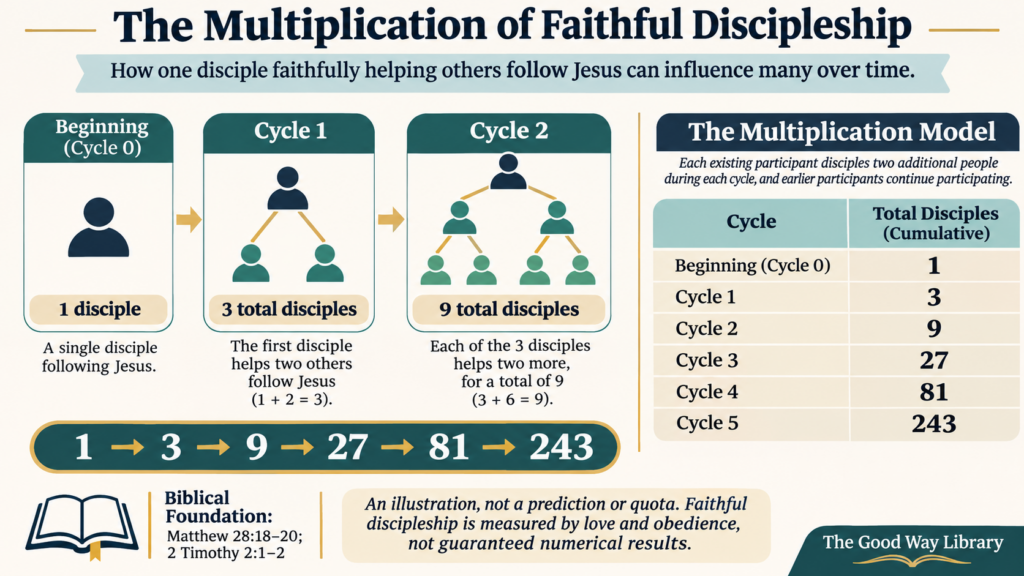
Consider a simple illustration.
Imagine one Christian who disciples just two people each year to follow Jesus. Now imagine those two people begin doing the same thing the following year, each helping two more people. Meanwhile, the Christian continues discipling two new people every year.
That’s it. Just two. For the full year.
If everyone continues discipling just two new people annually, the total number of people involved would grow like this:
1 → 3 → 9 → 27 → 81 → 243 → 729 → 2,187 → 6,561 → 19,683 → 59,049 → 177,147 → 531,441 → 1,594,323 → 4,782,969 → 14,348,907
That’s more than 14 million people after just 15 years, starting with one Christian discipling only two people a year!
Of course, this is only a mathematical illustration. Real discipleship takes time, and not everyone will be ready or able to disciple two new people every year. But by the power of God, some may do more than two a year.
The lesson is powerful: You do not have to reach thousands of people yourself to make a lasting difference. By faithfully helping even one or two people grow in Christ and teach them to do the same, you may influence many more lives than you will ever know.
You may never know how God uses a conversation, a prayer, a lesson, or an act of kindness in another person’s life. Someone you encourage today may eventually serve people you will never meet. Christian mission is therefore not measured by impressive numbers. It is characterized by obedience to Christ, love for people, and trust in God’s work. He will take care of the rest.
Christians Before Us: The Gospel Across Generations and Nations
The history of Christianity reminds us that the Great Commission has never belonged to one nation, culture, or generation. In the fourth century, a Christian named Frumentius helped establish Christianity in the ancient kingdom of Aksum, located in what is now Ethiopia and Eritrea. According to early historical accounts, Frumentius and his brother Aedesius were taken to Aksum after surviving an attack during a voyage along the Red Sea. Frumentius eventually gained responsibility within the royal court and used his position to encourage Christian worship and strengthen the existing Christian presence in the kingdom. Later, he traveled to Alexandria, where Athanasius appointed him bishop, and returned to continue his ministry. Frumentius became an important figure in the development of Ethiopian Christianity, remembered as Abba Salama, meaning Father of Peace. His story reminds us that God can use unexpected circumstances, personal relationships, and faithful service to open opportunities for the gospel. Frumentius did not begin with an elaborate missionary organization. He served faithfully where he found himself, recognized opportunities to strengthen the Christian faith, and helped establish a church that would continue long after his lifetime.
In the ninth century, two brothers named Cyril and Methodius demonstrated another important aspect of making disciples: helping people understand God’s truth in their own language. These Byzantine Christian missionaries traveled to Moravia in Central Europe, where Christianity had already been introduced but many people lacked access to Christian teaching in a language they could readily understand. Cyril developed the Glagolitic alphabet, an early writing system for the Slavic language, and the brothers worked to translate Scripture and materials used in Christian worship. They also trained local believers for ministry so that Christian teaching could continue through people who understood their own communities. Their work encountered political and religious opposition, yet their students carried their efforts into other regions, helping establish lasting traditions of Christian learning and worship. Their example reminds us that disciple-making is not simply delivering religious information. It involves helping people genuinely understand Scripture and preparing them to teach others faithfully. We should never expect people to adopt our language, culture, or personal preferences before they can follow Jesus Christ. The gospel belongs to every nation, and its truth must remain understandable to the people we hope to reach.
In the nineteenth century, Adoniram Judson (1788–1850) devoted much of his life to spreading the gospel of Jesus Christ in Burma, now known as Myanmar. Arriving with his wife Ann in 1813, Judson faced the challenge of communicating Christianity to people who spoke a different language and had little familiarity with Scripture. He spent years learning Burmese, preaching the gospel, and translating the Bible so that people could read God’s Word in their own language. Despite years of difficulty and slow progress, Judson remained committed to his calling, eventually completing his translation of the entire Bible into Burmese in 1834. His ministry helped establish Christian congregations and equipped others to continue sharing the faith. Judson’s example reminds us that making disciples involves more than leading someone to an initial profession of faith. Jesus commands us to teach others to observe everything he commanded (Matthew 28:19–20). While most Christians will never serve as foreign missionaries, every believer can participate in this calling through prayer, sharing the gospel, teaching Scripture, and helping others grow in faith. The goal is not simply to introduce people to Jesus, but to help them become faithful disciples who will eventually help others follow him as well.
What Is True in Christ
As we conclude this discipleship course, we should consider the extraordinary privilege and responsibility of participating in the mission of Jesus Christ. The Great Commission is not merely a task that the church must complete through human effort. Scripture reveals that Christ entrusts his message to ordinary believers, works through many different people to advance his purposes, and is gathering worshipers from every nation. Understanding these truths should fill us with gratitude, humility, and a deeper desire to help others know the Savior we follow.
We Are Ambassadors of Jesus Christ
In 2 Corinthians 5:18–20, Paul describes the ministry of reconciliation and identifies believers engaged in this work as ambassadors on behalf of Christ. An ambassador represents someone greater than themselves and communicates a message that does not originate from their own authority. This is a remarkable description of Christian witness. God has reconciled believers to himself through Jesus Christ, and he now calls his people to proclaim the message of reconciliation to others. When we share the gospel, we are not promoting our own ideas, defending our personal importance, or inviting people to become followers of us. We are representing Jesus Christ and announcing what God has accomplished through him.
This should change how we approach conversations about Christianity. An ambassador must communicate the message faithfully rather than alter it to gain approval. Likewise, Christians must resist the temptation to soften biblical truth merely to make the gospel more appealing or to add unnecessary requirements that Christ has not commanded. Yet representing Jesus also requires humility, patience, and genuine concern for others. We must not confuse boldness with harshness or faithfulness with winning arguments. Paul explains in 2 Corinthians 4:5 that his ministry does not proclaim himself, but Jesus Christ as Lord. The greatest privilege of Christian witness is not that people might remember our words, but that through our words they might come to know our Savior. Every conversation should therefore be approached with reverence for Christ and sincere love for the person before us.
God Gives Growth Through Many Faithful Servants
In 1 Corinthians 3:5–9, Paul addresses divisions among believers who had become overly attached to particular Christian teachers. Some identified themselves with Paul, while others preferred Apollos. Paul corrects their thinking by explaining that both men were servants through whom people came to believe. One had planted, another had watered, but God was responsible for the growth. This image provides a beautiful understanding of Christian ministry. We may participate meaningfully in someone’s spiritual journey without being the person who first introduced them to Christ or the one who eventually witnesses their conversion.
Consider how this might happen in ordinary life. A Christian parent may teach a child about Jesus for many years. A friend might later answer important questions about the gospel. A pastor may explain a difficult passage of Scripture, while another believer provides encouragement during a season of spiritual struggle. Each person serves in a different way, sometimes without knowing what others have contributed. Jesus expresses a similar principle in John 4:35–38, where he distinguishes between those who sow and those who reap, reminding his disciples that they are entering work in which others have already labored. No individual Christian is responsible for accomplishing everything in another person’s spiritual life. We are called to serve faithfully with the opportunities God provides, recognizing that his work is larger than our personal involvement. This should protect us from pride when ministry appears fruitful and from discouragement when we cannot see immediate results. God is the one who gives the growth, and the glory belongs to him.
Christ Is Gathering Worshipers From Every Nation
The Great Commission begins with the risen Jesus commanding his followers to make disciples of all nations. Near the end of Scripture, Revelation 7:9–10 presents an extraordinary vision of the fulfillment of God’s saving purposes. John sees a vast multitude from every nation, tribe, people, and language standing before God’s throne and the Lamb, celebrating the salvation that belongs to God. This scene reveals something profound about the ultimate purpose of Christian mission. We are not merely trying to increase church attendance, expand religious organizations, or persuade people to adopt a particular way of life. We are participating in God’s work of gathering people from every nation to worship Jesus Christ.
This vision should expand our understanding of what God is accomplishing throughout history. The gospel has crossed mountains, oceans, languages, political boundaries, and generations because Jesus Christ is worthy of worship everywhere. No culture possesses exclusive ownership of Christianity, and no nation stands beyond the reach of God’s saving purposes. The believers gathered before the throne in Revelation are not presented as people who have abandoned every cultural distinction. They come from every nation and language, united in their worship of God and the Lamb. This does not mean every person will ultimately be saved, nor does it guarantee that every attempt at evangelism will succeed. It reveals the glorious fulfillment of God’s purpose to redeem a people through Jesus Christ.
Learning to Follow Jesus To The Finish Line
Throughout the Gospels, Jesus calls people to follow him, trust him, and obey his teaching. His commands include repentance, love for God and neighbor, prayer, forgiveness, humility, service, and faithfulness through suffering.
In Matthew 28, these teachings become part of a worldwide commission. Jesus commands his followers to make disciples, baptize them, and teach them to observe everything he commanded.
Acts 1:8 adds Jesus’ promise that the Holy Spirit will empower his witnesses. Second Timothy 2:1–2 provides apostolic instruction about faithfully entrusting Christian teaching to others. Together, these passages show that making disciples requires both a clear gospel message and continued dependence upon God’s grace.
We should therefore never treat disciple-making as merely a technique for recruiting people. It is an expression of our ongoing fellowship with Jesus Christ.
Continue Abiding in Christ While Serving Others
Helping another person follow Jesus does not mean that you have finished your own discipleship.
You still need Scripture, prayer, repentance, worship, Christian fellowship, and the encouragement of others. You will continue facing difficult questions, temptation, suffering, and circumstances that reveal your need for God’s wisdom.
Return often to Jesus’ teaching in John 15:1–17. He describes himself as the true vine and his disciples as branches. Their fruitfulness depends upon remaining in him, not upon developing independence from him.
This truth remains important even when you begin teaching someone else.
You may encounter a question you cannot answer, a difficult conversation, or a situation that requires pastoral help. You may also discover your own weaknesses through the responsibilities of mentoring.
In such moments, return to Christ. Pray, open Scripture, seek wise counsel, and continue learning. Do not assume that serving another person requires pretending to be spiritually complete.
A faithful discipler remains a disciple of Jesus for life.
Continue Growing Within Christ’s Church
The local church is not an optional addition to Christian maturity. Jesus gathers believers into a community where they receive teaching, worship together, participate in baptism and the Lord’s Supper, encourage one another, and exercise their gifts in service.
If you are helping someone through this course, encourage them to participate in a healthy congregation. Speak with appropriate church leaders when questions arise concerning baptism, doctrine, pastoral care, or ministry responsibilities.
The Good Way Library can provide free biblical teaching and helpful study resources, but it does not replace the church. Our hope is that these materials will strengthen the work of faithful Christians and congregations by making sound biblical instruction more accessible.
As you continue serving Christ, remain open to correction and encouragement from other believers. Your relationship with Jesus is personal, but his mission is carried forward through the shared life of his people.
For the Discipler: Walking Through This Step Together
Before You Meet | Read Matthew 28:16–20 and 2 Timothy 2:1–2, along with Acts 1:6–11 and Colossians 1:24–29. Review the learner’s understanding of the gospel, Scripture, grace, obedience, and church fellowship without treating course completion as certification. Prepare to explain how disciple-making includes evangelism, continued teaching, and healthy church participation. Pray for humility and wisdom as you consider the learner’s readiness to help others.
During the Meeting | Return to the Great Commission and discuss how the learner’s understanding has developed since Step One. Invite them to explain the gospel naturally, then consider how they might offer someone a thoughtful invitation to study Scripture. Discuss what an initial meeting could involve and how a discipler should remain accountable to Christ’s church. Encourage the disciple to begin preparations to become a discipler. Remind them that they do not need to know everything about theology or the Bible to begin discipling, because the power rests on Jesus, not them.
What to Watch For | Do not require the learner to recruit someone as proof of salvation or maturity. Some participants need more time to develop sound understanding, Christian character, or healthy boundaries before assuming mentoring responsibility. Avoid conversion quotas, exaggerated promises, spiritual control, and pressure to disclose private struggles.
Before Moving Forward | Help the learner identify a faithful next step: continued study, prayer for another person, church-supported service, or a suitable discipleship invitation. If they are ready to mentor, encourage a thoughtful first meeting and ongoing church accountability. Remind them that both of you remain disciples of Jesus and must continue learning long after this course ends.
Discuss Together
Read Matthew 28:16–20 and 2 Timothy 2:1–2 again before discussing these questions. If you have a discipler, work through them together. If you are studying independently, consider recording your responses.
- Returning to the Great Commission: How has your understanding of Matthew 28 changed since Step One? What do Jesus’ authority, commands, and promised presence mean to you now?
- Explaining the gospel: If someone asked who Jesus is, why he died, and how a person can be saved, how would you explain the Christian gospel from Scripture?
- Making disciples: What is the difference between sharing the gospel in one conversation and helping someone grow in faith, obedience, prayer, and Christian fellowship over time?
- Readiness and humility: What qualities should characterize a Christian who begins discipling another person? Where might you need further understanding, encouragement, or guidance?
- Serving another person: Is there someone in your life who might benefit from patient Christian friendship, prayer, Scripture study, or intentional discipleship? How could you approach them respectfully?
- Continuing your own discipleship: How will you remain rooted in Christ, Scripture, prayer, and church fellowship while serving others? What support or accountability would be helpful?
Put It Into Practice
Completing this course should lead toward continued faithfulness, not pressure to accomplish an impressive ministry project. Consider these three practical responses as you prepare for the next season of following Christ.
Prepare to Explain the Gospel
Return to the approximately six-sentence gospel explanation you wrote in Step Two. Read 1 Corinthians 15:1–4, John 3:1–21, and Ephesians 2:1–10 again, then review what you originally wrote. Can you now explain more clearly who Jesus is, why humanity needs salvation, what his death and bodily resurrection accomplished, and how we respond through repentance and faith? Revise your explanation as needed, making sure that salvation by God’s grace remains central. Then practice explaining it naturally, as though you were speaking with someone who knows very little about Christianity.
If possible, also consider how you would describe your own relationship with Christ. Keep your testimony honest and centered upon him rather than upon extraordinary experiences or personal achievements.
You may benefit from practicing this explanation with a trusted Christian who can offer thoughtful feedback.
Pray for People You Might Encourage
Think of two people for whom you could begin praying. They might be exploring Christianity, growing in faith, struggling spiritually, or simply needing Christian friendship and encouragement.
Ask God to give you wisdom, genuine love, and opportunities to serve them appropriately. If someone appears interested in studying Scripture, consider offering an invitation to work through The Good Way Discipleship Course together.
Do not treat their response as a measure of your spiritual success. Your responsibility is to love and serve faithfully, leaving the results to God.
Prepare for a Faithful First Conversation
If you are ready to begin discipling someone, consider speaking with a pastor or trustworthy church leader about appropriate support and accountability.
Review the course’s first lesson, prepare a Bible, and think through how you would welcome the learner, open Scripture, explain the purpose of discipleship, and pray together.
If you are not yet ready to mentor, choose another faithful next step. Continue learning, participate in church life, and look for ordinary opportunities to encourage others in Christ. Make a plan to get to a position where you are ready to disciple another.
The goal is not to begin immediately at any cost. It is to serve faithfully, with wisdom and humility.
If You Are Studying Alone
You can complete certain parts of this final lesson meaningfully without a personal discipler. Read the assigned passages, consider the discussion questions, and reflect prayerfully on what you have learned throughout the course.
However, beginning a significant one-to-one mentoring responsibility without any Christian fellowship or accountability may be unwise. If possible, seek connection with a healthy local church and speak with a trustworthy pastor or mature Christian about your desire to serve others.
You can begin participating in Christ’s mission through prayer, hospitality, personal witness, and practical encouragement while continuing to grow in understanding and maturity.
The Good Way Library remains available to support your biblical study, but your Christian life should continue within the fellowship and care of Christ’s people whenever possible.
Suggested Prayer
Heavenly Father, thank you for sending your Son, Jesus Christ, to save sinners and call people into your family. Thank you for his death and resurrection, for the forgiveness and new life you give through faith, and for the Holy Spirit who dwells within those who belong to him.
Lord Jesus, thank you for your authority, your commands, and your promise to remain with your people. Help me continue abiding in you rather than relying upon my own strength or understanding. Teach me to love your Word, obey your commands, and grow in humility and faithfulness.
Holy Spirit, give me wisdom and courage to speak truthfully about Jesus. Help me recognize opportunities to encourage others, listen patiently to their questions, and serve them with genuine love. Keep me from pride, impatience, and the desire to measure spiritual success through numbers or recognition.
Prepare me to help others follow Christ when I am ready, and surround me with faithful Christians who will continue encouraging and correcting me. May the teaching I have received bear fruit in my life and bless others through your grace. In the name of Jesus Christ, my Lord and Savior, amen.
Scripture to Remember
2 Timothy 2:2 (WEBU):
The things which you have heard from me among many witnesses, commit the same things to faithful men who will be able to teach others also.
This verse reminds us that faithful Christian teaching is meant to be received, preserved, and entrusted to others. Paul instructed Timothy to pass along the apostolic message to people capable of continuing that same work.
The focus is not upon building personal influence or creating impressive numbers. It is upon remaining faithful to Christ and helping others receive the truth revealed in Scripture.
As you remember this verse, also return to Jesus’ promise in Matthew 28:20. The risen Lord remains with his people as they carry out his mission. Our confidence rests upon his authority, his grace, and his continuing presence.
Continue Studying With The Good Way Library
The following free resources support the teaching of this final lesson. Begin with the assigned biblical passages, then use The Good Way Library’s commentaries to strengthen your understanding and prepare for faithful service.
- Matthew 28 Commentary: Resurrection and the Great Commission – Return to the resurrection of Jesus, his universal authority, and his command to make disciples of all nations. The Walkthrough explains baptism, teaching obedience, and Christ’s continuing presence. The Application and Leading sections are especially useful when preparing to help someone else study the Great Commission.
- 2 Timothy 2 Commentary: Grace, Endurance, and Truth – Explore Paul’s instruction to entrust faithful teaching to others, endure hardship, handle Scripture correctly, and correct opponents with gentleness. This commentary is particularly valuable for understanding the character and responsibilities of a Christian discipler.
- Acts 1 Commentary: Witnesses, Ascension, and Matthias – Study Jesus’ promise of the Holy Spirit, his commission to bear witness, and the beginning of the church’s worldwide mission. The chapter connects Christian witness with the risen Christ’s authority and the Spirit’s empowering presence.
- Colossians 4 Commentary: Prayer, Witness, and Fellow Workers – Learn how prayer, wise conduct, gracious speech, and cooperation among believers support gospel ministry. This resource is especially useful for developing thoughtful conversations with people who are exploring Christianity.
The Good Way Library also provides free chapter-by-chapter Bible studies, book overviews, and additional Christian resources through our Commentary Library and Christian Resource Library.
These materials are available to support your continued learning and to help you study Scripture with others. However, always return to the biblical text itself. God’s Word remains the authority, and our resources exist to help readers understand and follow it faithfully.
If you have not yet read the full Bible, now is the time to do so. Sign up for our Bible Challenge.
Where the Journey Continues
You have now completed the twelve lessons of The Good Way Discipleship Course. Throughout this journey, we have considered the gospel, our new life in Christ, abiding in Jesus, Scripture, prayer, the Holy Spirit, repentance, Christian love, church fellowship, perseverance, and the command to make disciples.
Yet there is no thirteenth lesson that completes your Christian growth. The next step is to continue living what you have learned, remaining in fellowship with Jesus Christ and growing in faithful obedience throughout your life.
You may be ready to begin walking alongside another person in discipleship. If so, approach that responsibility prayerfully and with the support of a healthy local church. Begin with Scripture, offer patient encouragement, and remember that your responsibility is to point people toward Christ rather than yourself.
You may also recognize that you need more time. Perhaps an important doctrine remains unclear, your relationship with a local church needs attention, or you would benefit from continued mentoring before taking responsibility for another person’s spiritual instruction.
That is a faithful reason to continue learning. Christian maturity cannot be rushed, and completing a course is not a substitute for the transforming work of the Holy Spirit.
Keep Following the One Who Called You
Return to the words of Jesus in Matthew 28:16–20. The same passage that began this course now sends us back into ordinary life with a deeper understanding of our calling.
The risen Jesus possesses all authority. He commands his people to make disciples, baptize them, and teach them to observe everything he has commanded. And he promises to remain with them until the end of the age.
That promise carries us beyond this final lesson.
Continue reading Scripture and receiving its teaching. Continue approaching God in prayer, trusting the saving work of Christ, and depending upon the Holy Spirit. Move forward in worshiping and serving among God’s people, repenting when you sin, and remaining faithful through suffering and uncertainty.
And as God gives you opportunities, help others know the Savior who has called you.
Suggested Continuing Reading: John 15:1–17
Return to Jesus’ teaching about the vine and the branches. Remember that fruitfulness comes through abiding in him. Whether you are learning, teaching, praying, serving, or helping another person begin the journey of discipleship, your life remains dependent upon Christ.
The Good Way Library hopes that these twelve lessons have helped establish a foundation for deeper fellowship with Jesus and a lifetime of faithful Christian living. Our prayer is that you will continue growing in his Word, finding encouragement in his church, and sharing what you have received with others.
The journey began with Jesus Christ, and it continues with him.
You have been called to know Christ, to follow Christ, and to make Christ known. Wherever God places you, whoever he brings into your life, remain faithful to this calling until the day you stand before your Savior.
May God bless you on this journey to life everlasting. Amen.
Partner With The Good Way Library
The Good Way Library is supported entirely by everyday readers like you. If this resource has helped you grow in your understanding of God’s Word and the Christian faith, please consider supporting this work with a one-time or monthly gift. Please also pray for our ministry and help us spread the word by sharing The Good Way Library with your church, friends, and family. Together, we can expand completely free access to faithful biblical teaching and help strengthen shared understanding and unity across the Christian church.